

Nov. 06, 2026
Solar panels and a home battery can keep configured household loads supplied during a grid outage only when the installed system is designed to disconnect safely from the utility and operate as a local electrical island. The battery provides controllable energy, while an outage-capable inverter and transfer equipment establish the voltage and frequency that the home's backed-up circuits need. Once the local supply is stable, compatible solar equipment can serve those circuits and recharge the battery while sunlight is available. Panels, a battery, and an ordinary grid-tied inverter are not, by themselves, proof of this capability. The US Department of Energy's explanation of solar resilience makes the distinction between grid-dependent solar and configured solar-plus-storage backup explicit.
For a homeowner, the practical question is therefore not whether the roof is generating electricity on a sunny day. It is whether the installed power path can detect a failed grid, isolate the utility conductors, create a stable local supply, accept solar generation in that state, and carry the loads connected to its backup output. Each condition matters at a different point in the outage. A design that performs well for everyday self-consumption may lack a backup switch; a design with a backup switch may still serve only a selected subpanel; and a system with ample stored energy may trip when the simultaneous load is too high.
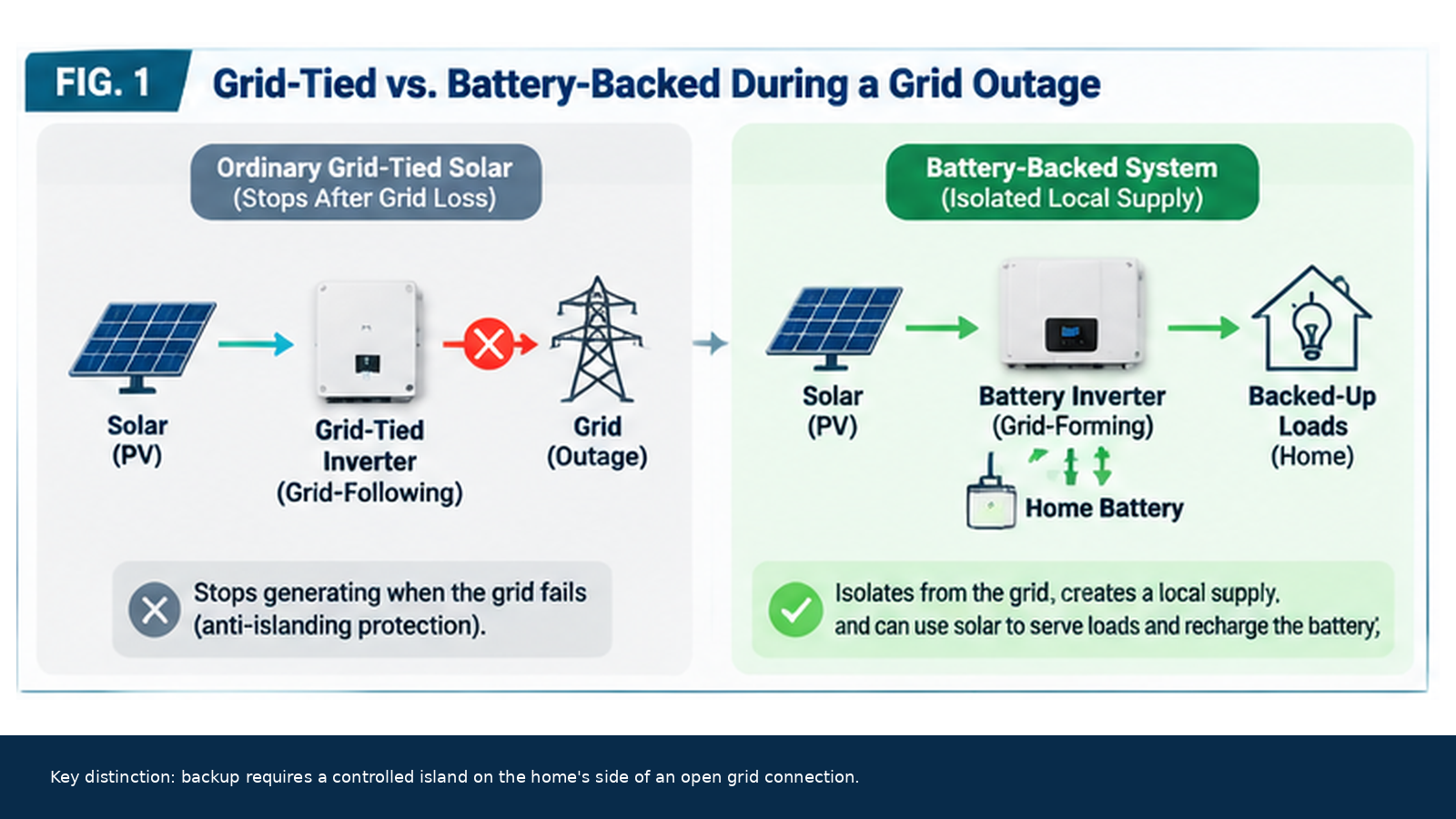
An ordinary grid-following solar inverter uses the utility supply as its electrical reference. When the grid disappears, it is designed to stop energizing the connection rather than send power into utility lines that workers may be repairing. That protective shutdown also means the home's usual grid-tied solar circuit generally stops supplying the house, even in bright sunshine. The Department of Energy's inverter overview distinguishes grid-following operation from equipment able to establish a local electrical reference.
The phrase “anti-islanding” can sound contradictory here. Unintentional islanding means a generator continues feeding a portion of a utility network after that network has been de-energized. Backup systems instead create an intentional, controlled island on the home's side of an open grid connection. The safety boundary is essential: the backup source must not backfeed the external grid. A transfer device, backup gateway, or equivalent isolation arrangement opens the grid connection before the local system supplies the circuits selected for backup. The exact switching hardware and sequence depend on the approved design; a battery cannot substitute for that isolation.
This distinction explains why a daytime PV production screen is weak evidence of outage service. Its graph reports generation while the utility is present. It does not show whether the solar inverter can operate after the utility reference vanishes, where the isolation point sits, or which branch circuits remain connected on the backup side. A homeowner who already has solar should ask for the installed single-line diagram and a demonstrated outage mode, not infer backup capability from annual kilowatt-hour output or the presence of a battery icon.
It detects loss of acceptable grid power, separates the backed-up section from the utility, and establishes a local AC supply. The battery is valuable at this transition because its inverter can respond to a load while solar output is changing or absent. The solar array cannot be counted on to match demand at the exact instant a cloud passes or a motor starts. In a suitable architecture, the battery-backed inverter regulates the local voltage and frequency, or an integrated system coordinates the same function, so connected equipment sees usable power. The Department of Energy's inverter guide explains how a grid-forming inverter can establish the electrical reference that grid-following equipment needs.
The transfer may involve a brief interruption. Whether a device resets depends on the installed system's switching behavior and the device's tolerance, so “backup” should not be interpreted as a universal uninterruptible-power-supply guarantee. If an application cannot tolerate a short break, its own power-continuity requirements need separate evaluation. The homeowner's first test is simpler: identify which outlets and fixed loads are on the backup side, then observe what actually stays energized during a supervised outage test.
The battery also needs enough usable charge at the time the outage begins. A system may reserve a portion of its energy for backup during normal operation, but that setting is not identical to the charge actually available after earlier use, temperature limits, protective shutdowns, or a long interruption. Different manufacturers implement reserve and restart behavior differently. For example, Tesla's published reserve explanation shows how one product family allocates stored energy between everyday use and backup; it should be treated as a product example, not a rule for every home battery.
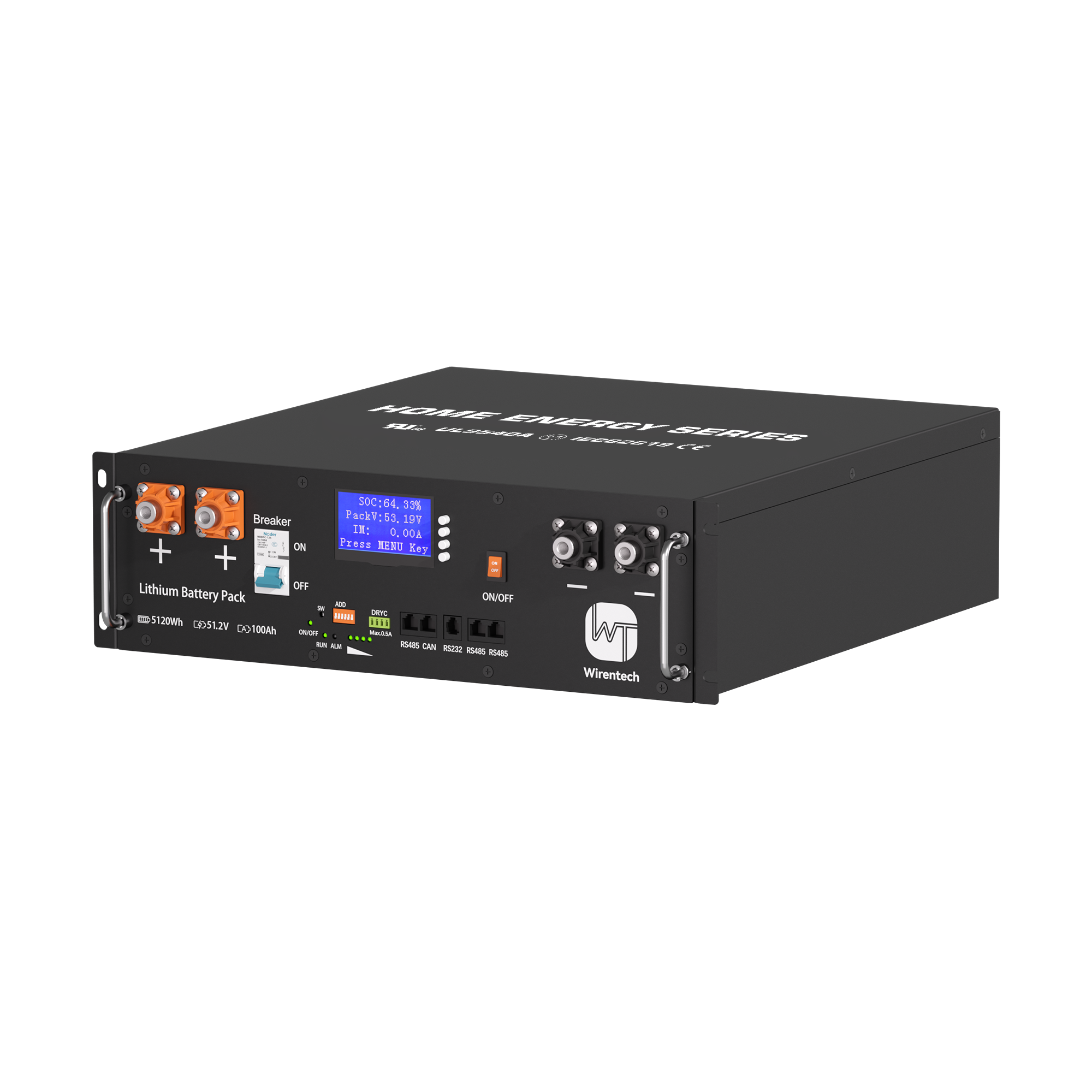
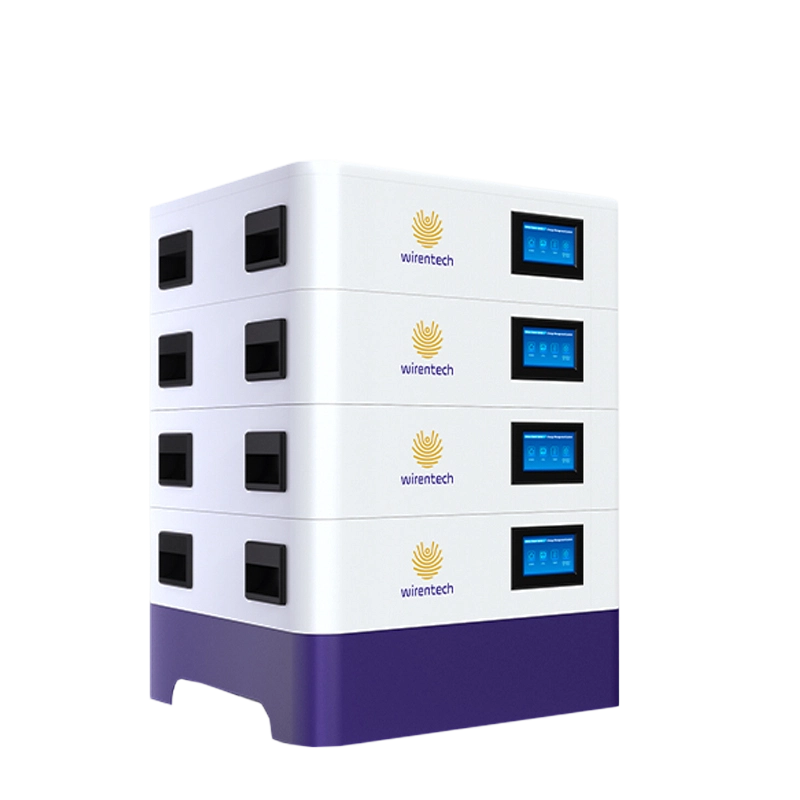
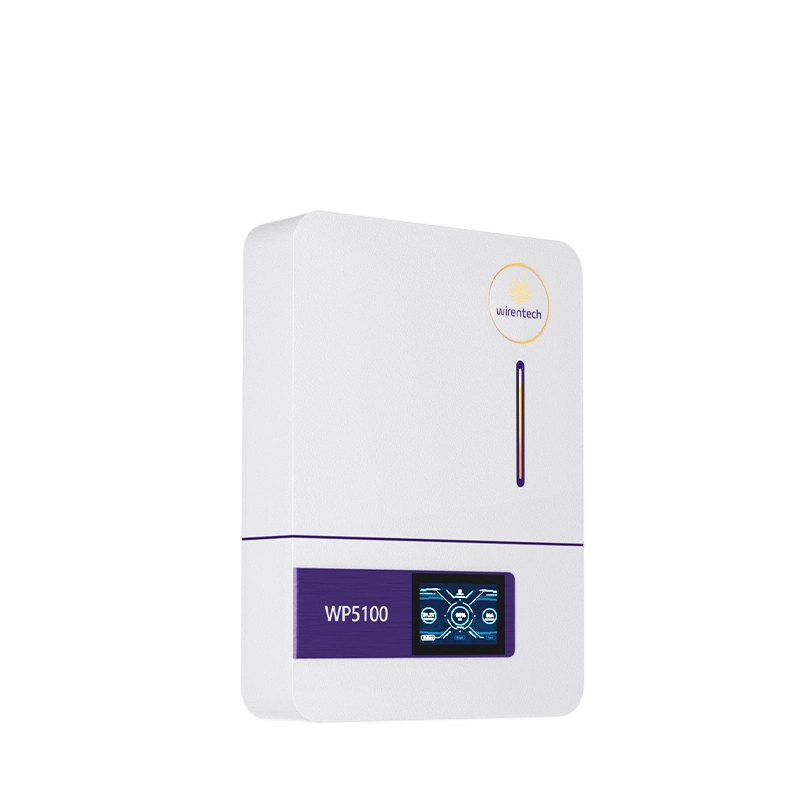
The enclosure containing the battery is only one part of this system. Wirentech's residential storage battery category lets readers see the currently listed rack, stackable, and wall-mounted battery forms. That category is a product browsing entry, not evidence that any particular battery, inverter, transfer device, and solar array have been tested together for outage operation. The specific system topology and compatibility have to be established for the proposed installation.
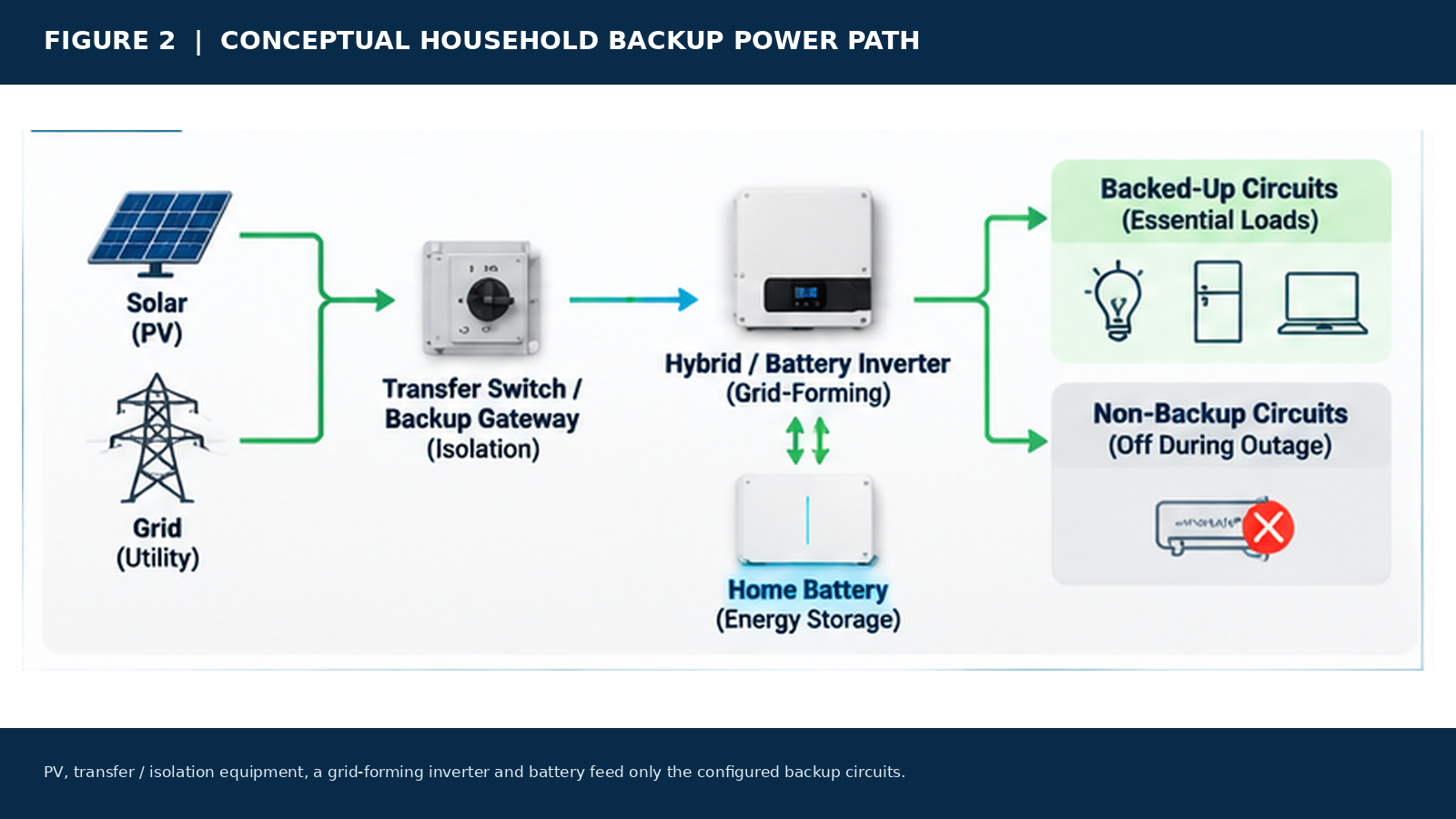
Solar can contribute when its output has a functioning path into the intentionally islanded system. In a DC-coupled design, PV and battery connect through equipment that coordinates conversion and charging before power reaches the household AC circuits. In an AC-coupled design, an existing or separate PV inverter can work on a backed-up AC bus only if the backup system provides a suitable reference and a compatible way to control excess solar output. These are descriptions of possible architectures, not a claim that every product called “hybrid” or “AC-coupled” supports every combination. The actual inverter pairing and protection design decide whether solar restarts and stays on during an outage.
Startup order matters. Immediately after grid loss, a grid-tied PV inverter may switch off. The battery-backed equipment then forms the local supply. Only after its voltage and frequency are suitable can compatible PV equipment resume generating into that local network. A system that cannot black-start its island when the battery is too depleted may wait for sufficient sunlight, a specific restart sequence, or the grid to return. In one documented implementation, Tesla's system alerts distinguish waiting for solar from waiting for grid when stored energy is too low; this is a product example, not a universal restart sequence. A homeowner should not assume that morning sunlight will always restart a fully depleted installation.
Once PV is active, power is balanced continuously. Some solar production is consumed immediately by backed-up loads; any remaining usable output may charge the battery. If production drops below demand, the battery can fill the gap while charge and output limits permit. If the battery is full and the loads are small, generation cannot simply continue at its maximum into an isolated circuit with nowhere for excess power to go. Compatible controls reduce or pause PV output. Tesla's explanation of solar curtailment documents that behavior for its systems; other equipment uses its own control method and operating limits.
Annual PV production cannot establish what the array contributes during a dark storm afternoon. The useful observation is the present balance among solar output, supported loads, and battery charge; nameplate PV capacity alone does not show it.
The backup duration depends on usable stored energy and changing supported loads whenever sunlight falls short; at night, the battery is usually the only source. During variable daylight, the battery bridges shortfalls and may later recharge from excess PV. A bright hour cannot be stored retroactively if the battery was full and solar was curtailed, and yesterday's production does not guarantee tonight's usable charge. The Department of Energy's solar and storage overview separates the roles of immediate generation and stored energy.
Backup duration depends on usable battery energy, the energy consumed by the supported circuits, conversion losses, changing solar input, and any configured reserve or minimum operating threshold. Instantaneous output power is a different constraint: an inverter can have enough total kilowatt-hours remaining while failing to carry a simultaneous load above its output limit. The system may shed a load, refuse to start it, or stop supplying power according to its control design. This article does not replace a load-by-load capacity calculation or a motor-start assessment; it explains why those inputs change what the solar-plus-battery island can actually sustain.
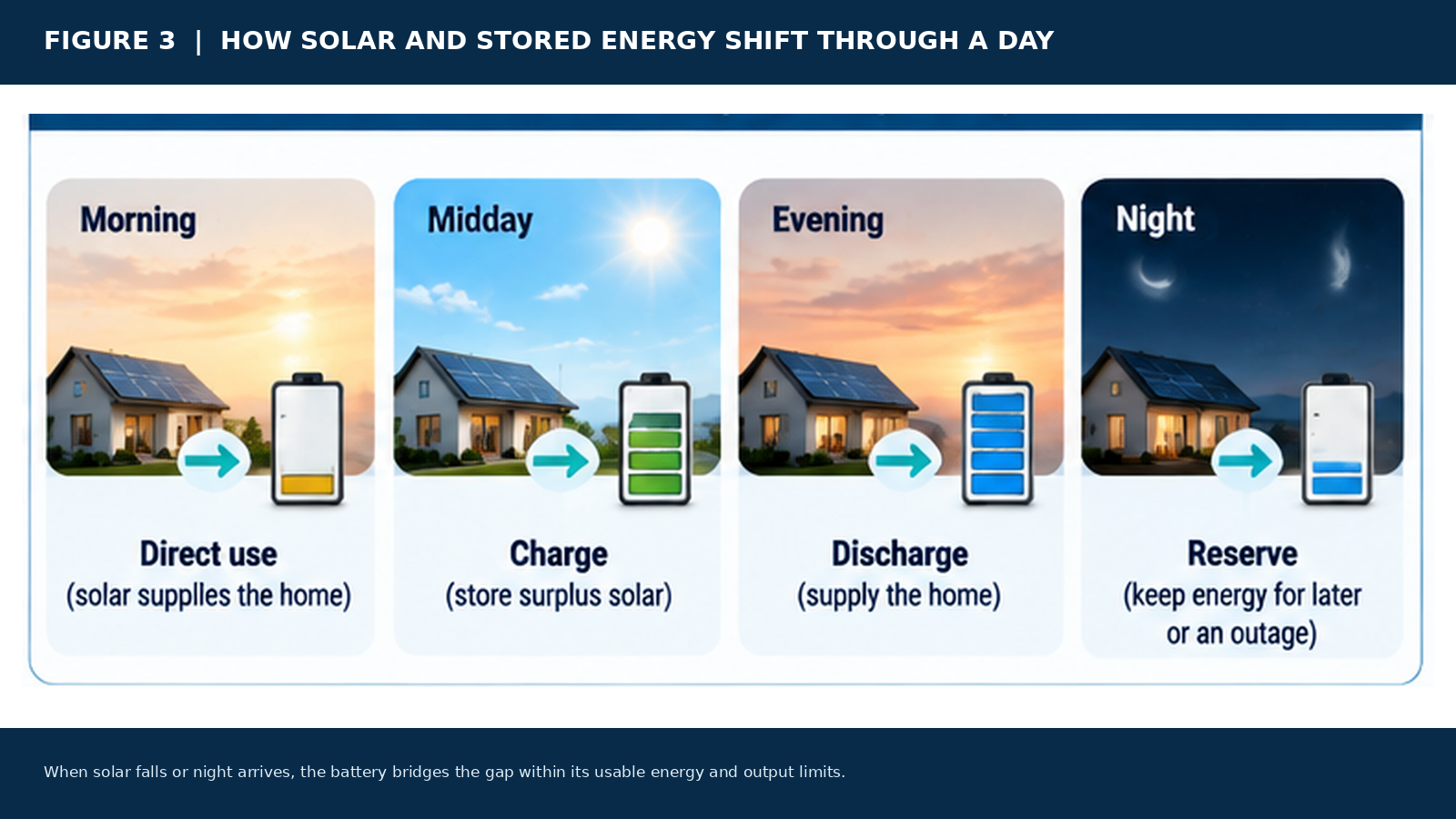
Consider a conceptual home with refrigeration, communications, a few lights, and a well pump. The first three may run for long periods at relatively modest power, but the pump can impose a short high starting demand. If the backup panel excludes the pump, it will not run regardless of sunlight or battery charge. If it is included, its start may still exceed inverter capability. If the pump starts successfully but cloudy weather limits recharge, repeated cycling uses stored energy and shortens the remaining backup window. Each outcome traces to a distinct boundary: circuit connection, power capability, and energy balance. A broad claim that the home is “solar powered during outages” hides those differences.
The table below is a way to interpret the operating state, not a promise of performance for a specific installation.
| Outage condition | Likely power path in a compatible system | Decisive limit for the homeowner |
|---|---|---|
| Sunlight and battery charge available | PV serves supported loads; remaining output may recharge storage | PV output must exceed some or all load before charging occurs |
| Sunlight changes suddenly | Battery can cover the shortfall while within output and charge limits | Fast load changes and inverter output can still cause interruption |
| Night or negligible PV production | Battery alone serves connected backup loads | Usable energy and present load determine how long supply continues |
| Battery full while PV exceeds island demand | Controls reduce or pause PV generation | Excess PV cannot be exported through the open grid connection |
| Battery depleted or load above backup rating | Supply may shut down, wait for solar or grid, or shed loads | Restart behavior and supported loads are product and configuration specific |
Only loads connected to the installation's supported backup output are eligible to run. A partial-home design may feed a dedicated subpanel or selected circuits; a whole-home design may connect a wider set of circuits but still enforce limits on peak demand and total energy. The Tesla solar-system explanation illustrates that partial and whole-home backup are distinct electrical configurations. It is an example of the distinction, not an endorsement of one layout for every house.
This makes circuit mapping more useful than a label on the sales page. Two neighboring receptacles can be on different breakers, and a large appliance may be excluded even though the room's lighting remains on. During an outage, the battery and PV do not “choose” useful appliances by reading what the family values. Power follows the installed wiring and control design. If load management is part of the system, the decision about which loads to shed also follows the equipment configuration. A homeowner can compare a circuit schedule and single-line diagram with the actual outlets and appliances expected to work.
The initial backup boundary also affects solar recharge. If the supported loads consume nearly all available daylight production, little may remain to fill the battery for evening use. Turning off discretionary loads can free solar output for charging, but cannot create energy when the array is shaded or weather is poor. A carefully defined backup scope can therefore improve the chance of reaching the next night with some stored energy. The separate decision between whole-home and selected-load backup deserves its own design assessment; here it matters because the same PV array and battery produce different outage outcomes when the supported load set changes.
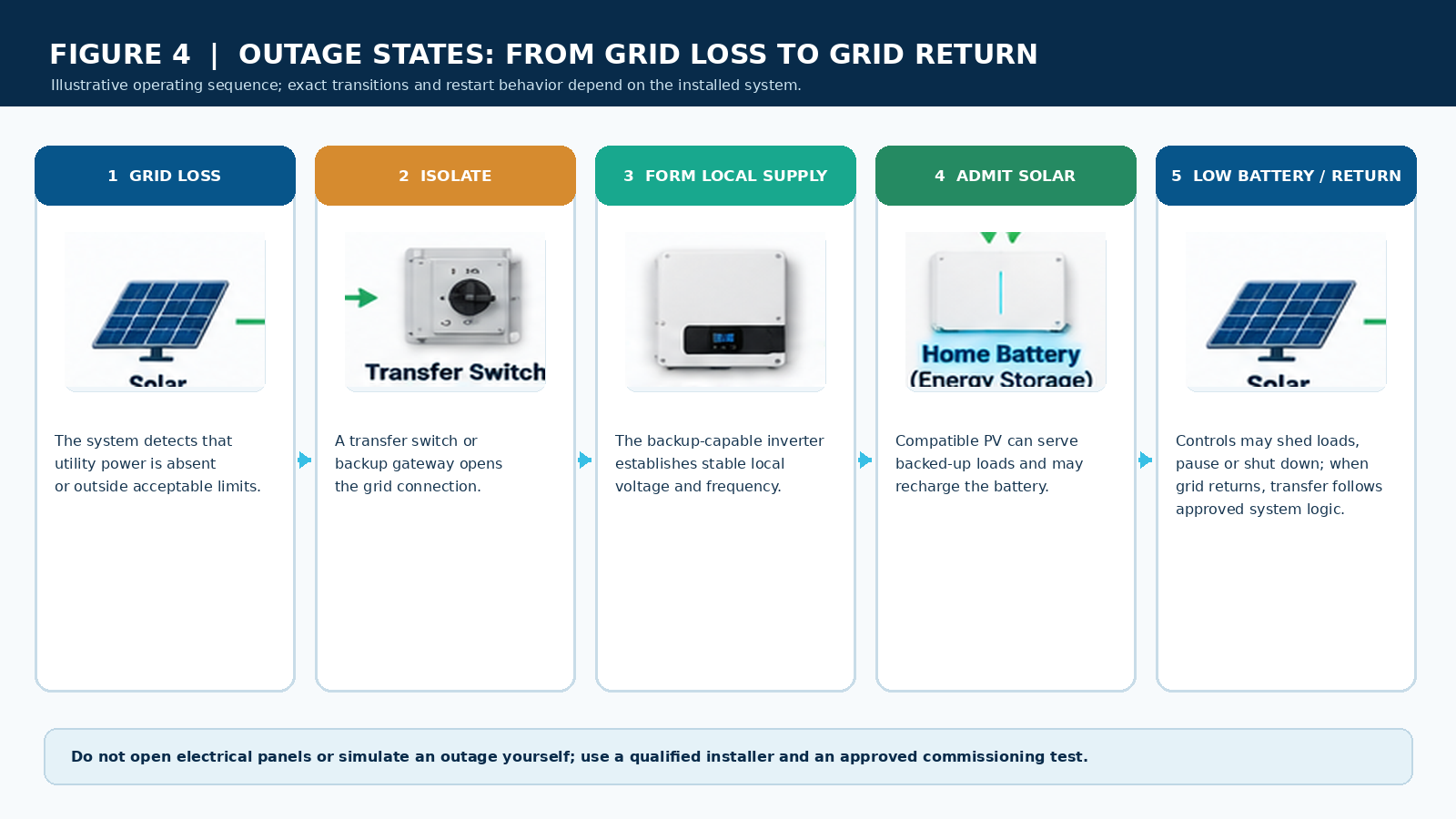
At low charge, controls may reduce output, disconnect some loads, pause operation, or shut down to protect the battery. Whether sunlight can restart the local supply after a complete shutdown depends on the inverter and battery architecture, minimum charge thresholds, solar conditions, and manufacturer logic. Published Tesla system alerts distinguish “waiting for solar,” “waiting for user input,” and “waiting for grid” states for one product family. The important general lesson is that recovery paths differ; no generic guarantee of automatic dawn restart follows from the mere presence of PV.
If the system is still operating when grid power returns, it must verify that the utility supply is acceptable and transfer back under its configured rules. A brief change in household power or a solar inverter restart can occur, depending on the equipment. Once back on-grid, the battery may recharge to its reserve setting, then resume its normal energy-management mode. A supervised commissioning test should show both the transition into backup and the return to normal operation, because an outage claim is incomplete if it only demonstrates one direction.
These operating states also change how a homeowner interprets monitoring data. Solar output falling when the battery is full could be normal curtailment; output absent after grid loss could reveal that PV is not integrated into the backup island; a battery that stops despite a nonzero displayed percentage could be protecting a reserved or unusable portion of its capacity. The app is a useful observation surface, but its state labels must be read against the documented equipment behavior. Repeated trips or unexpected restart failures require a qualified installer to diagnose the installed system, not speculative changes inside the electrical panel.
Ask the installer to show the electrical boundary, identify the supported circuits, and demonstrate a controlled transition with representative loads. The answer should be observable: which loads remain energized after grid isolation, whether the solar inverter restarts while isolated, whether the battery charges from PV when solar output exceeds those loads, and what happens when a high-demand appliance is requested. A commissioning record should identify equipment and software versions because a diagram for another inverter pairing may not describe this installation. This is a verification of the H1 promise, not a request for generic documentation in place of an explanation.
The observed test should distinguish three statements often conflated in marketing: battery backup works, solar keeps producing during backup, and solar can recharge the battery during backup. A test at night can establish the first but says nothing about the latter two. A daylight test with a full battery can show solar supplying a load but may not show charging. A daylight test with safe headroom in the battery can expose the charging path, subject to adequate irradiance. The electrician or installer should use an approved test procedure; homeowners should not open panels or imitate a grid failure by operating unqualified switching equipment.
For an inquiry about an actual home, give the existing PV inverter, the circuits that should remain powered, and the expected outage use. Ask how the proposed battery system would form the local supply and admit PV in that configuration; a battery category page cannot establish that pairing.
Related News
Nov. 07, 2026
Can a Home Battery Start and Run High-Surge Household Loads?
Learn why battery kWh alone cannot prove motor-start backup. Compare inverter surge duration, running demand, simultaneous loads and a supervised backup test.
Nov. 07, 2026
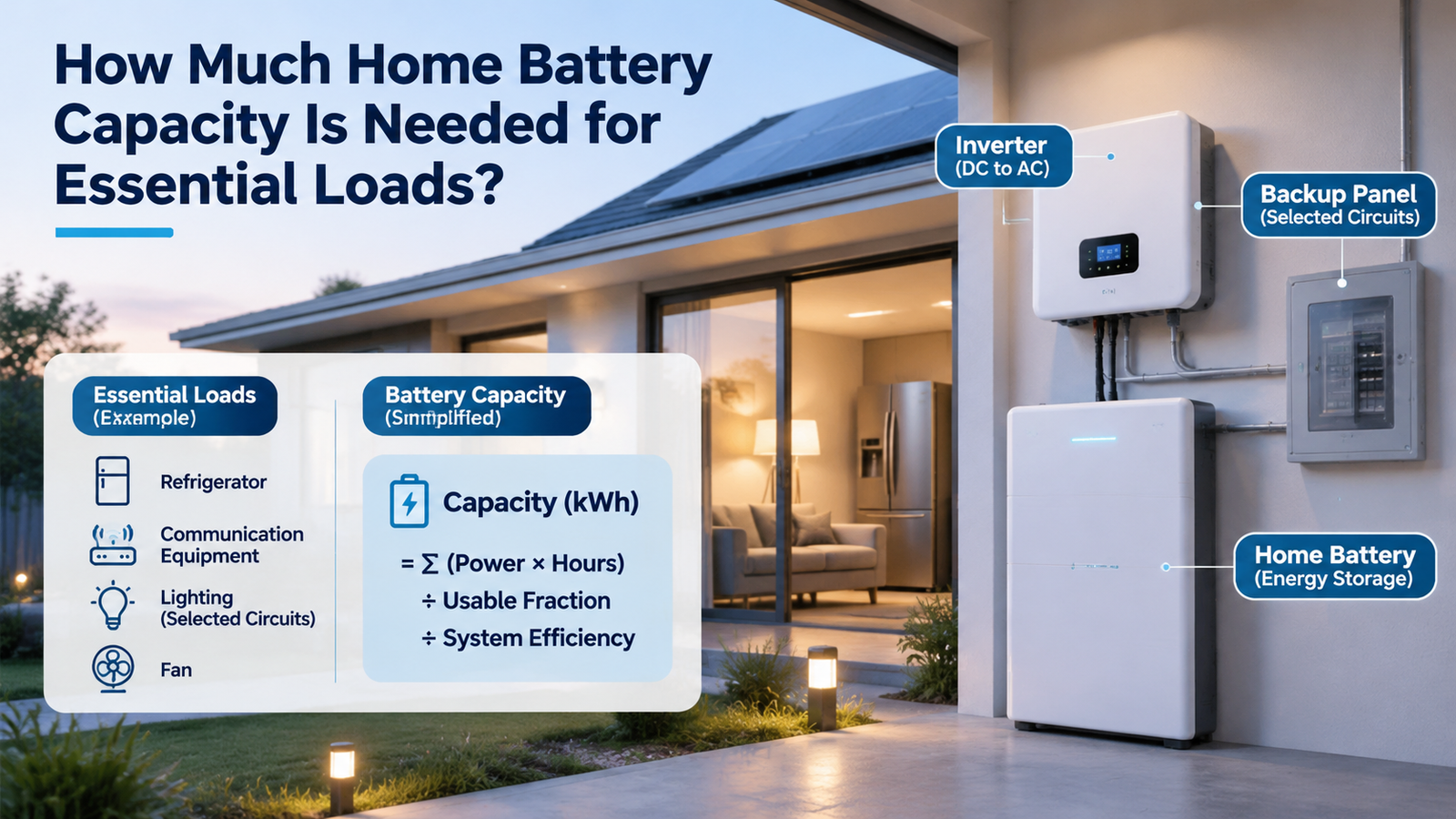
How Much Home Battery Capacity Is Needed for Essential Loads?
Calculate home battery capacity from essential-load power, duty cycle and outage hours. See a transparent kWh example and avoid double-counting losses.
Nov. 07, 2026
How Should a Home Battery Specification Sheet Be Read for Backup and Daily Use?
Compare home battery capacity, usable energy, continuous and peak output, charging limits and rating conditions before judging daily use or backup claims.
Nov. 06, 2026
Whole-Home Battery Backup or Critical-Load Backup: Which Scope Fits the Home?
Compare whole-home and critical-load battery backup by protected circuits, peak power, outage duration and load control to choose a realistic home backup scope.
Nov. 06, 2026
Can a Home Battery Provide Backup Power Without Solar Panels?
A home battery can provide backup without solar if grid charging, outage isolation and backup circuits are configured. Learn what limits runtime and recharge.
Nov. 06, 2026
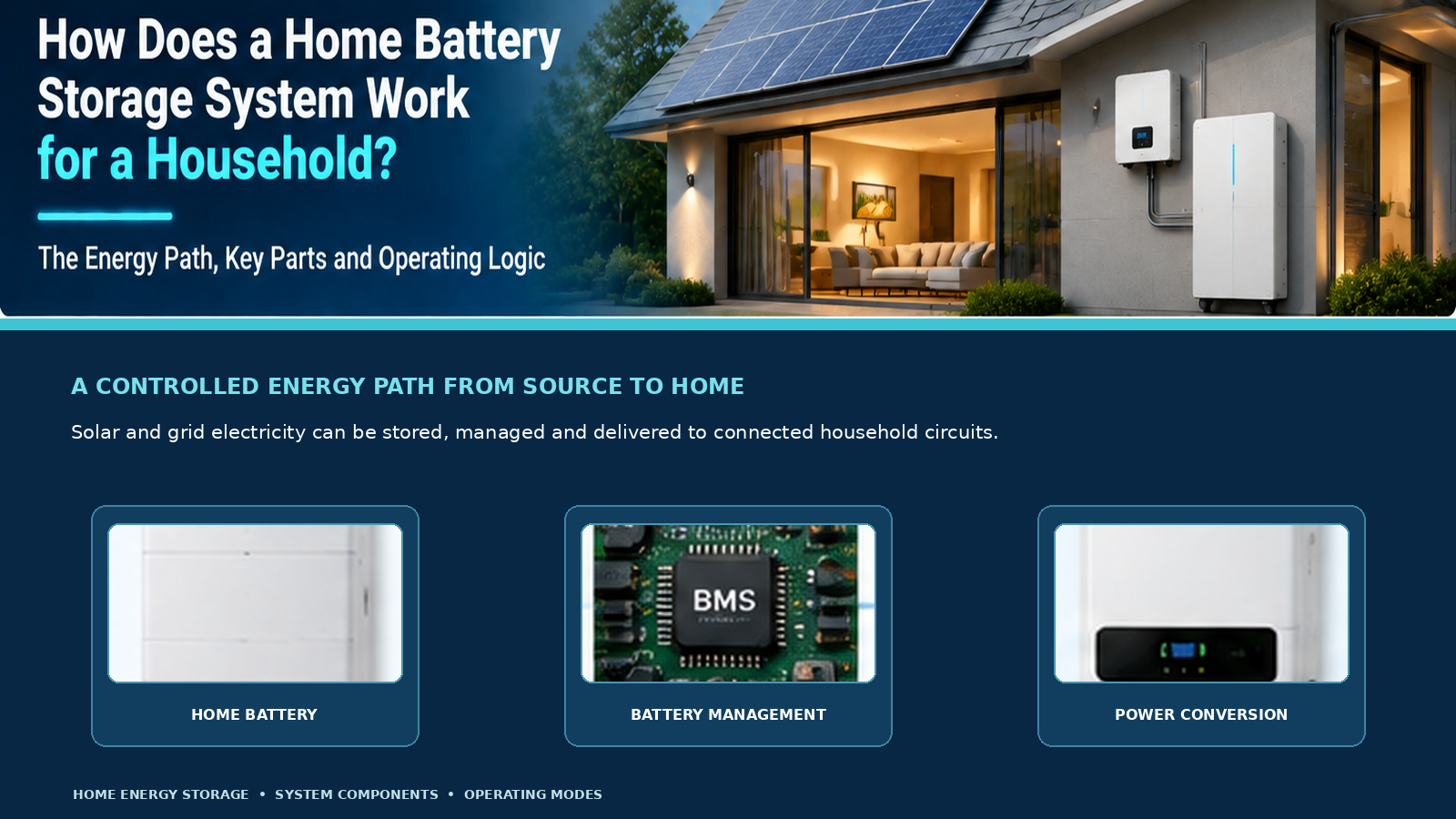
How Does a Home Battery Storage System Work for a Household?
Follow the energy path through a home battery, inverter and controls. Learn how charging, daily discharge and outage backup differ before comparing systems.
Nov. 06, 2026
How Can A Weak Battery Be Distinguished From A Weak Golf Cart Battery Bank?
Compare like-conditioned unit and bank readings to separate one weak battery from broad bank loss, charging shortfall or connection trouble.
Nov. 06, 2026
How Should A Replacement Golf Cart Battery Bank Be Planned?
Decide whether one unit or the bank needs replacement, then specify voltage, fit, connections and first-charge checks before ordering.
Nov. 06, 2026
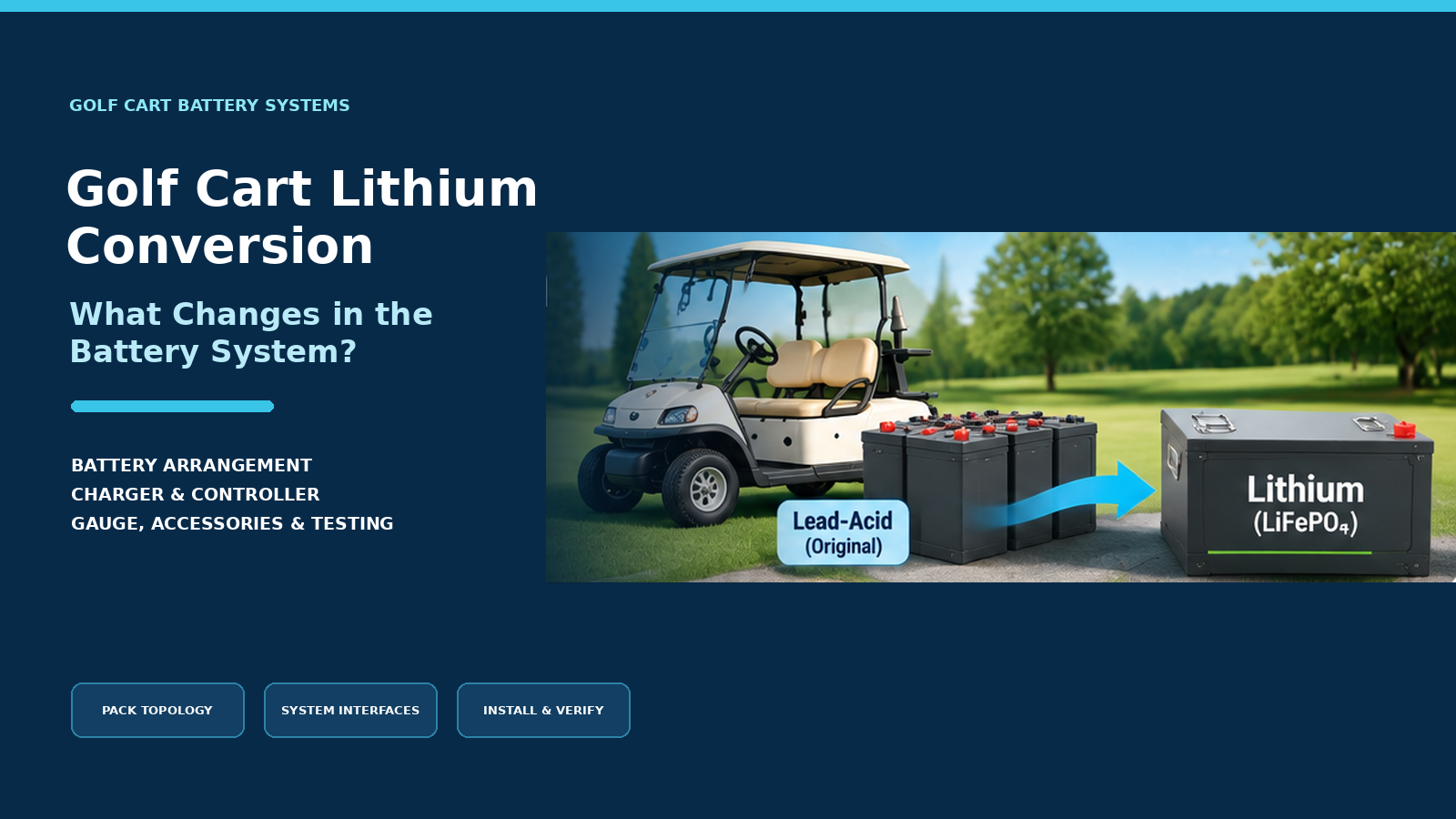
What Changes When A Golf Cart Battery Bank Is Converted To Lithium?
Map the battery bank, tray, charger, controller, gauge and accessory interfaces that change when converting a lead-acid golf cart to lithium.
Nov. 06, 2026
When Does Lithium Make Sense Instead Of Lead Acid For A Golf Cart?
Compare lithium and lead acid for the same golf-cart duty, charging routine, maintenance capacity and ownership horizon before deciding whether a switch is worthwhile.
Nov. 06, 2026
How Can Peak Current Demand Be Matched To A Golf Cart Battery?
Compare a golf cart’s acceleration and hill-load current by duration with battery continuous, pulse and protection ratings under matching conditions.
Nov. 06, 2026
How should a golf cart battery be sized for route energy and reserve?
Use measured route energy, usable battery capacity and a defined return reserve to plan golf cart battery size without treating Ah as guaranteed range.