

Nov. 06, 2026
A home battery can back up an entire electrical panel or a selected group of circuits, but the right boundary depends on what the household must keep doing when the grid fails. Critical-load backup can make a limited battery last longer when it excludes loads that would otherwise consume stored energy; it can also keep large loads outside the backup path. Whole-home backup preserves more everyday convenience, while demanding more careful control of simultaneous loads, motor starts and stored energy. The useful first decision is therefore a service boundary: name the loads that must remain available, the loads that may wait, and the conditions under which the boundary can change.
“Whole home” describes which circuits are connected to the backed-up side of a system; it does not promise that every appliance can run at once or indefinitely. “Critical loads” describes a deliberately selected subset, not an inferior battery chemistry. A home might choose a small dedicated backup panel, or a broader backup connection with programmed load control. The wiring design and controls must match the intended service. Tesla's system design guidance explicitly distinguishes partial and whole-home backup and shows why the circuit boundary is an installation choice, rather than a label assigned after purchase.
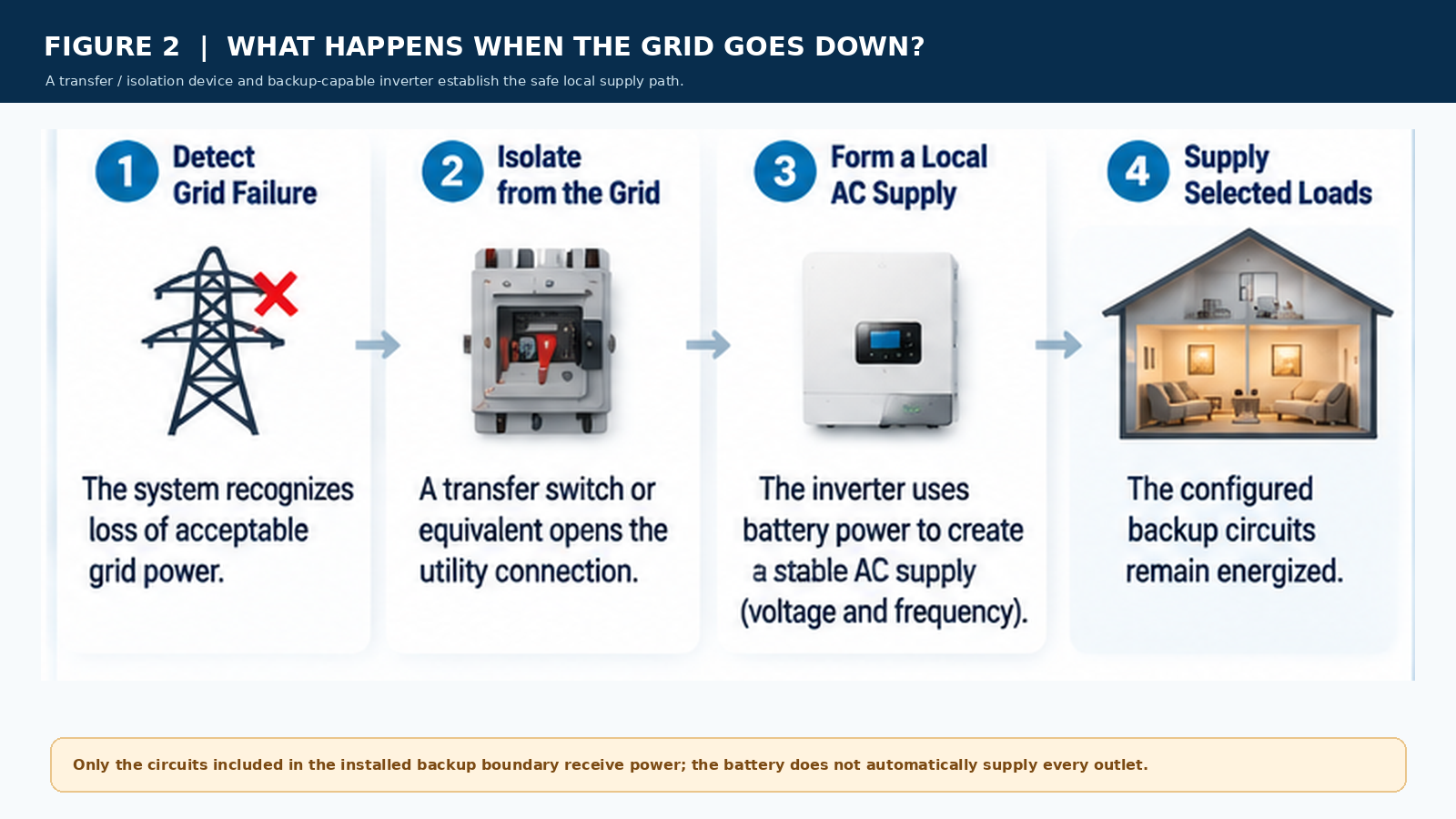
It changes which loads can receive battery power during an outage and how much demand the backup system must be ready to serve. In a selected-load arrangement, designated circuits are separated into a protected panel or equivalent approved configuration. Circuits outside that boundary go dark when the grid is lost. In a whole-home arrangement, more or all household circuits lie behind the transfer or isolation equipment, so more devices can request power. Neither arrangement changes the battery's rated output simply by changing its name.
Several high-power devices may request energy together; the inverter can reach its limit, or verified controls may disconnect selected loads. Whole-home access therefore still needs an operating rule for simultaneous demand. Tesla's consumer backup guidance similarly relates backup coverage to installed batteries and actual home loads.
The decision should be made at the circuit and function level, not from appliance names alone. A refrigerator and the receptacles it uses must actually be on a protected circuit. A furnace may need both a blower and controls; an internet connection may depend on a modem, router and upstream service. A well pump may have a modest running average but a demanding start. The supported function can therefore include several electrical pieces and dependencies. The backup boundary must contain the pieces necessary to complete the task.
The functions that need power are those whose loss would defeat the household's outage goal. Food preservation, safe movement at night, communications, medical equipment, water, sanitation and temperature control may qualify, depending on climate, occupants and alternatives. Trace each chosen function to its actual circuits: a home with gravity-fed water differs from one with an electric well pump, and gas heat may still need electrical controls and circulation.
Distinguish “must stay on continuously” from “must be available on demand.” Refrigeration cycles. A phone charger may be used briefly. A sump pump may operate rarely yet matter most during a storm. These patterns affect both which circuits are selected and whether a limited battery can protect them. A high-priority intermittent load cannot simply be omitted from the design because its daily energy looks small; the battery and inverter must still be able to start and run it when required.
The following table is a scoping tool. It separates the reader's desired function from the circuit and the constraint that could change the decision. It is not a universal “essential appliances” list.
| Household function | Likely electrical dependency to trace | Boundary decision | Constraint that may change it |
|---|---|---|---|
| Keep food cold | Refrigerator or freezer receptacle circuit | Usually protect the actual connected circuit | A shared circuit may also feed other receptacles |
| Maintain communications | Modem, router, device charging and any local network equipment | Protect a suitable receptacle or dedicated supply | Internet service itself may be unavailable in a regional outage |
| Provide nighttime safety | Selected lighting circuits and any powered access equipment | Protect routes and exits, not every lamp | Lighting may share circuits with larger loads |
| Maintain water or drainage | Pump controls, pump motor and associated equipment | Include only after start and running demand are assessed | Motor start can exceed ordinary running demand |
| Keep a safe indoor temperature | One feasible heating or cooling path and its controls | Decide whether to support one zone, a small unit or a larger system | Weather, insulation and motor or compressor starts alter demand |
If a function requires a circuit shared with an unwanted load, the panel layout may not match the neat list of appliances. An electrician may be able to rearrange circuits or propose an approved control method; the homeowner should not assume that a battery app can separate devices that share one branch circuit. The desired outcome is a clear protected-function list with an electrical route for each function, plus a list of loads intentionally outside the outage plan.
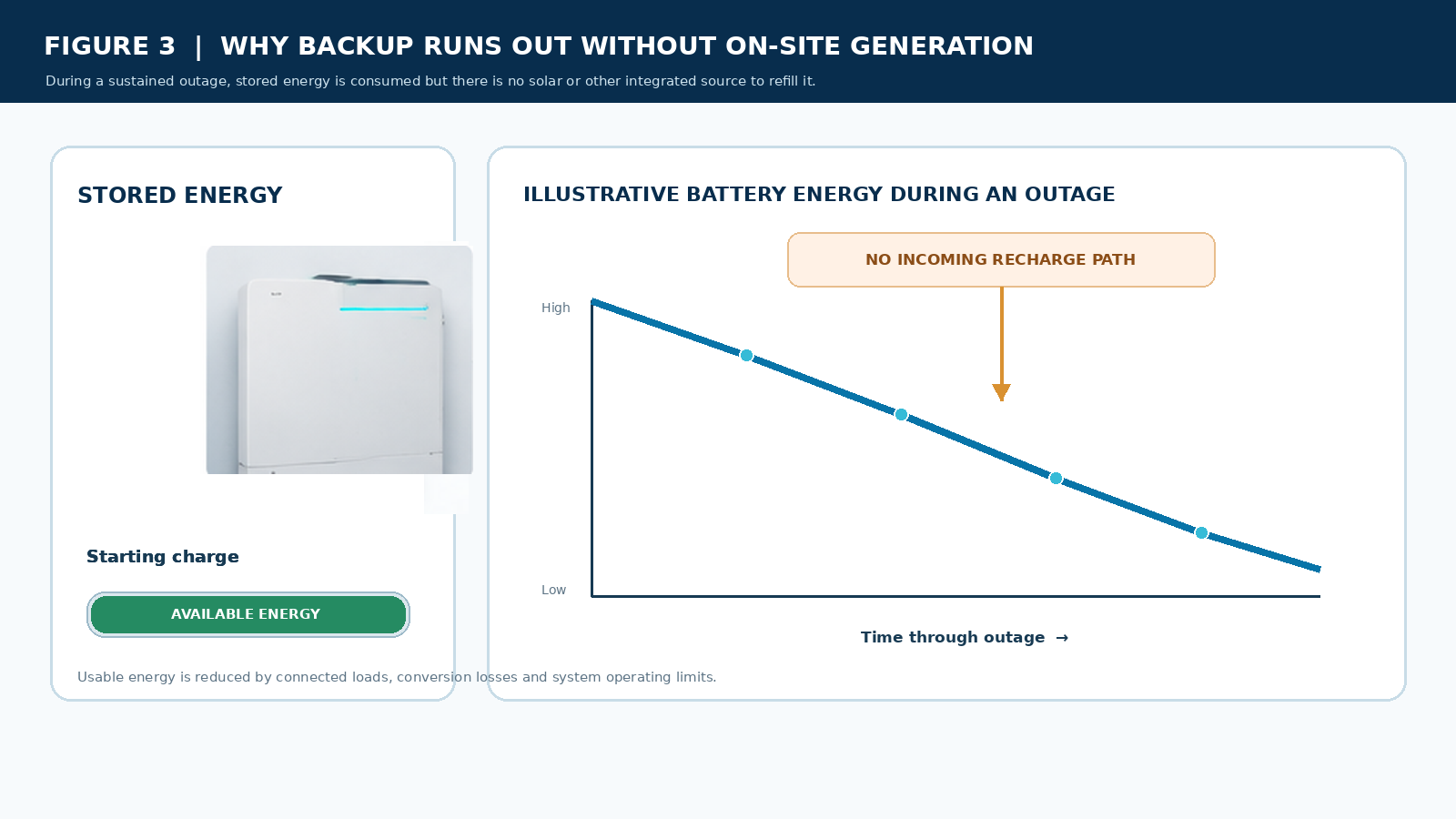
The boundary must work on two time scales: an instant and an outage. Instantaneous power determines whether connected equipment can start and run together. Usable stored energy and any recharging determine how long the supported mix can continue. A smaller protected set usually reduces both demands, but only if the chosen circuits really exclude the large discretionary loads. A large battery with inadequate inverter output may still fail to start a motor; a powerful inverter with too little usable energy may run the chosen loads only briefly. Product specifications and system configuration must be read for both dimensions.
For a first pass, group protected loads into continuous, cycling and occasional use. Consider what might run at the same instant, especially after an outage begins or when power returns to the protected panel. A pump, refrigerator compressor and air conditioner can create a different peak from the sum of their ordinary averages. Some systems sequence or shed loads, but that capability must be present and correctly configured; it should not be assumed from a “whole-home” label. Manufacturer system design materials, including Tesla's backup-load guidance, distinguish running and start constraints in system planning.
Duration is a different question. A household that needs a few hours of refrigeration and communication can choose a narrower boundary than one expecting multi-day support for electric heating. Keeping an electric oven or water heater on a backed-up panel may be convenient in a brief interruption yet consume much of a limited energy reserve during a longer outage. If the system permits it, usage rules or automatic controls can reserve those devices for times when sufficient energy or solar output is available. Such rules do not increase battery energy; they determine which activities receive it.
Season matters. The same household may need a different outage plan in summer heat, winter cold or a wet season when drainage becomes critical. A scope chosen from one calm day's consumption can overlook a seasonal function. The answer is not to design every seasonal extreme into every circuit indiscriminately. Instead, identify which seasonal cases the project promises to cover and test the electrical implications of those cases. A household may accept shorter coverage for a large seasonal load, support a smaller substitute, or expand the system if that function is non-negotiable.
This scope decision comes before detailed battery-capacity calculation. Once the protected functions and operating rules are chosen, the household can build an hourly load profile, determine required usable energy, account for losses and compare system configurations. That quantitative workflow belongs to the separate sizing task. Here the key is to avoid calculating a precise battery size against an undefined phrase such as “the whole house.”
Selected-load backup is a strong fit when the household can identify a stable group of essential circuits and is willing to postpone energy-intensive activities during an outage. It can keep the protected service predictable: the circuits that stay live are named, and nonessential loads cannot silently consume the reserved energy if they remain outside the boundary. That makes the operating plan easier for every occupant to understand. It is especially useful when the budget, available installation space or existing battery configuration cannot support the peaks and duration implied by a broader service boundary.
Its limitation is rigidity. A circuit excluded from the protected set cannot be used during an outage merely because today it feels important. Shared branches may bring unwanted loads along with a desired device, while a needed function may be split across multiple circuits. The household may also discover that a change in equipment, use of a room or occupant needs makes the original selection outdated. Therefore, a selected-load design should include a clear circuit schedule and enough thought about foreseeable changes, not just a label saying “essentials.”
Selected-load backup is not the same as selecting only tiny appliances. A pump or a single-room cooling option may be essential for a particular home. The question is whether that load can be supported within the actual system's start, running and duration limits, and whether its circuit can be included appropriately. If it cannot, the household needs a different electrical strategy or a narrower promised function. Calling a load “critical” does not make it compatible with a battery system.
A broader boundary makes sense when the household values access to many circuits and the installed system can control the resulting demand. It can reduce the need to decide every protected branch in advance and may accommodate changing daily patterns more easily. It can also keep ordinary outlets and lighting available throughout the house, which matters for households whose essential activity moves between rooms. The benefits are real only if the power path, inverter output, controls and stored energy support the intended behavior.
Whole-home backup still requires an outage operating plan. During normal grid service, several large appliances may run without the occupants noticing their combined draw. During backup, a limited inverter and battery must supply that draw or shed some loads. Some whole-home designs therefore include controlled circuits, device settings or household rules that defer water heating, vehicle charging, cooking or other discretionary use. A homeowner should ask which loads remain connected, which may be automatically disconnected, and which require a person to stop using them. Those are different promises.
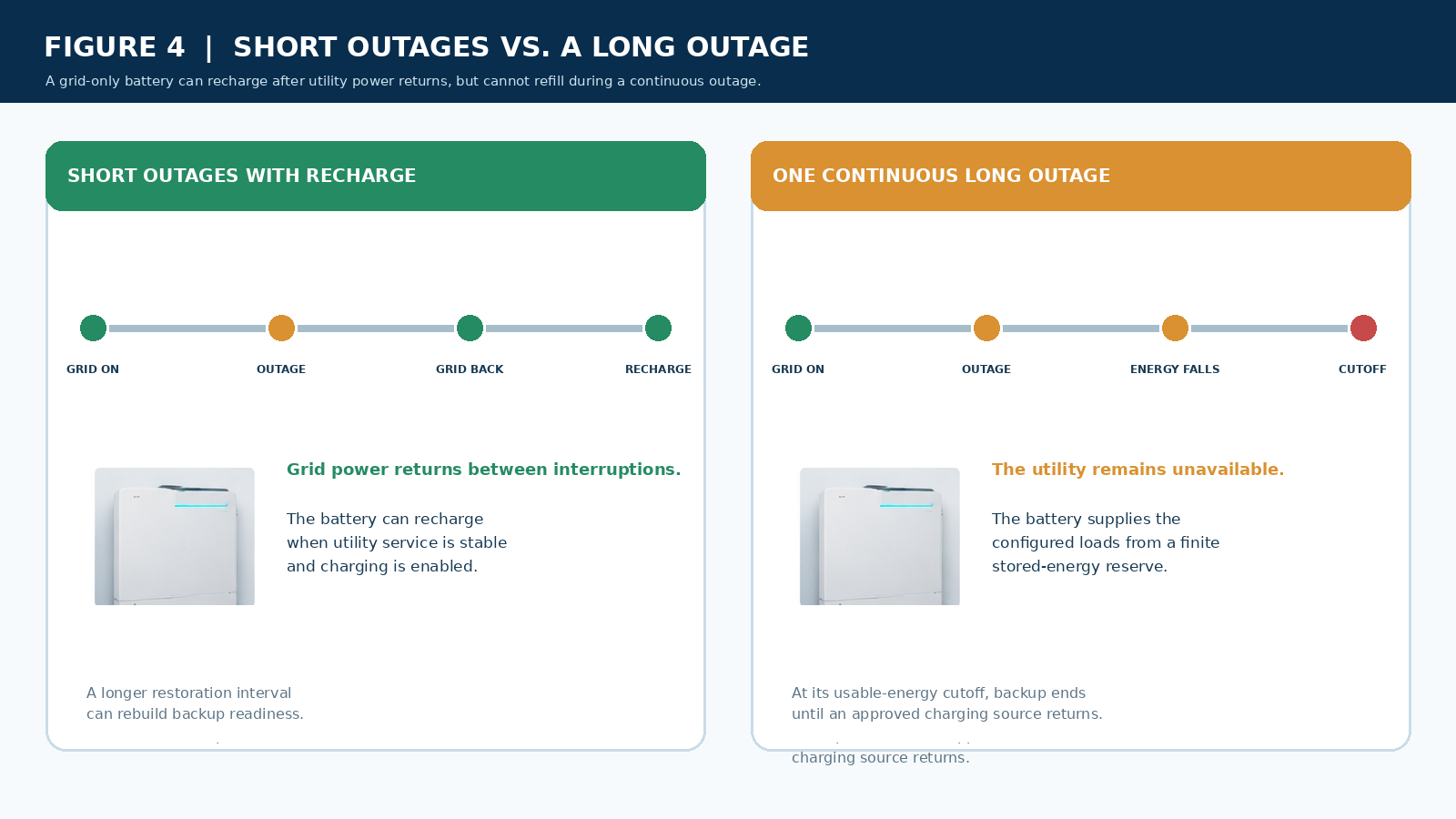
There is also a difference between backing up the whole panel and maintaining normal comfort for a long outage. A full-panel connection may make a high-demand appliance electrically accessible, yet a prolonged run could shorten the available backup period. A broad panel boundary solves access; adequate energy and load management solve endurance. Where a household needs both broad access and long autonomy, the project may require more storage, more inverter capacity, solar recharging or stronger demand controls, depending on the conditions and compatible equipment. None should be inferred from the words “whole home” alone.
Write a short outage service statement before comparing equipment. It should name the household functions that must remain available, the expected outage period, any seasonal case that changes priorities and the activities occupants will postpone. Translate those functions into candidate circuits and note any shared branches or dependencies. Then identify loads that may run together and the large starts that could challenge the system. This creates a boundary that an installer can evaluate and later demonstrate.
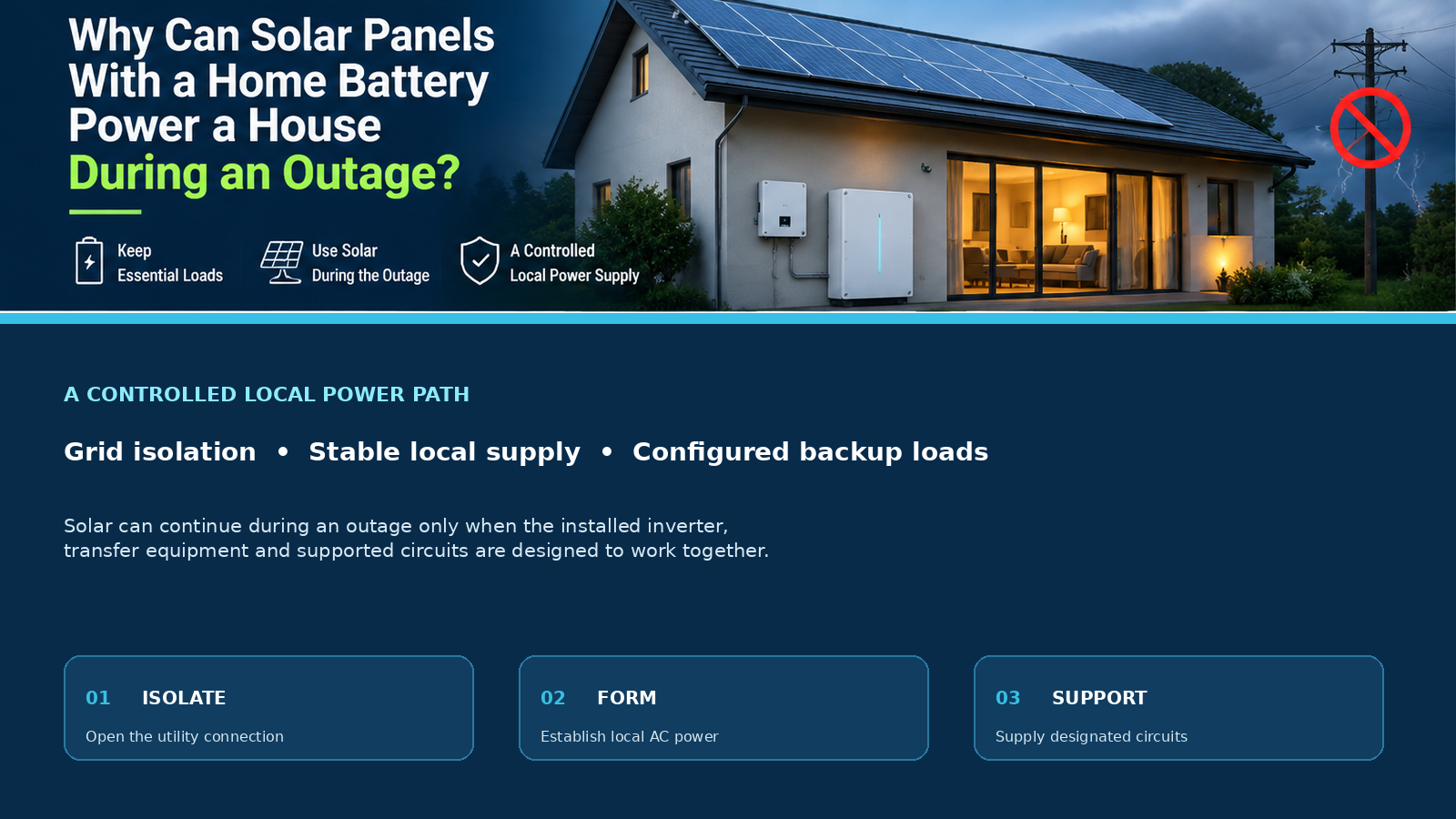
Ask the installer to show the proposed backup path on a circuit schedule or single-line diagram, including the grid isolation or transfer equipment, protected panel or whole-panel connection and any controllable loads. This is a request for a project-specific design, not a reason to treat a generic diagram as a wiring instruction. Confirm how the system behaves when the grid fails, when several loads start together, when battery charge becomes low and when the grid returns. The answer should describe actual configuration and controls, including any device that will be unavailable or automatically shed.
The household should also decide how to recognize that the scope is being exceeded. A display or app may show output and state of charge, but occupants still need a simple rule for turning off discretionary loads when backup begins. If a load-control device is part of the design, identify its priority order and what happens if a high-priority load requests power while a lower-priority one is running. The installation handover should match the original service statement. A design that promises refrigeration and communications but leaves their actual circuits outside the protected path has failed the scope decision regardless of battery size.
Before accepting the arrangement, request a demonstration of the outage configuration under safe, installer-controlled conditions. Verify which selected circuits remain live, which loads are shed, and whether the household can use the necessary functions. A test does not prove performance through every weather pattern or every outage duration, but it can expose a mistaken circuit assignment or control setting. Record the final circuit list and operating rules where occupants can find them during an outage. If household needs change later, revisit the protected-function list before assuming the original boundary still fits.
Related News
Nov. 07, 2026
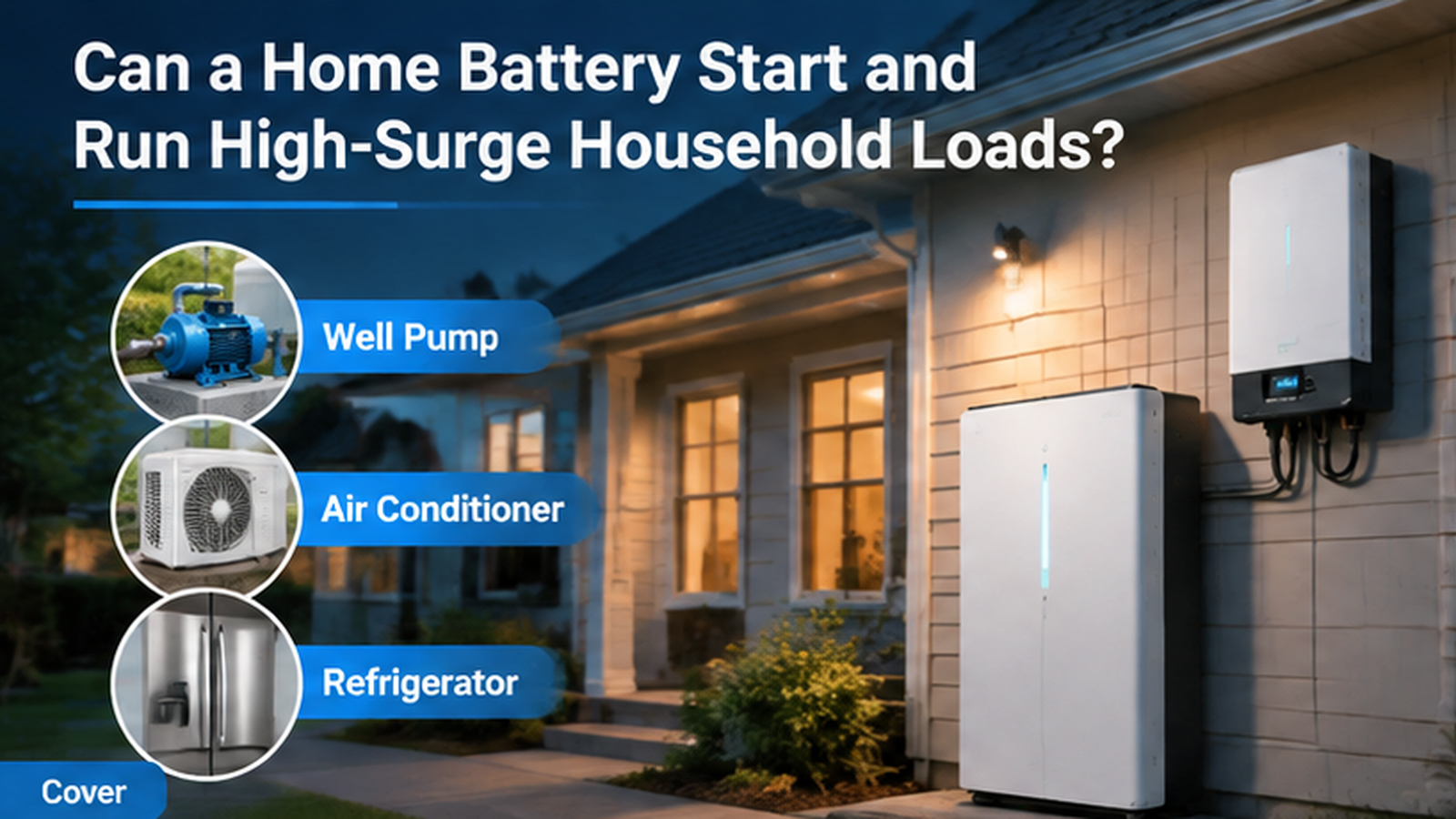
Can a Home Battery Start and Run High-Surge Household Loads?
Learn why battery kWh alone cannot prove motor-start backup. Compare inverter surge duration, running demand, simultaneous loads and a supervised backup test.
Nov. 07, 2026
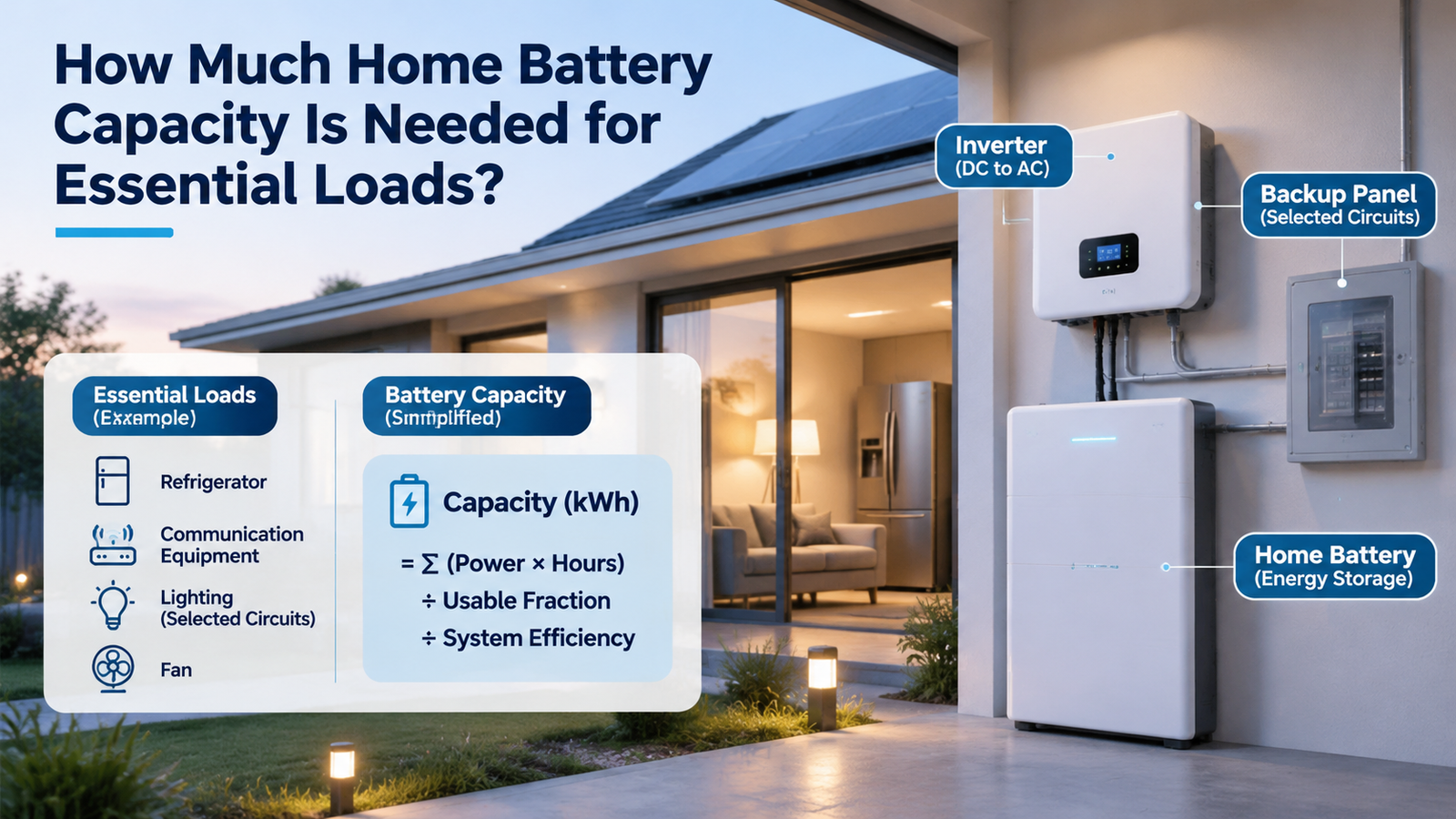
How Much Home Battery Capacity Is Needed for Essential Loads?
Calculate home battery capacity from essential-load power, duty cycle and outage hours. See a transparent kWh example and avoid double-counting losses.
Nov. 07, 2026
How Should a Home Battery Specification Sheet Be Read for Backup and Daily Use?
Compare home battery capacity, usable energy, continuous and peak output, charging limits and rating conditions before judging daily use or backup claims.
Nov. 06, 2026
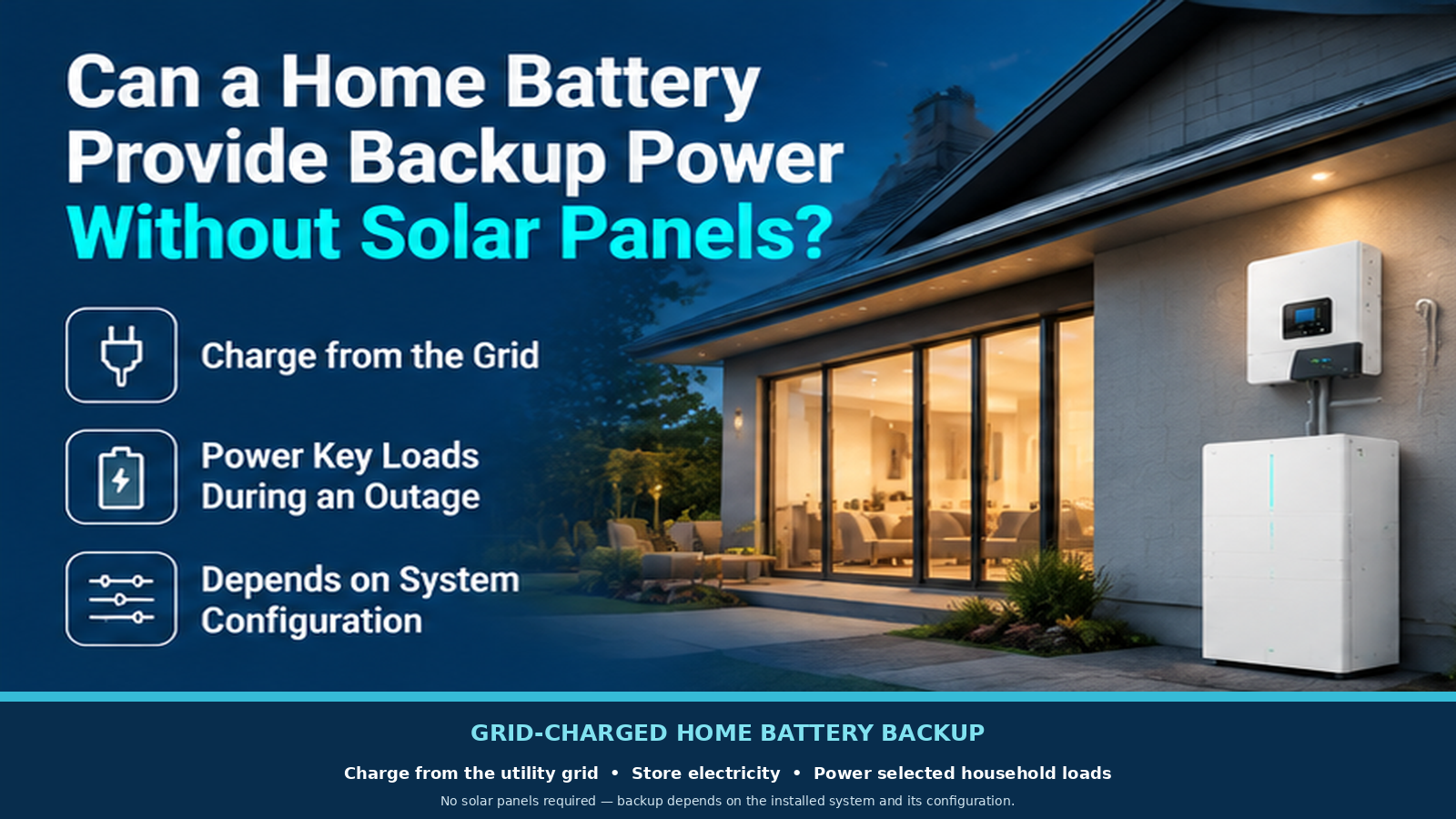
Can a Home Battery Provide Backup Power Without Solar Panels?
A home battery can provide backup without solar if grid charging, outage isolation and backup circuits are configured. Learn what limits runtime and recharge.
Nov. 06, 2026
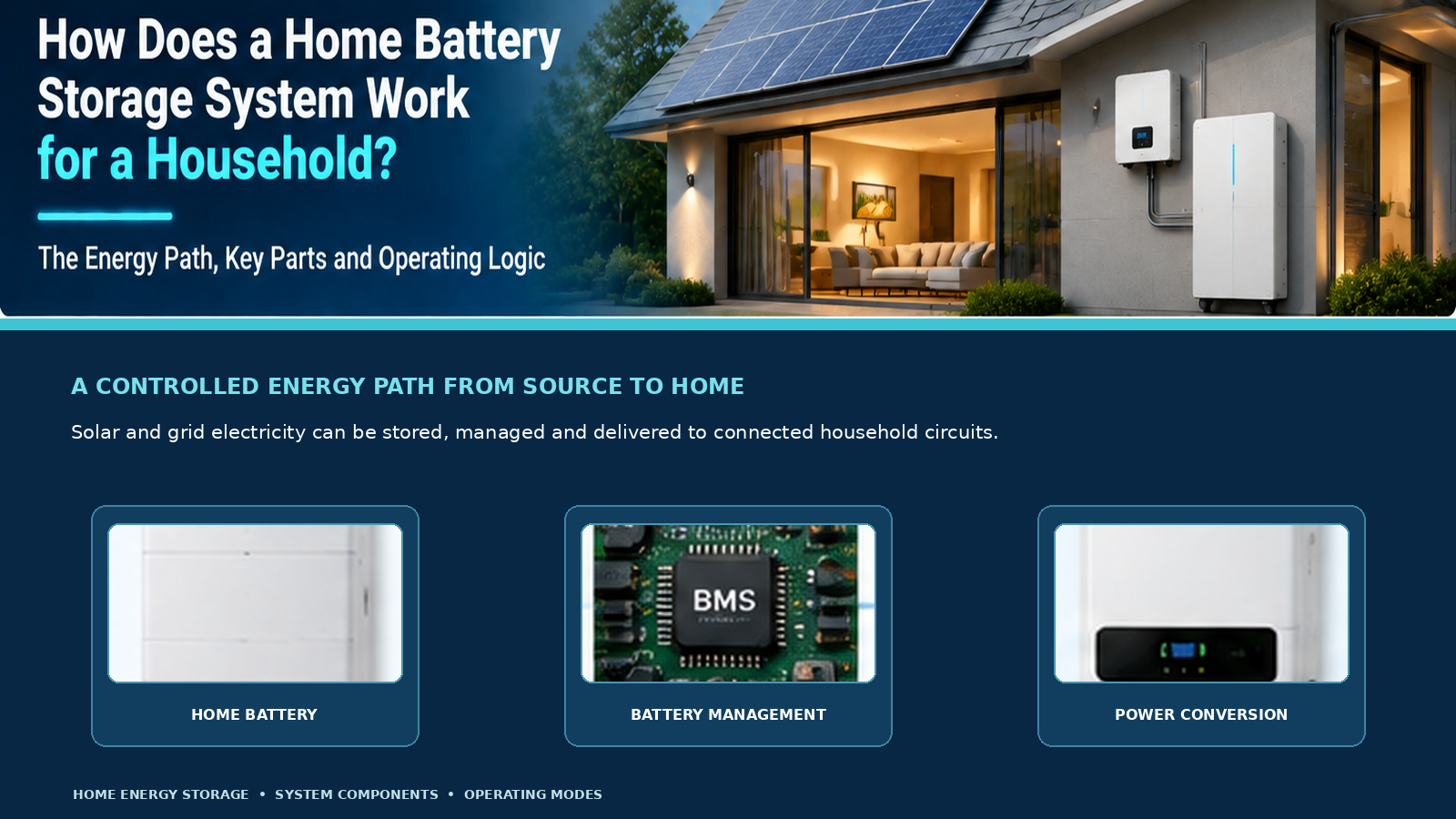
How Does a Home Battery Storage System Work for a Household?
Follow the energy path through a home battery, inverter and controls. Learn how charging, daily discharge and outage backup differ before comparing systems.
Nov. 06, 2026
How Can A Weak Battery Be Distinguished From A Weak Golf Cart Battery Bank?
Compare like-conditioned unit and bank readings to separate one weak battery from broad bank loss, charging shortfall or connection trouble.
Nov. 06, 2026
How Should A Replacement Golf Cart Battery Bank Be Planned?
Decide whether one unit or the bank needs replacement, then specify voltage, fit, connections and first-charge checks before ordering.
Nov. 06, 2026
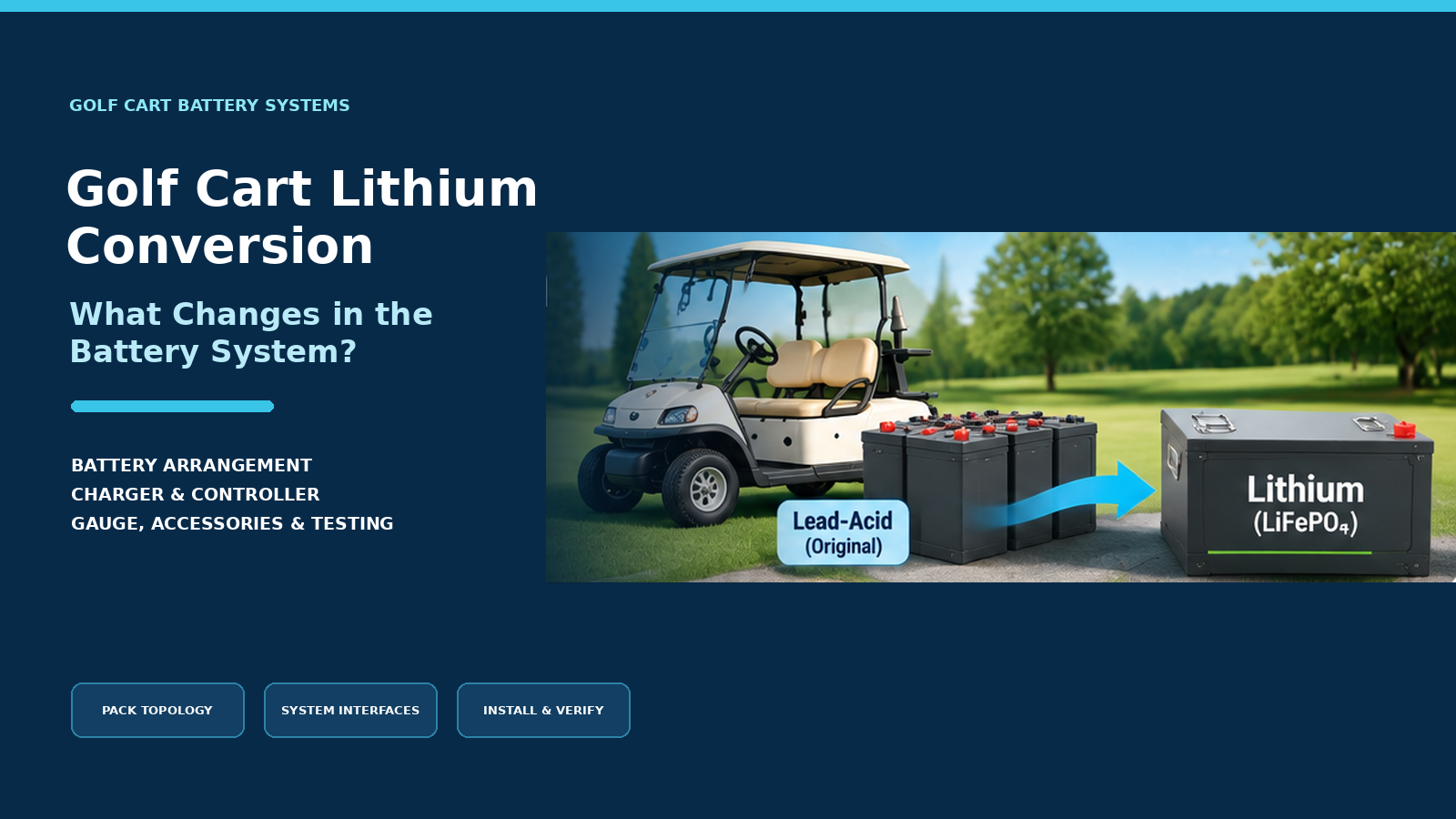
What Changes When A Golf Cart Battery Bank Is Converted To Lithium?
Map the battery bank, tray, charger, controller, gauge and accessory interfaces that change when converting a lead-acid golf cart to lithium.
Nov. 06, 2026
When Does Lithium Make Sense Instead Of Lead Acid For A Golf Cart?
Compare lithium and lead acid for the same golf-cart duty, charging routine, maintenance capacity and ownership horizon before deciding whether a switch is worthwhile.
Nov. 06, 2026
How Can Peak Current Demand Be Matched To A Golf Cart Battery?
Compare a golf cart’s acceleration and hill-load current by duration with battery continuous, pulse and protection ratings under matching conditions.
Nov. 06, 2026
How should a golf cart battery be sized for route energy and reserve?
Use measured route energy, usable battery capacity and a defined return reserve to plan golf cart battery size without treating Ah as guaranteed range.