

Nov. 06, 2026
Lithium makes sense when a compatible battery system meets the cart's actual route and power demand, reduces a burden that matters to its owner, and justifies its full conversion cost during the intended ownership period. Lead acid remains a sound choice when the present charging and care routine is manageable and a suitable bank already covers the duty. The useful comparison is between two systems doing the *same job*, not two labels carrying similar amp-hour or advertised life figures. A battery can have attractive specifications and still be a poor choice for a particular cart if it needs an unplanned charger, mounting arrangement or operating schedule. The decision therefore starts with the service the cart must provide and ends with a conditional choice: which system can provide that service reliably at an acceptable total cost?
Hold the cart, route, payload, operating conditions, required return margin and ownership period constant. Then compare the energy and current each candidate can actually deliver within its permitted operating window. A change in route or load between examples makes a claim about battery chemistry impossible to interpret: the battery may look better simply because it did less work.
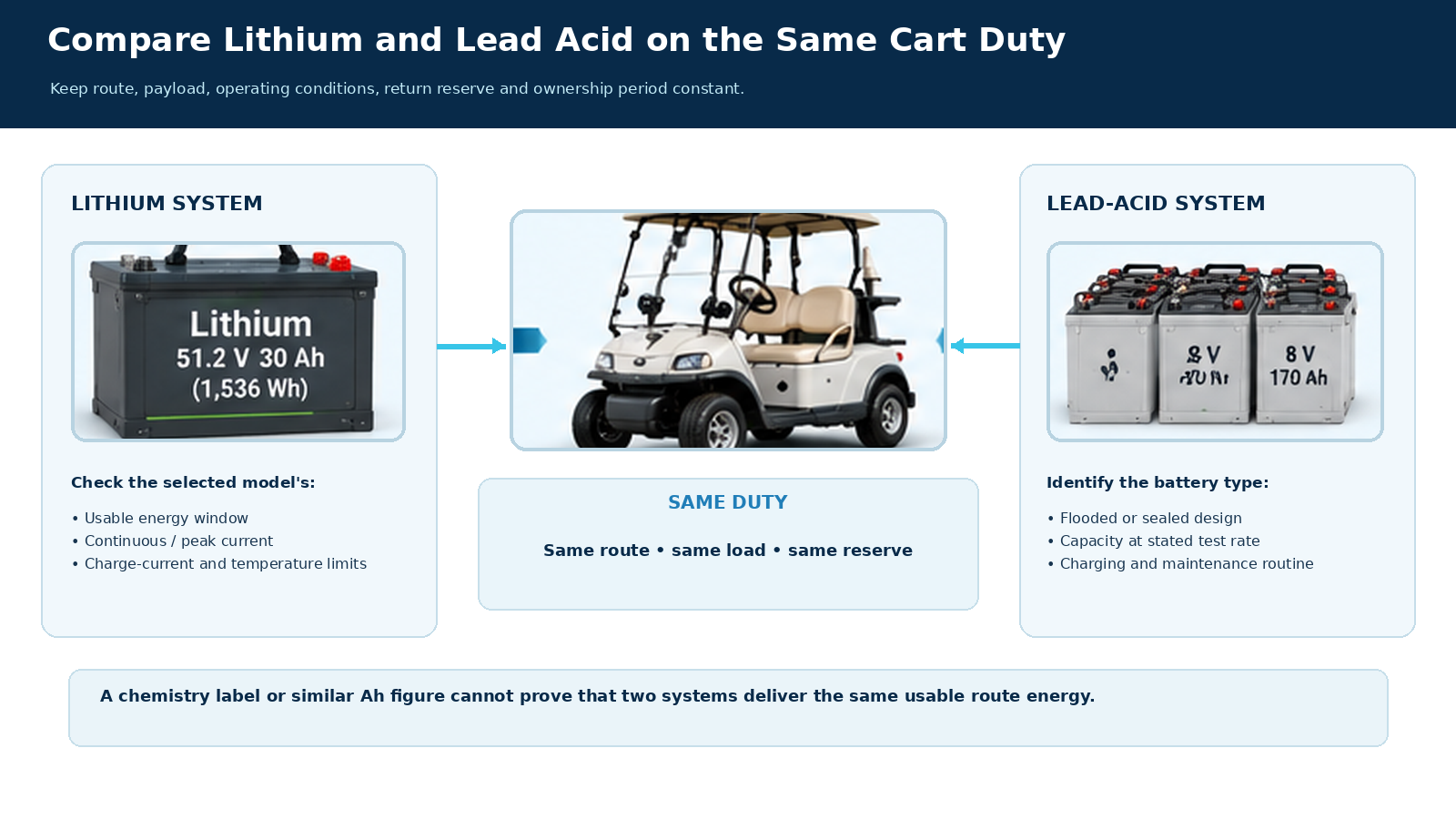
A nominal voltage identifies the cart's system class but does not tell you how much work a bank can do. A 48 V lead-acid bank, for example, may consist of eight 6 V, six 8 V or four 12 V units in series, according to Trojan's battery installation guidance. The unit count changes the physical layout even though the nominal bank voltage is the same. Amp-hours describe charge capacity at specified test conditions; watt-hours relate voltage to charge capacity. Neither figure alone is the energy a cart will deliver on a particular route. Load current, the voltage reached during use, the permitted discharge window and protective limits all affect the usable portion.
Start with the route's required energy and the power events that matter, such as a loaded climb, and use the same assumptions for both candidates. If the cart must complete two loops before a charge opportunity, compare both systems against those two loops. If it normally returns with a reserve for an unexpected detour, preserve that reserve in both comparisons. This is a comparison rule, not a claim that a given percentage of nameplate energy is always usable. The battery and cart documents determine the allowed window, while actual route measurements establish the demand. A chemistry choice cannot be separated from either side of that equation. The detailed calculation of route energy belongs to battery sizing; here it establishes a fair basis for choosing the chemistry.
Lithium becomes more compelling when the cart repeatedly approaches the limits of its present system and a specific lithium pack can cover that duty within its own energy, current and charging limits. A short, predictable route that the existing lead-acid bank already handles comfortably gives less operational value to a chemistry change.
Think of duty as a sequence rather than a mileage claim. A cart may travel the same distance on level ground and on a hilly route, but the loaded hill asks for more current and can consume more energy. A system that reaches its lower usable boundary before the final trip does not become suitable merely because its nominal watt-hours look large. Conversely, buying more nominal energy than the route needs may never pay for itself in service. The relevant result is whether the cart completes the required work with its intended reserve and without protection interruptions, on the repeated difficult day as well as the easy day.
The named RELiON InSight GC2-48V specification illustrates why a lithium label cannot stand in for a duty analysis. It gives a 51.2 V nominal rating, 30 Ah and 1,536 Wh per module, together with distinct continuous and short-duration discharge limits. Those figures describe that model under its stated conditions; they do not establish the range of another battery or a specific cart. A suitable system would need enough approved modules or another appropriate pack, and its current limits would have to cover the cart's events for the relevant durations. Comparing its 30 Ah to the Ah on one lead-acid unit without accounting for voltage, configuration and usable window would mislead.
Charging opportunities can change the answer too. If the cart must return to work before the present bank is ready, a compatible pack and charger with an appropriate charging schedule might improve utilization. If the cart rests overnight and has ample time to charge, the possible speed advantage may have little value. U.S. Battery's lead-acid charging guidance also discusses opportunity charging for its batteries, so the mere presence of short charging breaks does not prove lithium is necessary. The decisive question is whether a proposed system fits the actual intervals and avoids a service interruption, with its charge limits and temperature conditions respected.
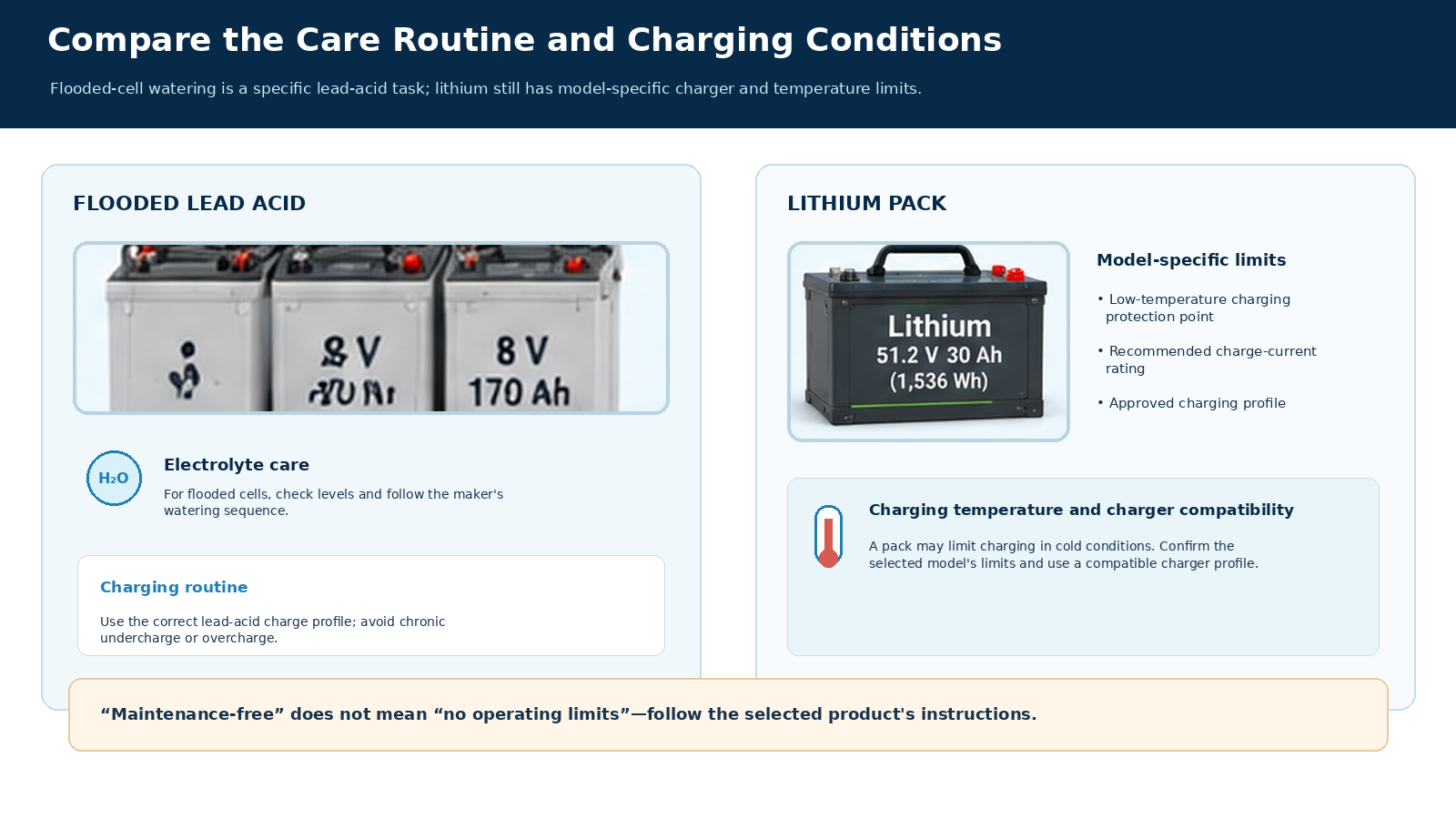
Flooded lead-acid batteries require electrolyte-level care and a suitable charging routine; a sealed lithium pack does not require watering, but it still has specific charger and temperature conditions. The value of eliminating watering depends on who performs that work, how often it occurs and whether it disrupts the cart's availability.
This comparison must name the type of lead-acid battery. Trojan's maintenance guidance describes checking electrolyte in flooded cells and generally adding water after a full charge; if plates are exposed before charging, they must first be covered. That is a real recurring task for a flooded bank, not a universal chore for every lead-acid design. The same guidance explains why a correct charging setup matters: excessive charge promotes heat and gassing, while insufficient charge can leave the battery chronically undercharged. Skipping care therefore changes service life and reliability, not merely the owner's schedule.
A lithium pack removes that specific electrolyte task, but its management system and cell chemistry create other boundaries. For the named RELiON model, the published specifications give a recommended charge current and a low-temperature charging protection point. Those are not permission to apply the same numbers to every lithium product. A cart stored in a cold building may need a different charging arrangement or a model designed for those conditions. A pack that refuses charging when cold can still be usable for a duty cycle if the charging schedule and location accommodate that state; it is a poor choice if the operator needs immediate charging there and has no workable solution.
Put labor and charging time on the same operational calendar. For a single lightly used cart, periodic flooded-cell care may be easy to perform. For a fleet whose carts must be turned around quickly, scheduled care, missed charges and downtime can have a meaningful cost. The comparison should count the actual work saved and any new charging constraints, rather than calling one chemistry maintenance-free or treating an advertised recharge rate as a guaranteed turnaround time.
A lithium choice must include the work needed to secure the new battery arrangement and make its charger and vehicle interfaces compatible. Equal nominal voltage does not mean a pack drops into the old battery bay or works with the old charging program.
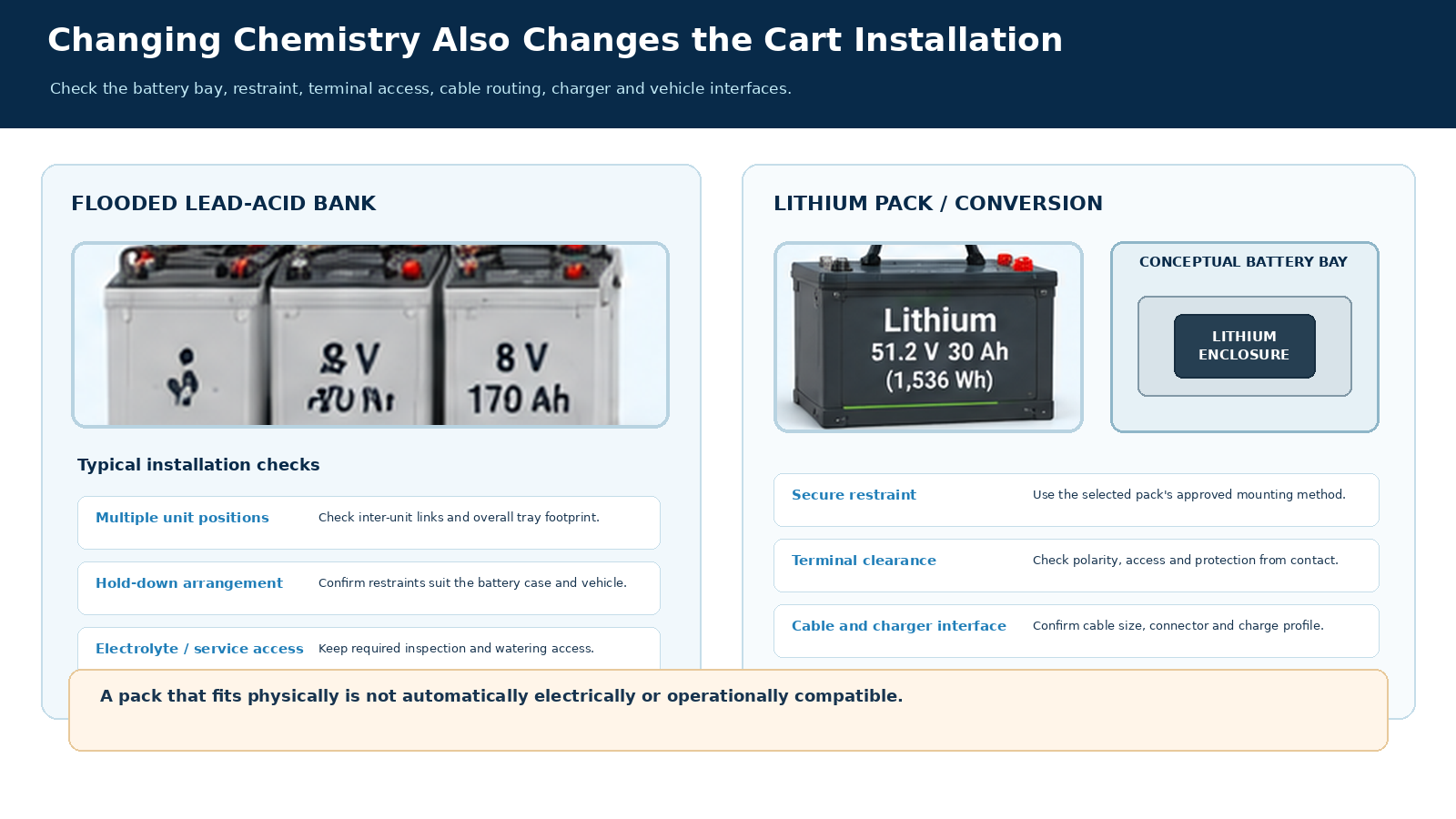
The physical problem is easiest to see in the tray. A lead-acid bank occupies several unit positions and uses inter-unit cables and a hold-down suited to that layout. A lithium system may use one enclosure or a smaller number of modules, leaving empty positions or changing terminal locations. The named RELiON InSight GC2-48V page gives its own dimensions and describes using spacers or another secure restraint where slots are vacant. That is evidence of a possible mounting issue, not proof that a different lithium pack needs the same spacer or fits a particular tray. Terminal clearance and cable routing matter as much as whether the enclosure can physically enter the compartment.
Electrical changes can be wider than the tray. A lead-acid charger may follow a charging program that the selected lithium pack does not accept. A gauge that used lead-acid voltage behavior to suggest state of charge may not give useful information after the change. Vehicle controller behavior, accessories and regenerative charging, if present, may also need matching components. A Trojan vehicle-specific bundle guide separates batteries, mounting brackets, chargers, receptacles, gauges and harnesses by vehicle and bundle. Its specific combinations are not universal instructions, but the separate columns show why the conversion can be a system purchase rather than a battery-only swap.
Compatibility is a feasibility gate for the chemistry decision. If the required interfaces can be addressed with documented parts and an acceptable installation cost, lithium remains a candidate. If a necessary charger or mounting arrangement is unavailable, a theoretical chemistry advantage cannot be realized on that cart. Detailed interface mapping and acceptance follow only after the chemistry choice is justified.
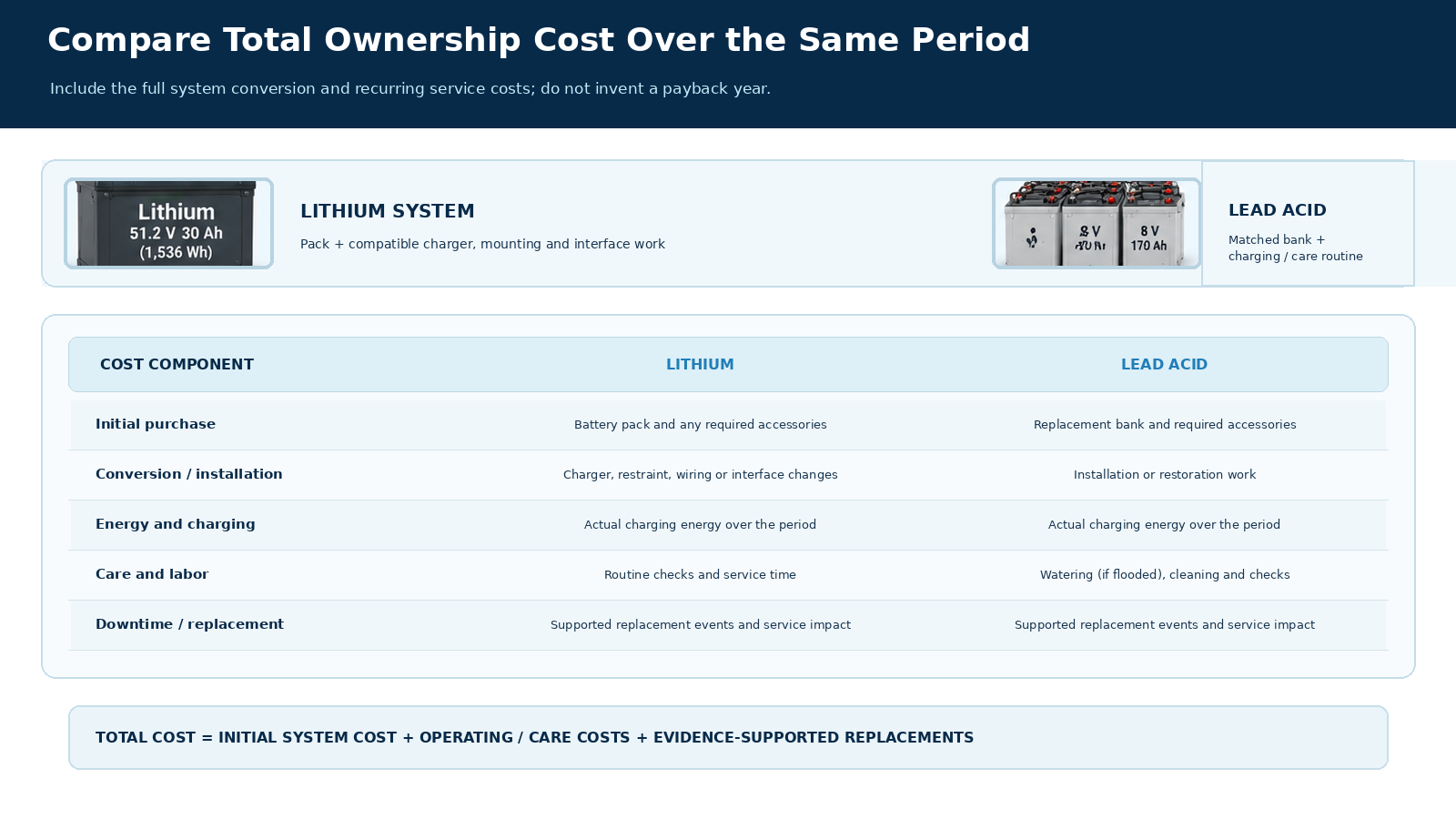
Compare the cost of providing the same cart service over a declared ownership period, including the battery, any charger and mounting changes, installation, energy, routine care, downtime and evidence-supported replacement events. A lower lifetime cost or payback date cannot be calculated from purchase price and a headline cycle-life claim alone.
Write the comparison as a ledger with the same beginning and end dates for both options. The initial lithium column may include pack, charger, restraint and interface work. The lead-acid column may include a replacement matched bank and any work needed to restore the existing system. During operation, add actual charging energy, paid maintenance time and service interruptions that can be reasonably attributed to the battery system. At the end of the period, count a replacement only if the assumed service life is stated and defensible for the duty. A warranty term is not automatically a prediction of service life, and a published cycle figure measured under laboratory conditions is not a field replacement date.
The calculation can stay symbolic until trustworthy inputs are available: total ownership cost equals initial system cost plus operating and care costs plus supported replacement costs over the chosen horizon. This is still useful without a fabricated number. A short ownership period places more weight on upfront conversion cost. Frequent paid watering and charging disruption place more weight on recurring work. A new charger required by the selected pack raises the lithium entry cost; an already suitable charging system would change that term. The same underlying route should be used in both columns, or the energy and downtime comparison ceases to be fair.
Avoid turning a conditional cost curve into a promise. Two cost lines may cross only under particular prices, labor rates, usage and replacement assumptions. If a value is unknown, showing the variable and the direction in which it changes the decision is more honest than inventing a crossover year. This method gives the owner a usable threshold: the additional upfront amount must be justified by benefits that occur within the period they expect to own and operate the cart.
Lead acid remains reasonable when a sound bank meets the actual route, charging time is available, flooded-cell care can be performed if relevant, and the cost or complexity of conversion would not produce enough value during the remaining ownership period. This is a positive decision under those conditions, not an assertion that lead acid is always equivalent to lithium.
The distinction between a tired battery and an unsuitable chemistry matters. A cart returning early because its existing bank is worn may only need a properly specified replacement of the same type. Replacing chemistry before locating that cause can add conversion work without solving a charger or connection problem. Light daily duty also reduces the value of any extra usable-energy margin that the operator never needs. If a fleet has staff and a stable routine for Trojan's flooded-cell care and charging, the saved labor may be small. These are conditions to measure, not arguments for tolerating poor maintenance.
| Same-duty condition | Lead-acid consequence | Lithium consequence | What changes the choice |
|---|---|---|---|
| Flooded-bank care time matters | Charging and electrolyte checks consume scheduled labor | A named LFP pack has no watering task | Value changes with actual labor time and cost |
| Existing charger or cold charging is a constraint | Present lead-acid program may remain usable for a matched bank | Selected lithium pack may need another profile or temperature arrangement | Feasibility and conversion cost change with the chosen model |
| Route energy or current margin is narrow | Compare the bank's delivered output on the same route | Compare the selected pack's permitted output under that duty | Ah labels alone cannot decide; route and rating evidence can |
| Remaining ownership is short | Avoided conversion expense has immediate value | Higher initial expense has less time to be recovered | Longer service horizon or larger recurring savings may reverse the result |
The rows are separate tests, not votes to count. A cart may favor lithium for care labor yet lose that advantage if a difficult charger change costs more than the owner could save before retirement. A light-duty cart may favor lead acid on cost even though lithium would technically work. The choice emerges from how these conditions interact for the same cart, not from whichever column contains more attractive adjectives.
Pursue lithium when the selected system can meet the same demanding duty with an acceptable reserve, its vehicle and charging interfaces can be implemented, and the resulting service or care benefit is worth its complete cost during the intended ownership period. If one of those conditions fails, retaining or renewing lead acid is a coherent result; if an input remains uncertain, identify the decision it affects before committing to a model.
Consider two different carts without inventing outcomes for either. One works short predictable routes, charges overnight, and has manageable flooded-cell care. Its owner gains little from a faster turnaround and may not recover conversion expense before replacing the cart. The other has repeated routes, a costly care schedule and a clearly documented compatible lithium system. There is a stronger reason to examine lithium, but its route energy, current and charging window still have to match that duty. Once those decision conditions are defined, Wirentech's golf-cart lithium battery category provides a browsing entry to product classes; the listing itself establishes neither cart fit nor range.
Related News

Nov. 07, 2026
Can a Home Battery Start and Run High-Surge Household Loads?
Learn why battery kWh alone cannot prove motor-start backup. Compare inverter surge duration, running demand, simultaneous loads and a supervised backup test.
Nov. 07, 2026
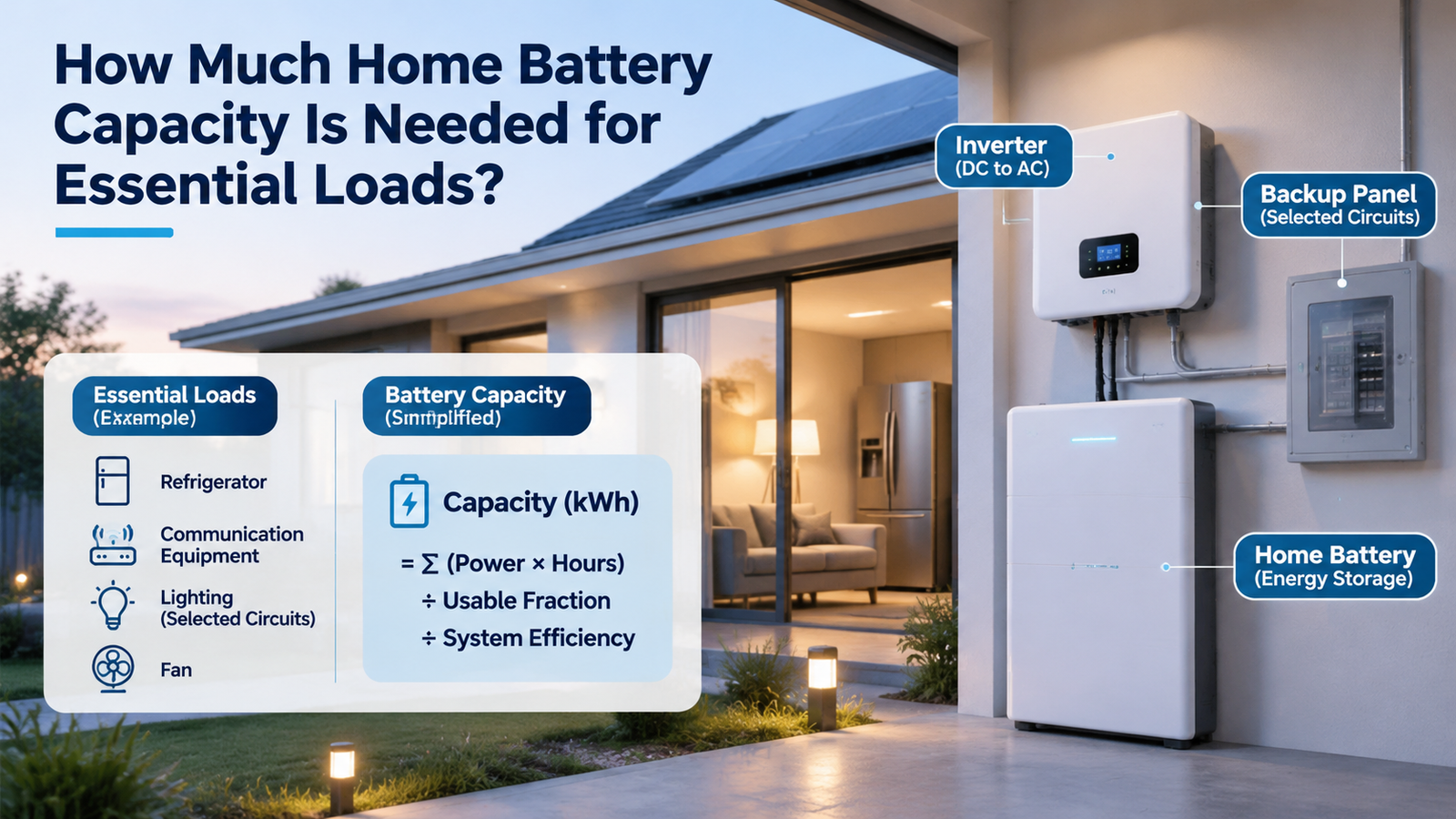
How Much Home Battery Capacity Is Needed for Essential Loads?
Calculate home battery capacity from essential-load power, duty cycle and outage hours. See a transparent kWh example and avoid double-counting losses.

Nov. 07, 2026
How Should a Home Battery Specification Sheet Be Read for Backup and Daily Use?
Compare home battery capacity, usable energy, continuous and peak output, charging limits and rating conditions before judging daily use or backup claims.

Nov. 06, 2026
Whole-Home Battery Backup or Critical-Load Backup: Which Scope Fits the Home?
Compare whole-home and critical-load battery backup by protected circuits, peak power, outage duration and load control to choose a realistic home backup scope.
Nov. 06, 2026
Can a Home Battery Provide Backup Power Without Solar Panels?
A home battery can provide backup without solar if grid charging, outage isolation and backup circuits are configured. Learn what limits runtime and recharge.

Nov. 06, 2026
How Does a Home Battery Storage System Work for a Household?
Follow the energy path through a home battery, inverter and controls. Learn how charging, daily discharge and outage backup differ before comparing systems.
Nov. 06, 2026
How Can A Weak Battery Be Distinguished From A Weak Golf Cart Battery Bank?
Compare like-conditioned unit and bank readings to separate one weak battery from broad bank loss, charging shortfall or connection trouble.
Nov. 06, 2026
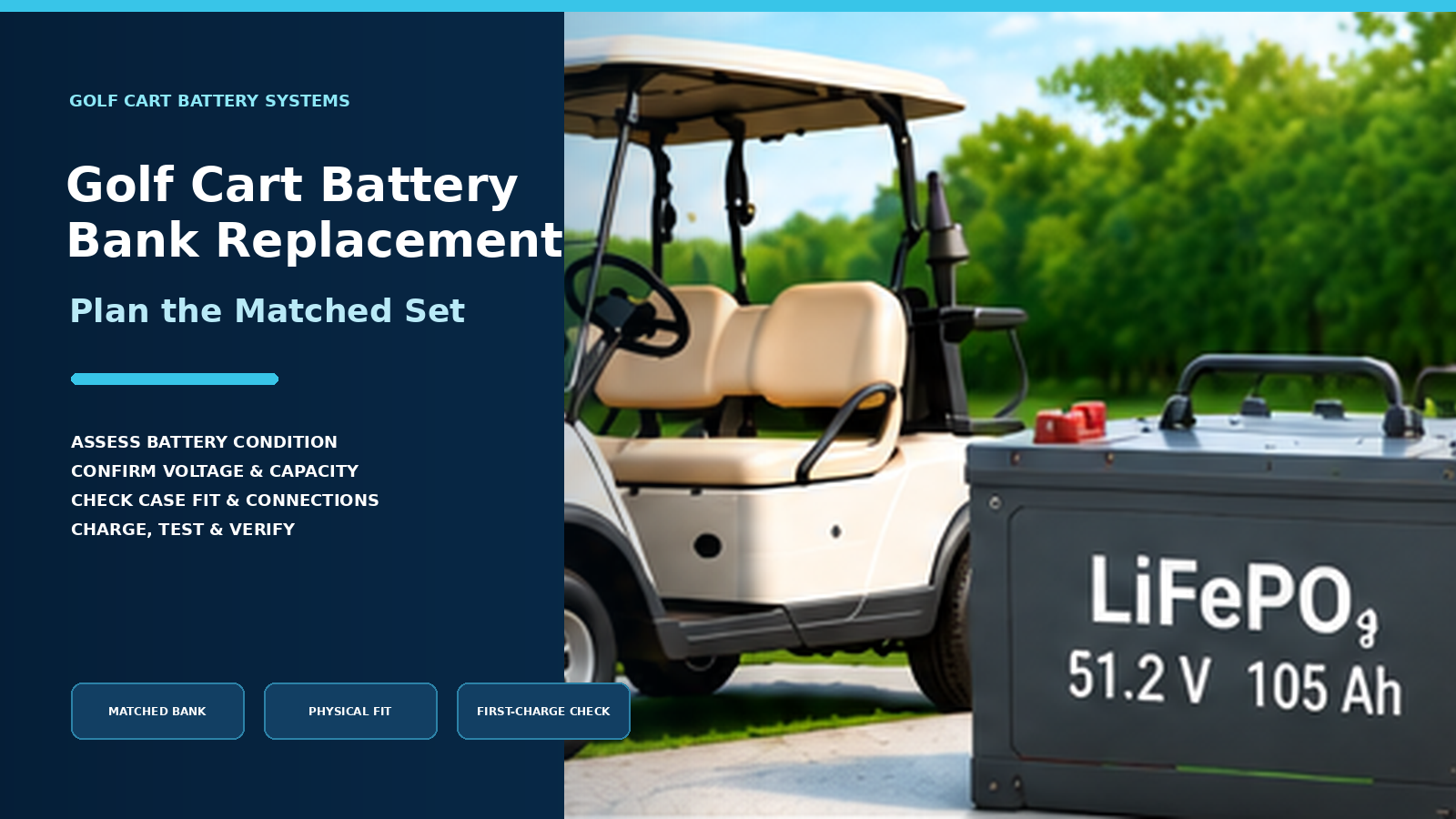
How Should A Replacement Golf Cart Battery Bank Be Planned?
Decide whether one unit or the bank needs replacement, then specify voltage, fit, connections and first-charge checks before ordering.
Nov. 06, 2026
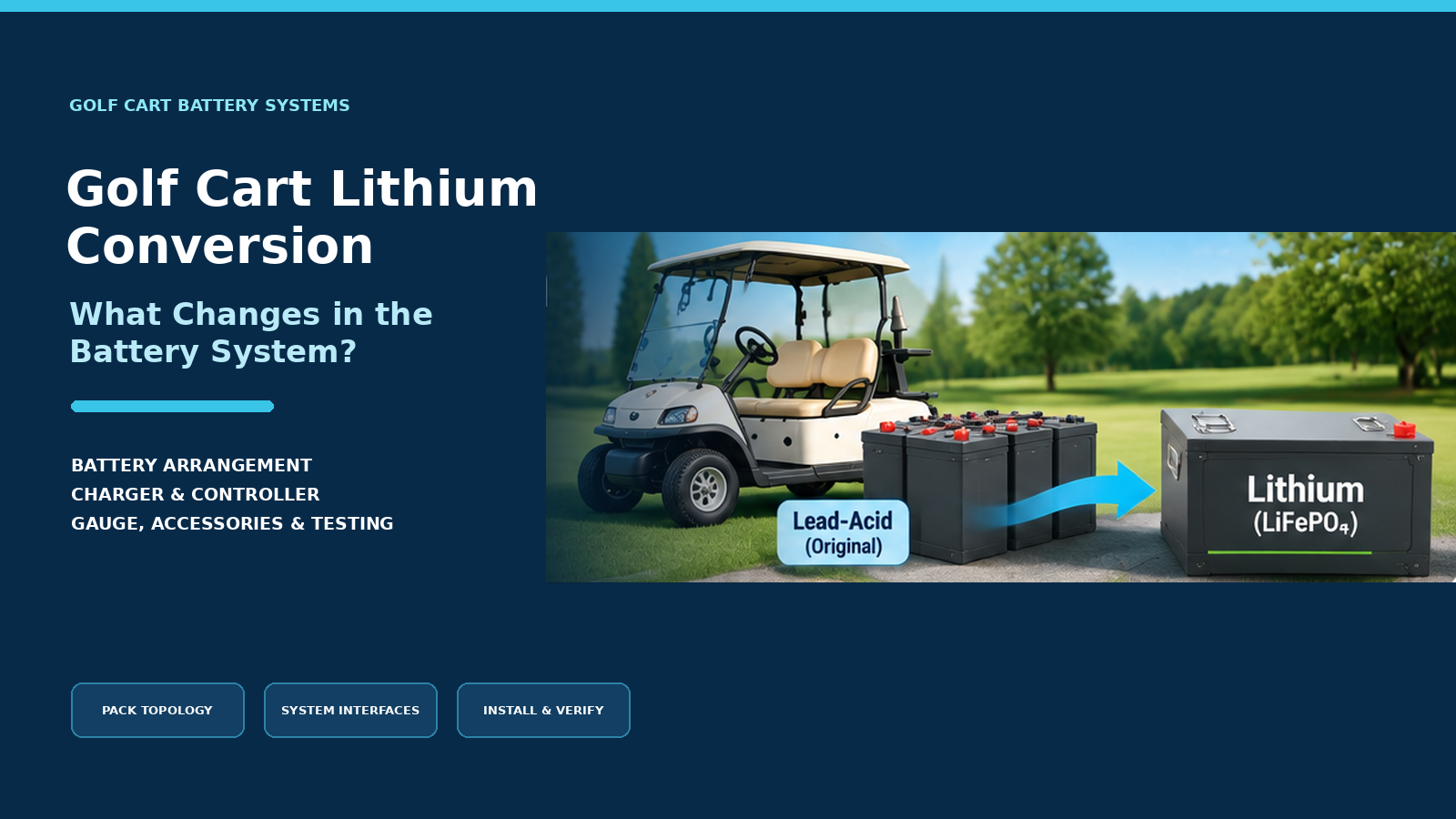
What Changes When A Golf Cart Battery Bank Is Converted To Lithium?
Map the battery bank, tray, charger, controller, gauge and accessory interfaces that change when converting a lead-acid golf cart to lithium.

Nov. 06, 2026
How Can Peak Current Demand Be Matched To A Golf Cart Battery?
Compare a golf cart’s acceleration and hill-load current by duration with battery continuous, pulse and protection ratings under matching conditions.
Nov. 06, 2026
How should a golf cart battery be sized for route energy and reserve?
Use measured route energy, usable battery capacity and a defined return reserve to plan golf cart battery size without treating Ah as guaranteed range.