

Nov. 06, 2026
Converting a golf cart from a lead-acid bank to lithium changes the battery arrangement and the interfaces around it. The new pack must be held securely, connected in its approved configuration, charged within its own limits, accepted by the cart's control system, and able to support monitoring and accessories where those are fitted. Matching the old bank's nominal voltage does not complete those changes. A conversion is ready only when the chosen battery and the actual cart work together through charging and a representative drive without unresolved faults. The relationships below explain what changes and what an owner can use as a completion standard. Exact cables, brackets, settings and terminal instructions belong to the selected pack and vehicle documents; a generic diagram cannot supply them.
The existing system voltage, series-unit layout, cart-side terminals, battery bay and connected charger and controller define the boundary that a lithium system must replace. The cart sees a bank at its main positive and negative connections, but inside a lead-acid bank several units may be joined by interconnects. Those internal connections are not automatically part of the new lithium architecture.
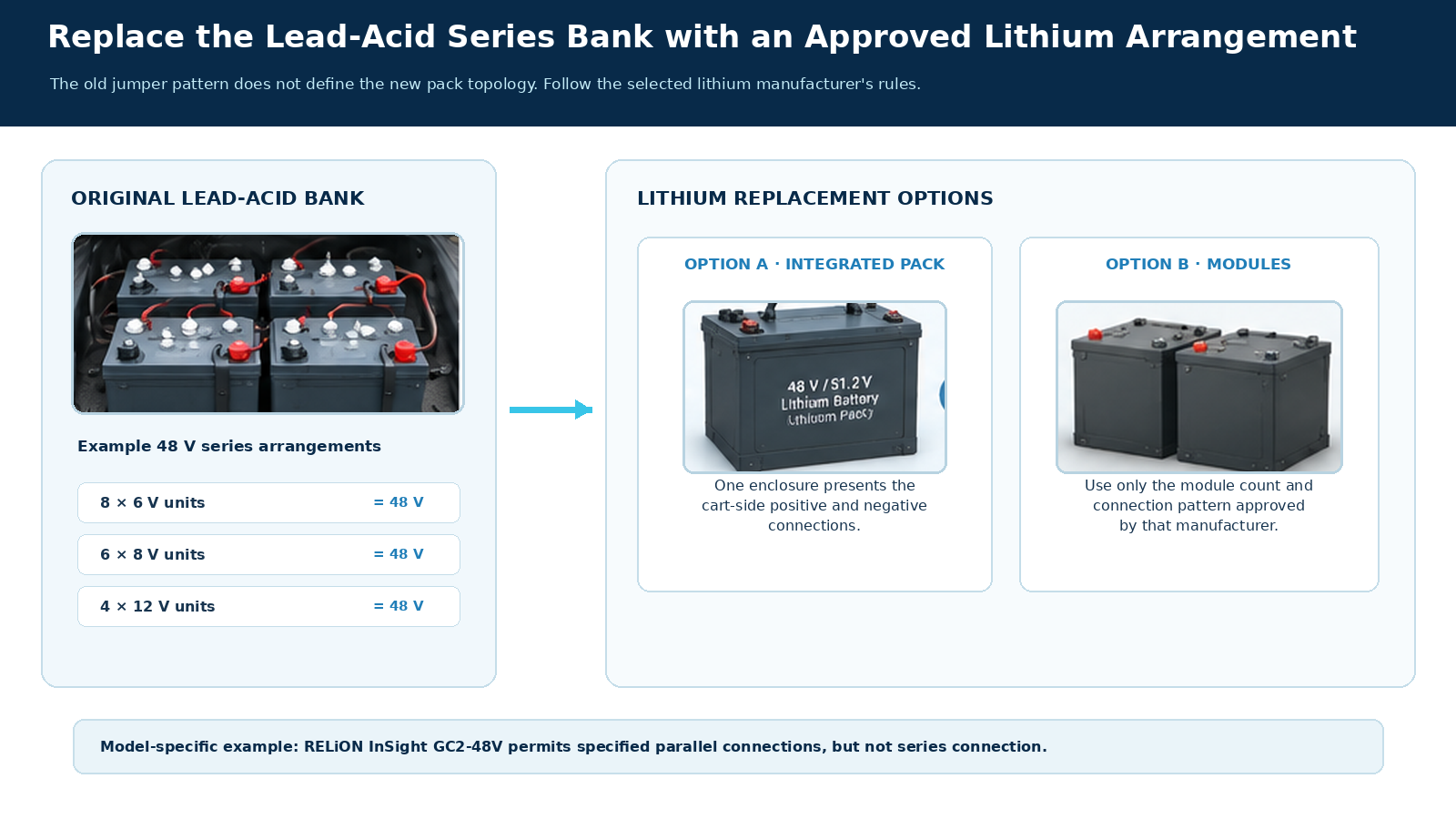
For example, Trojan's installation guidance shows that a nominal 48 V lead-acid system can be formed by eight 6 V, six 8 V or four 12 V units in series. The figures illustrate why counting batteries alone cannot identify the system voltage. In a series string, the unit voltages add. The cart's charger and drive components interact with the resulting bank, while the unit-to-unit jumpers make that bank internally. A conversion can keep the required cart-side voltage class yet remove all of those jumper positions if it uses an integrated pack. Conversely, a set of lithium modules may need a manufacturer-approved connection pattern of its own.
The original bay is part of the boundary too. Note which unit positions support the old hold-down, where the main cables enter, and how much clearance exists at the terminals and cover. A pack that is electrically suitable but cannot be restrained safely has not replaced the old bank's function. The existing charger location, receptacle and gauge are also relevant because they may have been chosen for lead-acid behavior. This is a map of interfaces, not a demand that every owner collect a large file before learning what a conversion involves: it shows why a battery-only invoice can miss necessary changes.
The new lithium arrangement may be one integrated pack or multiple modules connected only as their manufacturer permits. The old lead-acid series jumpers must not be copied into the lithium modules merely because both systems are described as 48 V. The permitted topology and current sharing depend on the selected product's design and protection system.
An integrated pack presents a main positive and negative connection to the cart. Its cells and protection are managed inside its enclosure; the installer does not recreate the external series string of old 6 V or 8 V units. A modular system can look physically similar to several battery units while following a different electrical rule. The named RELiON InSight GC2-48V battery, for example, is nominally 51.2 V and allows specified parallel connections, while its documentation does not permit connecting those modules in series. That is a rule for this named model, not a universal rule for all lithium products. It demonstrates why the pack maker's wiring architecture, not the old jumper pattern, controls the replacement arrangement.
Parallel compatible modules share a voltage class while adding available capacity when used within their stated limits. They also introduce questions about approved module count, cable arrangement and current sharing. A single larger pack removes module-to-module connections but brings its own main-terminal and enclosure requirements. In either case, the cart's current demand must fit the system's continuous and time-limited output ratings; nominal voltage alone is not a current rating. A category listing cannot establish a Wirentech series/parallel permission, cable size or terminal order, and the RELiON example cannot serve as instructions for another manufacturer.
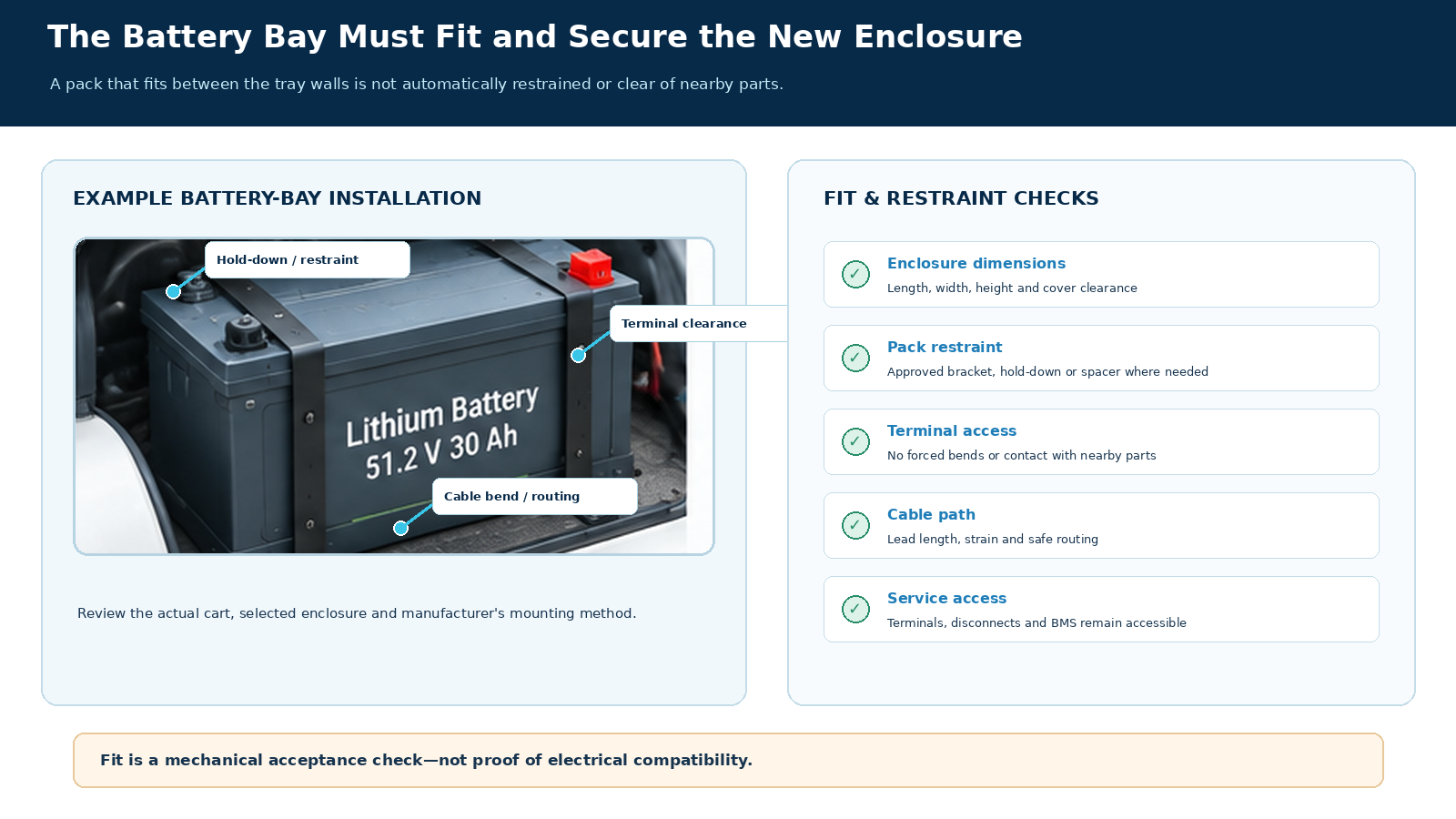
A different enclosure or module count changes how the battery occupies the tray, where its weight is held and how the terminals clear nearby parts. The converted battery must be restrained by a solution suitable for that specific battery and cart; a nominal voltage match says nothing about physical fit.
The old multi-unit bank may fill most of the bay. Its tray dividers and hold-down can keep individual cases in known positions. One integrated lithium enclosure may leave unused spaces or put terminals in a different location. Several modules might fit old GC2-sized positions, yet a vacant slot can make the old crossbar ineffective. The RELiON InSight product and installation FAQ provide a concrete example: the manufacturer publishes its module dimensions and discusses spacers or other precautions where an existing hold-down no longer secures the smaller arrangement. That does not establish the dimensions or mounting needs of a Wirentech product or any particular cart.
Think of fit in three dimensions rather than as a footprint alone. The enclosure must fit under the cover, but the cable lugs must also approach the terminals without forced bends or contact with moving or conductive parts. A hold-down must restrain the pack during use, not merely touch it while the cart is parked. The physical route of the main leads may change when terminals move; that can alter cable length and strain. The effect of a weight change on a cart should not be guessed from chemistry, since mass, placement and cart design vary by product.
A useful acceptance condition is visible restraint and clearance in the actual vehicle using the selected manufacturer's mounting method. If that method depends on a bracket or spacer, it is part of the conversion scope. If there is no documented way to secure the selected enclosure, the battery should not be treated as a drop-in conversion just because it fits between the tray walls. This is a spatial and mechanical change separate from charging and software behavior.
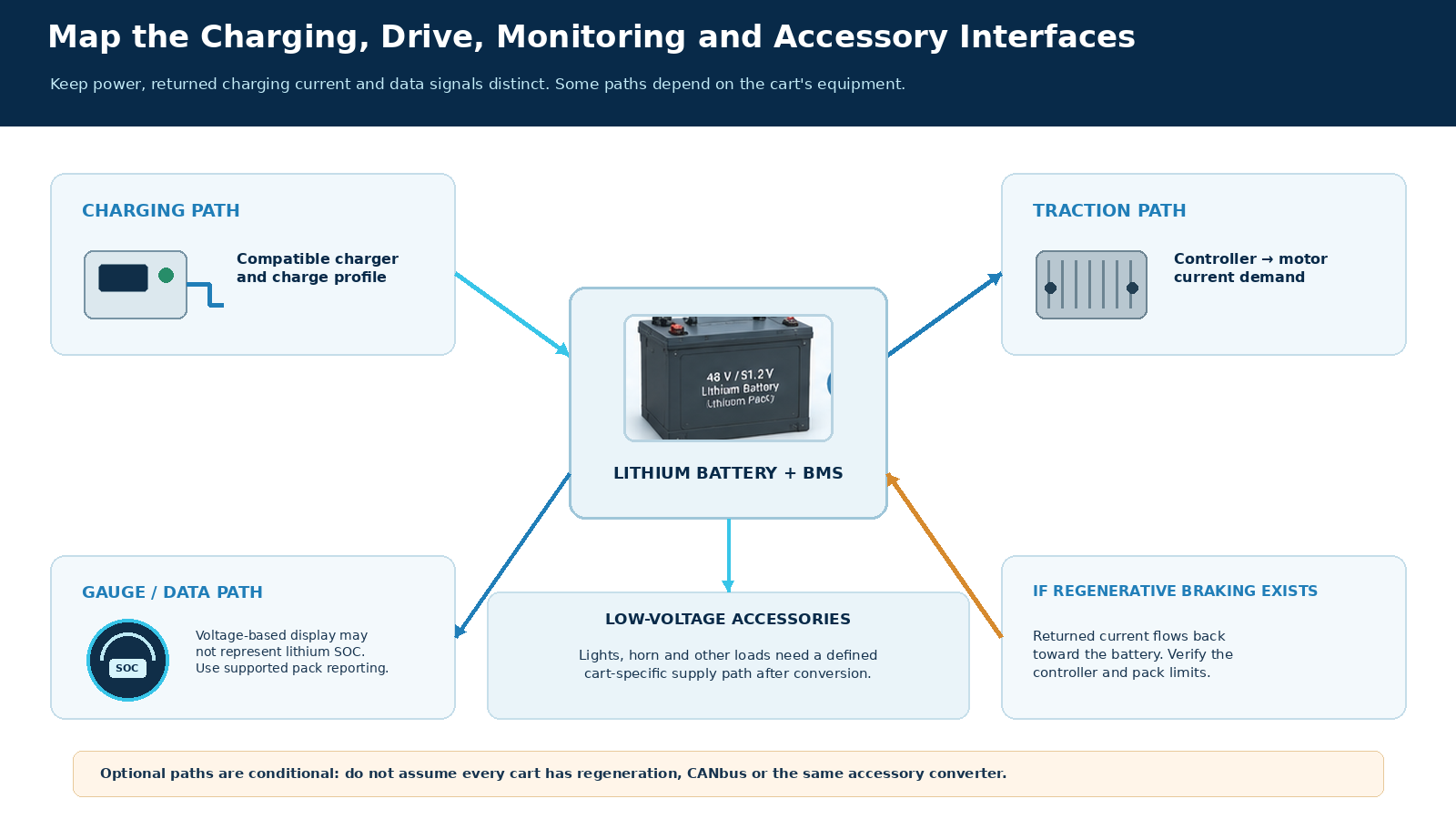
The charger must follow the selected lithium pack's voltage, current and temperature limits, while the cart's controller must operate without forcing the pack beyond its discharge or accepted charging behavior. An existing lead-acid charger program cannot be assumed suitable for a different chemistry merely because its nominal voltage class matches.
Charging has a physical path from the AC source through the charger, receptacle or on-board wiring to the pack. The selected battery may allow a particular peak voltage and charge-current range, and its protection may refuse charge under certain temperatures. For the named RELiON InSight module, the manufacturer specification distinguishes recommended charge current, a maximum continuous charge current, a peak charge voltage and a charge-under-temperature protection point. Those numbers are useful only for that product and stated configuration. Its low-temperature discharge boundary is different from its charging boundary, so a cart that can drive in a cold state may still be unable to accept a charge then. The answer is a compatible selected charger and use pattern, not a universal lithium setting.
Lead-acid charging rules serve different needs. Trojan's maintenance instructions describe lead-acid charging and flooded-battery equalization and gassing considerations. Carrying over that program without checking the selected lithium pack risks an inappropriate charge profile. The charger may need a different algorithm, a replacement unit or a model-specific configuration. The correct choice depends on the actual charger and pack, and the conversion cannot be called complete while that path is unresolved.
The drive side has another path: the pack supplies traction current to the controller and motor. Some carts also return energy through regenerative braking. That returned current enters the battery as charging current, even though the cart is moving. RELiON's model guidance addresses regeneration for its own BMS; it does not prove every cart regenerates or that another BMS accepts the same current. A cart without regeneration has no such returned-current path. A cart with it needs controller behavior and selected pack limits to agree. Keeping traction, charging and control signals distinct prevents an apparently correct two-terminal connection from hiding a system conflict.
A lead-acid voltage-based gauge may no longer express lithium state of charge usefully, and low-voltage accessories still need a defined supply path after the traction bank changes. Neither issue can be settled by matching the traction battery's nominal voltage.
Voltage is not a universal fuel gauge. A display or controller that estimates remaining energy from lead-acid voltage behavior can give a misleading indication when the battery chemistry and discharge curve change. Some lithium systems report state of charge through a dedicated display or data connection. The RELiON InSight documentation describes CANbus reporting of voltage, current, state of charge and state of health, plus named cables and a wake-up button for its system. That is an example of a model-specific monitoring interface, not evidence that every cart has CAN or requires that exact part. The converted system should show the information its selected pack and cart design intend to provide.
Lights, horns or other low-voltage accessories are a separate electrical load. Their supply might come through a converter or another cart-specific arrangement. Removing a lead-acid string or changing bank connections can disturb that path, but the sources reviewed do not establish any particular cart's converter wiring. The essential relationship is that auxiliary power must remain available and properly bounded after the traction system changes. Treat the accessory path as conditional: if the cart has these loads, identify how the selected conversion supplies them and test that they work in their intended states. Do not draw a universal converter into every golf-cart diagram or claim a named accessory circuit has been verified without its vehicle documentation.
A workable conversion scope connects the selected pack architecture to its restraint, charging, drive/control, monitoring and accessory interfaces. Stating only the pack's nominal voltage and capacity leaves several independent completion conditions unanswered. Each interface should have a selected design and an observable sign that it works in the actual cart.
| Interface | Existing lead-acid arrangement | Potential lithium change | Completion sign or condition |
|---|---|---|---|
| Bank topology | Multi-unit series links form the cart-side bank | One integrated pack or only manufacturer-approved modules | Main polarity and topology follow the selected pack design |
| Bay restraint | Old units fill defined slots under a hold-down | Different enclosure or vacant slots can need bracket or spacer | Pack is secured and terminals have clearance |
| Charging | Lead-acid charger program serves the old bank | Selected lithium pack may need a different profile or charger | Charger accepts the pack within its stated operating limits |
| Control and regeneration | Controller draws traction current; some carts return charge current | BMS and controller behavior must agree where regeneration exists | Relevant operating and returned-current states are accepted |
| Gauge | Old display may infer state from lead-acid voltage | Selected pack may supply dedicated SOC reporting | Intended display or data path works for the selected system |
| Accessories | Low-voltage loads have an existing supply route | Supply route may need to be retained or changed | Accessories work through their intended operating states |
The table is a scope check, not a wiring recipe. These interfaces interact. For example, a new charger might require a receptacle or harness change; an altered module count may change the hold-down and cable path together. A Trojan vehicle-specific lithium bundle guide shows brackets, charger, receptacle, gauge and harness as separate model-dependent components. A given cart may not need every item in that guide, but its breakdown explains why an incomplete parts selection can leave the battery electrically present and the vehicle still not ready for service.
With the required interfaces defined, the reader can browse Wirentech's golf-cart lithium battery category for possible pack classes. The listing does not establish a matching bracket, charger profile, controller response or harness for this cart.
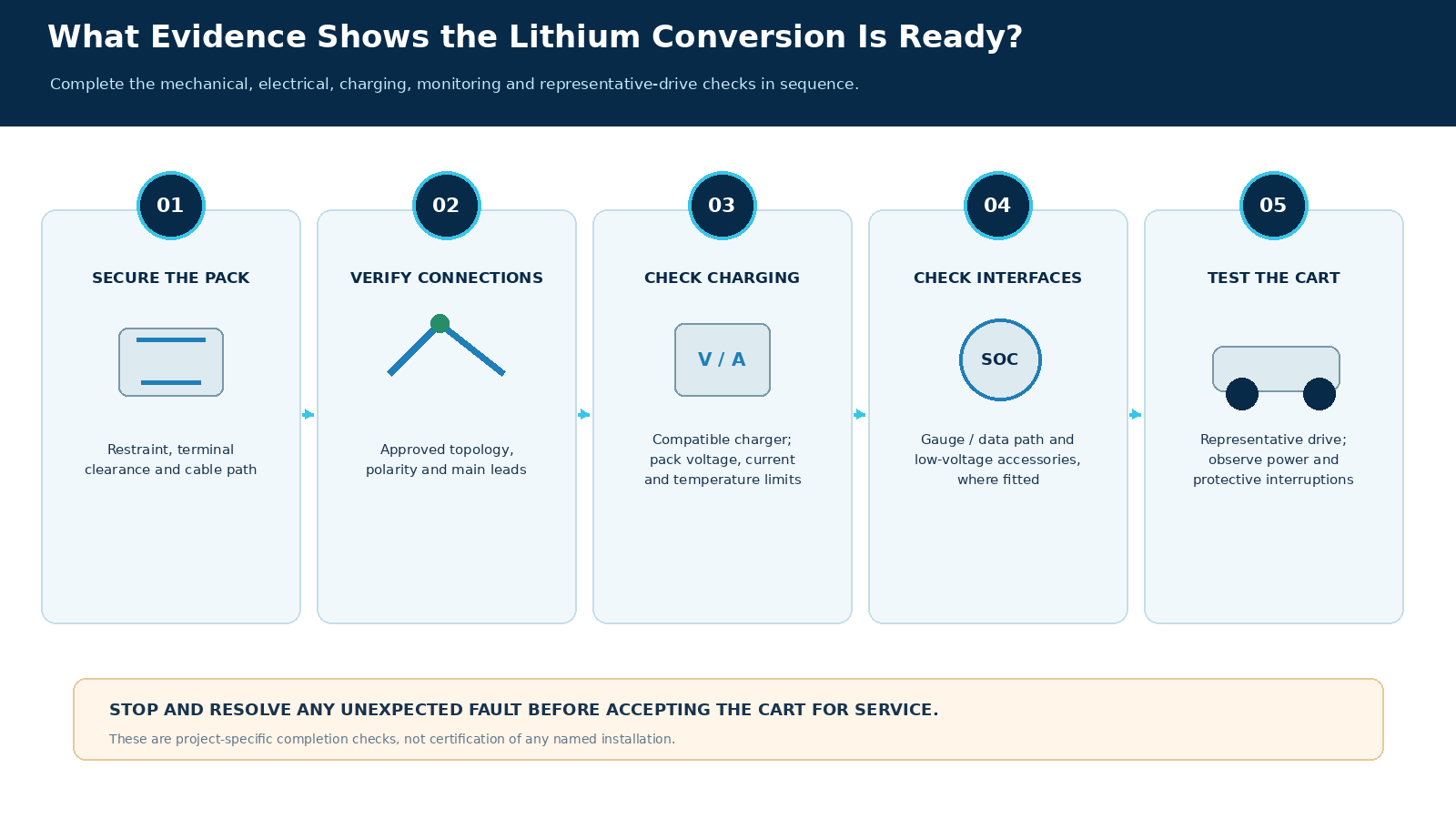
The conversion is ready only when the selected pack is mechanically secure, connected in its approved topology and polarity, charged within its limits, recognized by the relevant control and monitoring interfaces, and able to serve a representative drive without an unresolved fault. These are completion checks for the chosen cart and pack, not a claim that any specific installation has passed them.
The order matters because a failed early interface invalidates a later demonstration. Verify restraint and terminal clearance before energizing; a loose enclosure or strained lead should be corrected before a drive test. Check the selected charging path and any protection response under the actual temperature and charger conditions. Then check that the gauge or communications path, where fitted, reports as intended and that low-voltage accessories work. Finally, use a controlled load appropriate to the cart and pack to observe whether the system delivers power without an unexpected protective interruption. A stop or alarm should lead back to its specific interface rather than an assumption that the battery chemistry is defective.
The RELiON model guidance and Trojan bundle breakdown illustrate model-specific acceptance needs, but neither certifies a different manufacturer's conversion. A full commissioning protocol may add measurements and procedures for the selected cart and pack.
Related News

Nov. 07, 2026
Can a Home Battery Start and Run High-Surge Household Loads?
Learn why battery kWh alone cannot prove motor-start backup. Compare inverter surge duration, running demand, simultaneous loads and a supervised backup test.

Nov. 07, 2026
How Much Home Battery Capacity Is Needed for Essential Loads?
Calculate home battery capacity from essential-load power, duty cycle and outage hours. See a transparent kWh example and avoid double-counting losses.

Nov. 07, 2026
How Should a Home Battery Specification Sheet Be Read for Backup and Daily Use?
Compare home battery capacity, usable energy, continuous and peak output, charging limits and rating conditions before judging daily use or backup claims.

Nov. 06, 2026
Whole-Home Battery Backup or Critical-Load Backup: Which Scope Fits the Home?
Compare whole-home and critical-load battery backup by protected circuits, peak power, outage duration and load control to choose a realistic home backup scope.
Nov. 06, 2026
Can a Home Battery Provide Backup Power Without Solar Panels?
A home battery can provide backup without solar if grid charging, outage isolation and backup circuits are configured. Learn what limits runtime and recharge.

Nov. 06, 2026
How Does a Home Battery Storage System Work for a Household?
Follow the energy path through a home battery, inverter and controls. Learn how charging, daily discharge and outage backup differ before comparing systems.

Nov. 06, 2026
How Can A Weak Battery Be Distinguished From A Weak Golf Cart Battery Bank?
Compare like-conditioned unit and bank readings to separate one weak battery from broad bank loss, charging shortfall or connection trouble.
Nov. 06, 2026
How Should A Replacement Golf Cart Battery Bank Be Planned?
Decide whether one unit or the bank needs replacement, then specify voltage, fit, connections and first-charge checks before ordering.
Nov. 06, 2026
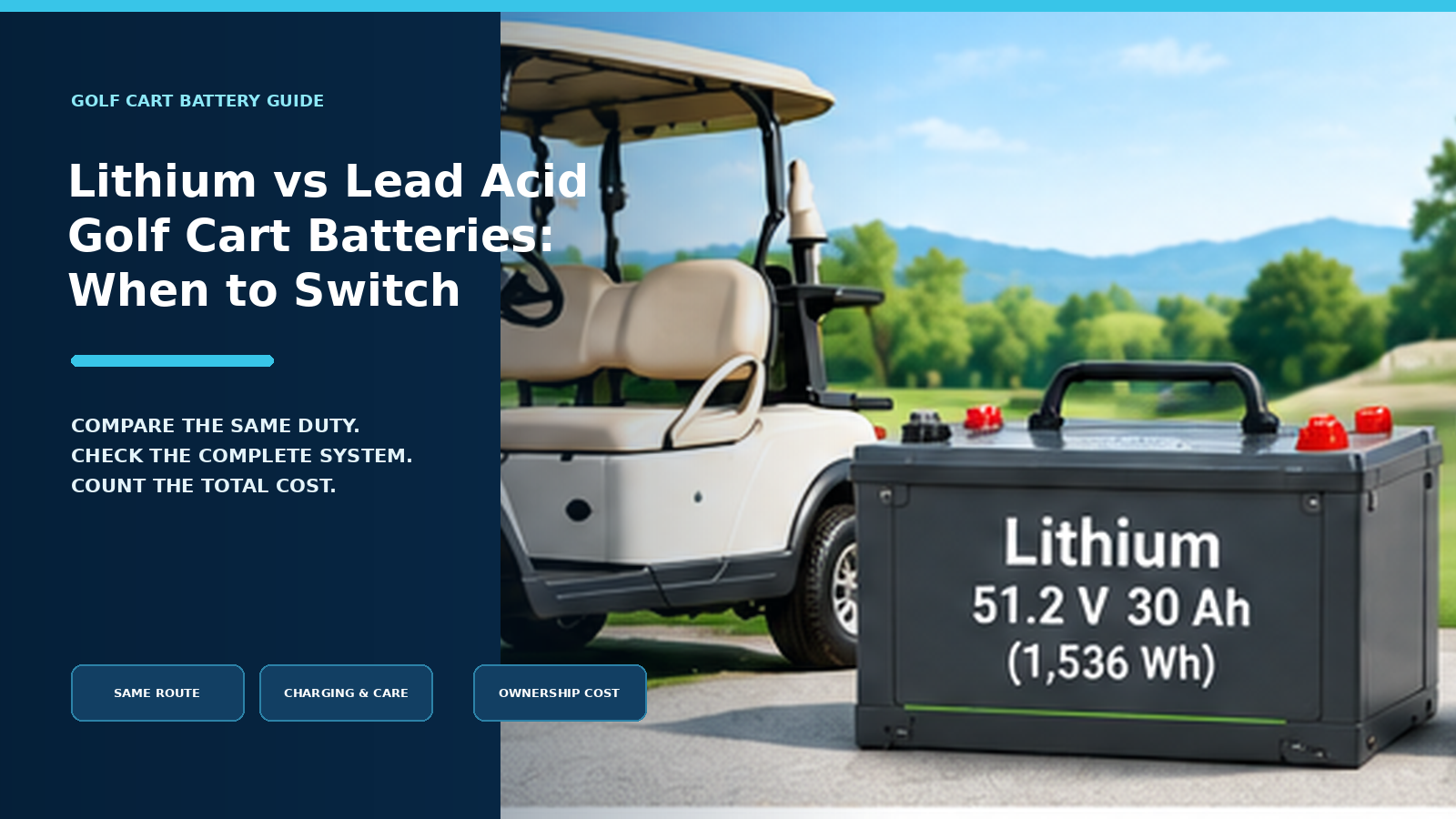
When Does Lithium Make Sense Instead Of Lead Acid For A Golf Cart?
Compare lithium and lead acid for the same golf-cart duty, charging routine, maintenance capacity and ownership horizon before deciding whether a switch is worthwhile.

Nov. 06, 2026
How Can Peak Current Demand Be Matched To A Golf Cart Battery?
Compare a golf cart’s acceleration and hill-load current by duration with battery continuous, pulse and protection ratings under matching conditions.

Nov. 06, 2026
How should a golf cart battery be sized for route energy and reserve?
Use measured route energy, usable battery capacity and a defined return reserve to plan golf cart battery size without treating Ah as guaranteed range.