

Nov. 06, 2026
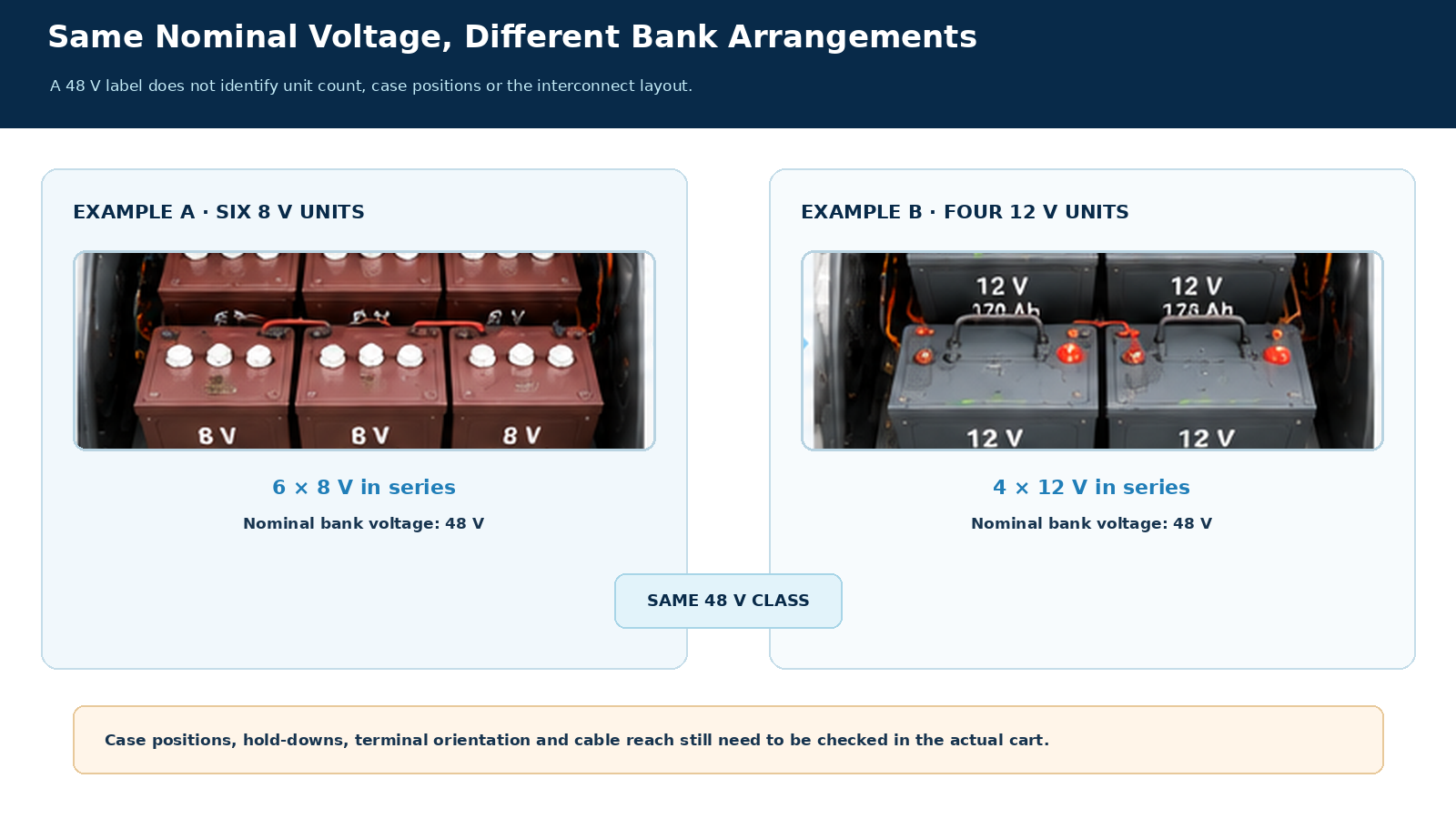
A replacement bank should be planned as one matched electrical and physical system. First decide whether the evidence points to one faulty unit or an aged set; then specify the series arrangement, capacity target, case fit, terminals, cables, retention and charger. The order is complete only when the new bank can be installed without improvising its connections and can be fully charged and checked against the cart's real duty. A 48 V label alone cannot make that decision: eight 6 V batteries, six 8 V batteries and four 12 V batteries can all create a nominal 48 V series bank, yet occupy different spaces and require different interconnects. Trojan's installation guidance illustrates those arrangements. A chemistry change adds further charging and control interfaces to the replacement plan.
Replace only an isolated failed unit when comparable testing supports that finding and the remainder of the set still has useful life; plan a matched whole-bank replacement when the set is broadly worn or no single unit explains its poor service. The distinction matters because one new battery cannot restore capacity already lost across the other units. Conversely, replacing an otherwise healthy set because one connection or one unit failed wastes serviceable batteries.
Begin with the condition in which the complaint occurred. A cart that returned from a route with short range might simply have started undercharged. A charged set that weakens under a repeatable load is more informative. The Exide golf-cart maintenance guide advises charging and testing a relatively new poor-performing set before discarding it, because one unit may be responsible. Its six-unit example compares unit voltages under a common load, then considers whole-set discharge performance when no individual failure is found. Those are examples for the batteries and method in that guide, not universal thresholds for every chemistry or cart.
A local outlier is useful only if its connections and test conditions are comparable. A loose or corroded link can produce a local voltage loss that resembles a weak battery. If a charger has not completed its intended cycle, a low set voltage says little about remaining capacity. These distinctions determine whether the order covers one unit or the set.
As the other units age, a single replacement is less likely to give a balanced result. Units in a series string carry the same current, so a new unit must operate beside the older ones; the new unit's rating does not erase their reduced capacity or different charge response. Exide advises using batteries of comparable age when one or two units in a set are replaced. That guidance makes partial replacement a conditional option, not a rule that any weak unit should be swapped alone.
Suppose one unit is clearly abnormal in a recent set, the others perform consistently and a suitable matching unit is available. A partial order may be reasonable. If all units shorten the route together, or the only available unit differs materially from the set, the decision shifts toward a matched bank. This example describes a reasoning path, not an observed cart result. Record why the scope was chosen: an isolated defect, broad loss, or a result still too uncertain to support either order. An uncertain result should lead to another controlled check before purchase, rather than a guessed unit count.
The replacement must satisfy the cart's required system voltage and the intended series configuration, while its usable capacity and charge behavior must fit the job. Nominal voltage is the first boundary, not the whole specification. The old bank might be eight 6 V units, six 8 V units or four 12 V units in series for the same 48 V class. Count and read the installed units and trace the series path between bank endpoints before ordering. Trojan's installation examples show why a single voltage label does not identify the unit arrangement.
Series wiring adds unit voltage; it does not multiply the ampere-hour rating by the number of units. If six identical 8 V, 170 Ah units are connected in series, their nominal total is 48 V while the string remains a 170 Ah string under the rating conditions used for those units. That arithmetic is an illustrative calculation, not a claim that the cart contains that rating or will deliver a particular distance. A second, manufacturer-approved parallel string changes the capacity architecture, but it also changes cables, balancing and current paths; it cannot be assumed from a photograph of a similar cart.
The existing chemistry and charger are part of the electrical specification. A charger intended for one battery type or a different unit count may reach the wrong endpoints or fail to complete its program. Trojan's charger-selection guidance treats charger choice as dependent on the battery system. A like-for-like replacement can often retain a known matching charge setup, but the selected replacement's actual charging instructions still govern. Identify the intended program before ordering the bank because a mismatched charger can defeat an otherwise coherent replacement.
The plan should name what is being preserved and what is intentionally changing. Preserving nominal voltage while changing unit height may be electrically coherent yet physically impossible. Preserving the case size while choosing a substantially different rated capacity might change useful route margin. A chemistry conversion is a different project because the pack, controller, charger, monitoring and sometimes accessory interfaces may change together. A bank-replacement plan should not silently become that project merely because a lithium product appears in a catalog.
The old capacity is a useful starting point when the cart's route, load and charging opportunity have remained satisfactory; it is a poor target when the duty has changed or the old bank had inadequate margin. A rated Ah value also belongs to a particular discharge test and battery model. Compare it with the replacement under appropriate conditions instead of treating the printed Ah numbers as an automatic like-for-like match. Exide's guide uses set testing to distinguish poor service from a named unit fault, while the old bank's service record tells the owner whether its original capacity served the route.
For a cart that consistently finished its required duty with useful charge remaining before the bank aged, a similar bank is a defensible baseline. For a cart that always needed an unplanned midday charge, ordering the same nominal capacity merely reproduces that limitation. A longer route, heavier payload or changed operating temperature can alter the energy needed even though the cart's nominal voltage does not. Capacity sizing deserves its own route-energy calculation; here the practical order specification states whether the old capacity remains the target, needs an evidence-based adjustment, or is unresolved pending a real duty measurement. Do not infer a universal reserve percentage from the old nameplate.
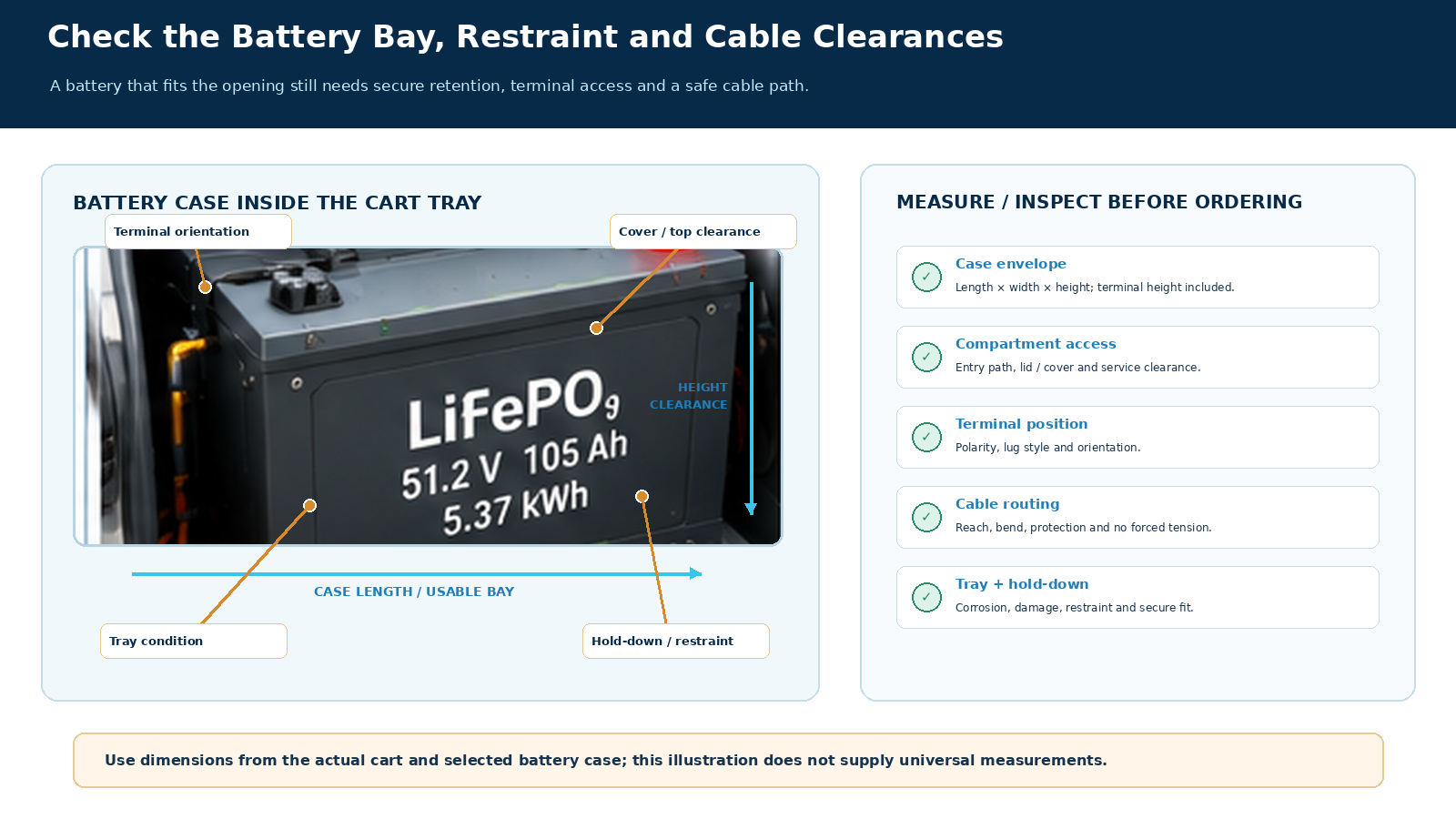
Specify the battery case envelope and compartment clearance, terminal style and orientation, cable and interconnect arrangement, plus tray and hold-down condition. These are part of compatibility: a bank with the right nominal voltage cannot be safely fitted by forcing cables across sharp edges or allowing cases to move. Exide's installation guidance calls for inspecting the tray, restraints and connectors and for recording the old arrangement before removal.
Measure the usable bay, not merely the outside of one old case. Allow for the way each battery enters the compartment, the height of terminals and covers, cable bend and service access. The relevant dimensions come from the actual cart and the chosen case; a generic diagram can show what to measure but cannot supply those values. Terminal choice should follow how the specified cable lugs can seat and be protected. A terminal on the opposite side may turn an apparently equivalent battery into an awkward cable-routing problem. Do not solve a short cable by stretching it over a cover or substituting a connector without a suitable electrical and mechanical design.
Retention is equally concrete. The hold-down must restrain motion over bumps without cracking a case. Frayed, broken or loose cables and connectors should be addressed as part of the replacement rather than inherited as if they were batteries. Trojan's maintenance instructions also emphasize secure, clean connections. Specific fastening torque and installation details must come from the chosen equipment instructions; there is no universal number to add to a general plan.
| Bank-order dimension | Existing-bank finding | Replacement specification | Why it changes the order |
|---|---|---|---|
| Series architecture | Count units and read each nominal voltage | Preserve required bank voltage and intended series count | A 48 V bank may use 8×6 V, 6×8 V or 4×12 V units. |
| Case and retention | Measure bay, clearance and hold-down; inspect damage | Choose cases that fit and can be restrained without cracking | A correct electrical rating does not establish physical fit. |
| Terminals and cables | Record polarity, lug style, cable route and connector condition | Match the selected terminal option and replace unsound links | An opposite terminal or worn link changes installation and loss. |
| Charger | Identify the existing battery type and charge program | Use the selected bank's approved charge profile | Nominal voltage alone does not establish charge compatibility. |
The table converts four distinct observations into one order specification. It does not replace the reasoning that a series bank shares one current path or that a physically insecure bank can fail even when its nameplate matches. Use it as the final set of order dimensions, rather than repeating each row as a separate shopping list.
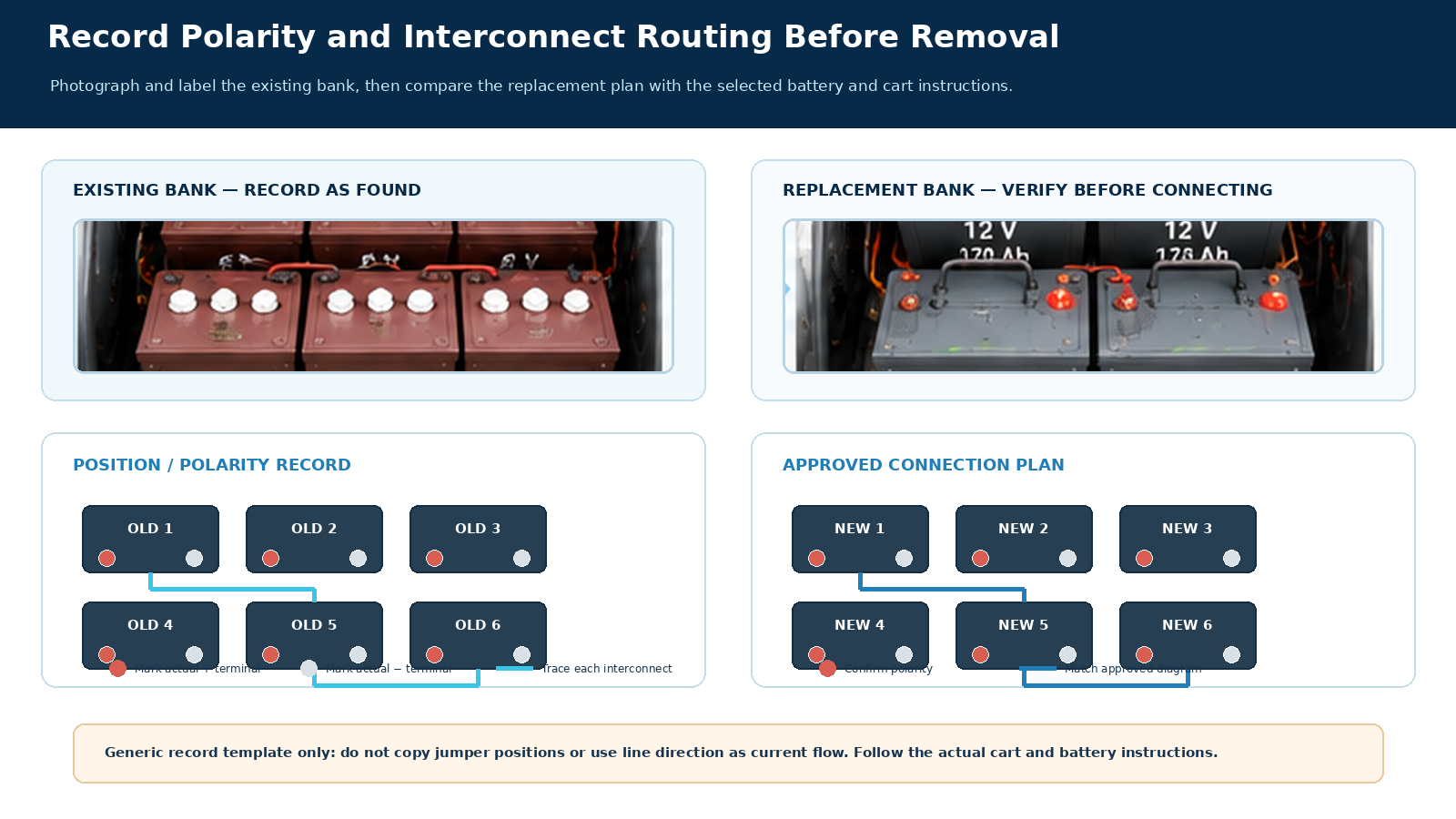
A record of polarity, unit positions and interconnect order prevents an apparently simple replacement from reversing a link or leaving a cable with no safe route. Exide recommends recording the existing positions and cable routing. The owner can mark bank endpoints and photograph the intact arrangement before disturbing it, then compare the new connection plan with the cart and chosen battery instructions. A photograph is a reference to the old system, not proof that a different pack should copy every jumper.
This matters most when identical cases occupy a tray in several rows. A cable that looks like a harmless jumper may be the one connecting two series segments; reversing a position can change polarity or leave the bank incomplete. The order should include the right number and form of interconnects and replacement for any visibly compromised piece. The detailed installation sequence belongs to the actual cart and battery instructions, but the purchase plan can already prevent missing hardware and improvised cable runs.
Accept the replacement only after it is securely installed, charged with the selected bank's appropriate program and shown to meet a representative cart duty without an abnormal unit or connection response. Exide instructs that its new batteries receive a full charge before first use. This is a model-scoped instruction; its duration and numerical thresholds should not be copied to every replacement chemistry.
Acceptance has an order because each stage rules out a different failure. Before energizing, the assembled bank should match the planned polarity and series path, cases should be restrained, and cables should be protected from rubbing or heat. During the first charge, the charger should run the program approved for the bank and reach its stated completion condition without a recurring alarm or abnormal heating. After charging, compare bank and unit behavior where the selected battery permits that measurement; a single outlier under comparable conditions is more useful than an isolated open-circuit number. Finally, use the cart on a representative route and note whether the service outcome resembles the duty for which the bank was selected. Those are distinct checks of installation, charging and useful operation, not three ways of asking whether the battery is “good.”
The acceptance evidence should fit the battery type. A vented flooded set can have maintenance and cell-level observations unavailable on a sealed lithium product; a lithium module may provide its own status information. Do not open a sealed case or apply flooded-cell methods to a closed pack. The chosen manufacturer instructions define safe measurements, completion indications and service actions. If the charger never completes, the issue might be the charger program, input power, connection or battery state; a no-charge diagnostic path should be followed rather than labeling the new bank defective from one symptom.
A representative route check is also conditional. If the cart now carries a different load or travels farther than before, a shortfall cannot be interpreted against the former duty without adjustment. If it runs the required trip but returns with little margin, that may expose an undersized target rather than a defective new set. The acceptance result should therefore be compared to the stated route and reserve objective, not a promised universal range. A product listing can show what models exist, but it cannot substitute for this observed service result.
The order is ready when its replacement scope, electrical bank design, physical interfaces and first-charge responsibility form one coherent specification. If the original diagnosis identifies one weak unit, state why the rest of the set remains suitable for partial replacement and whether a comparable-age unit exists. If the set is broadly weak, specify the complete matched set. For either path, state required nominal voltage, unit count and configuration, chosen case and terminal option, cable work, restraint and matching charger. This is the point where separate observations become a purchase decision.
Some unknowns change the actual item ordered. An unmeasured compartment can defeat case selection; an unidentified charger program can defeat acceptance; an undocumented vehicle modification can change the intended bank topology. Resolve these for the named cart before buying rather than guessing from a 48 V badge. If a seller lists several batteries, browsing a category is a next step only after these constraints are understood; the category itself cannot certify fit.
Related News

Nov. 07, 2026
Can a Home Battery Start and Run High-Surge Household Loads?
Learn why battery kWh alone cannot prove motor-start backup. Compare inverter surge duration, running demand, simultaneous loads and a supervised backup test.

Nov. 07, 2026
How Much Home Battery Capacity Is Needed for Essential Loads?
Calculate home battery capacity from essential-load power, duty cycle and outage hours. See a transparent kWh example and avoid double-counting losses.

Nov. 07, 2026
How Should a Home Battery Specification Sheet Be Read for Backup and Daily Use?
Compare home battery capacity, usable energy, continuous and peak output, charging limits and rating conditions before judging daily use or backup claims.

Nov. 06, 2026
Whole-Home Battery Backup or Critical-Load Backup: Which Scope Fits the Home?
Compare whole-home and critical-load battery backup by protected circuits, peak power, outage duration and load control to choose a realistic home backup scope.
Nov. 06, 2026
Can a Home Battery Provide Backup Power Without Solar Panels?
A home battery can provide backup without solar if grid charging, outage isolation and backup circuits are configured. Learn what limits runtime and recharge.

Nov. 06, 2026
How Does a Home Battery Storage System Work for a Household?
Follow the energy path through a home battery, inverter and controls. Learn how charging, daily discharge and outage backup differ before comparing systems.

Nov. 06, 2026
How Can A Weak Battery Be Distinguished From A Weak Golf Cart Battery Bank?
Compare like-conditioned unit and bank readings to separate one weak battery from broad bank loss, charging shortfall or connection trouble.
Nov. 06, 2026
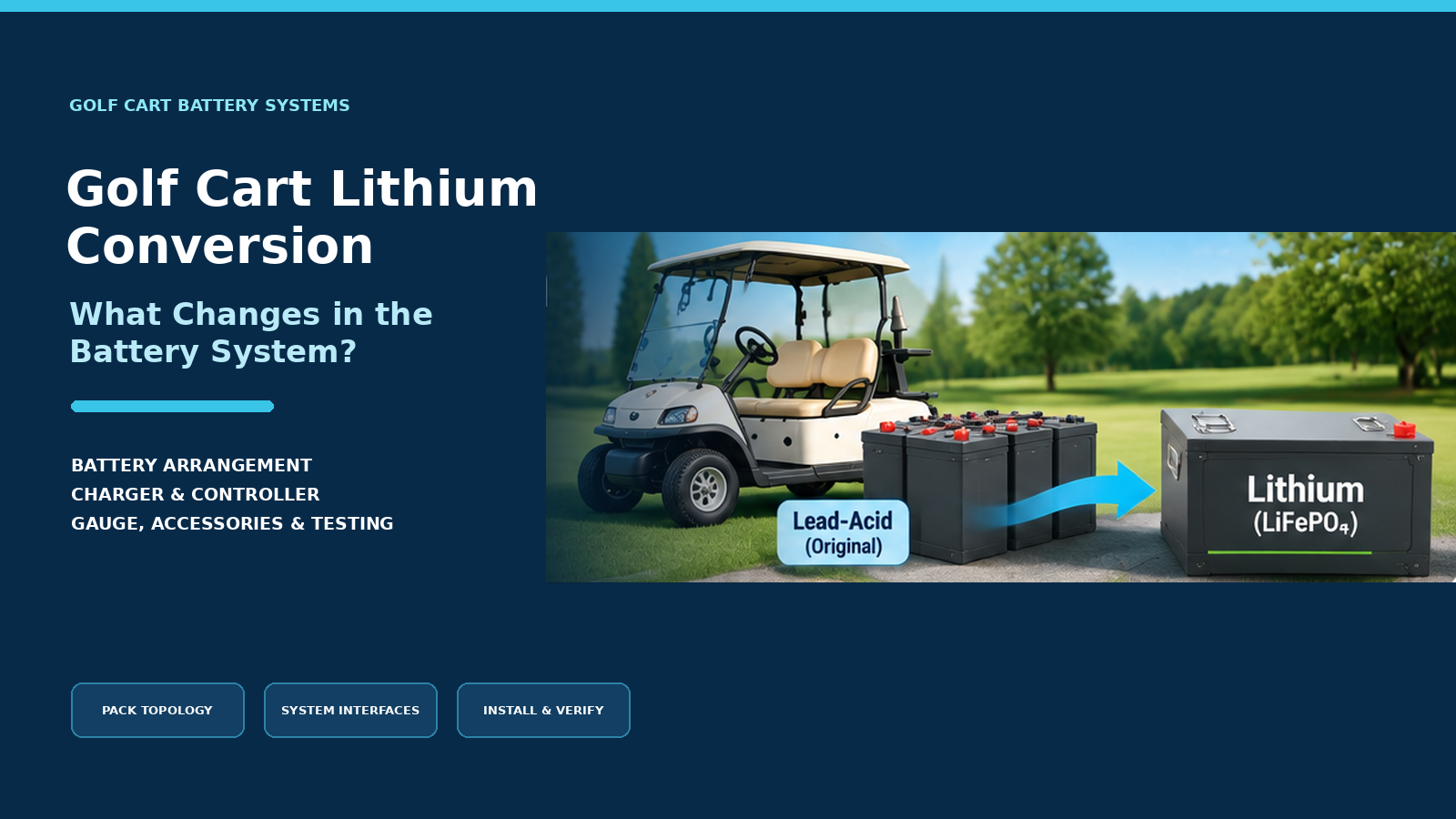
What Changes When A Golf Cart Battery Bank Is Converted To Lithium?
Map the battery bank, tray, charger, controller, gauge and accessory interfaces that change when converting a lead-acid golf cart to lithium.
Nov. 06, 2026
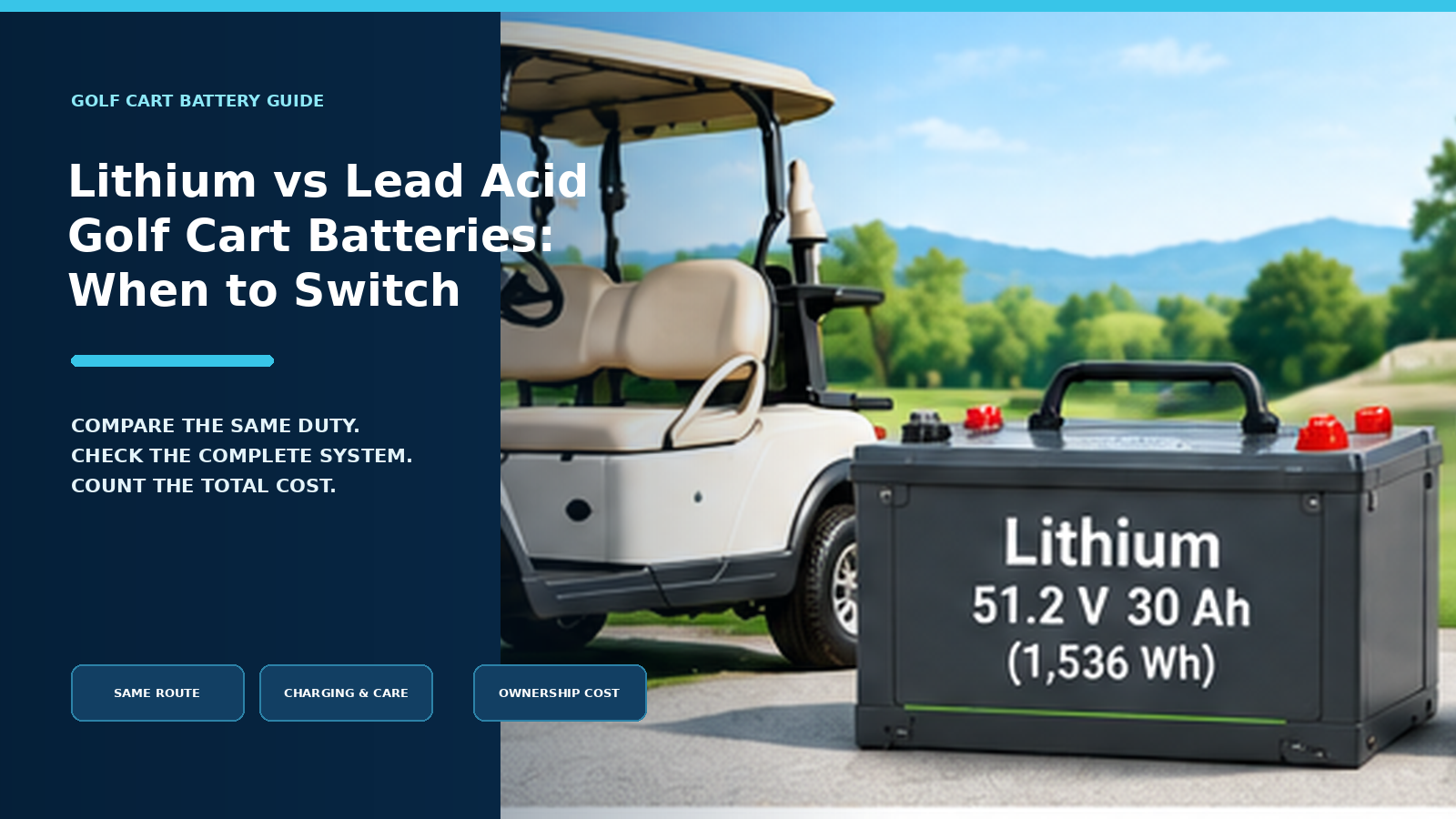
When Does Lithium Make Sense Instead Of Lead Acid For A Golf Cart?
Compare lithium and lead acid for the same golf-cart duty, charging routine, maintenance capacity and ownership horizon before deciding whether a switch is worthwhile.

Nov. 06, 2026
How Can Peak Current Demand Be Matched To A Golf Cart Battery?
Compare a golf cart’s acceleration and hill-load current by duration with battery continuous, pulse and protection ratings under matching conditions.

Nov. 06, 2026
How should a golf cart battery be sized for route energy and reserve?
Use measured route energy, usable battery capacity and a defined return reserve to plan golf cart battery size without treating Ah as guaranteed range.