

Nov. 06, 2026
Size a golf-cart battery from the energy the cart uses on a representative demanding route, then add a return or next-duty reserve and compare that total with the battery's usable energy under the same operating conditions. Nominal amp-hours alone cannot determine miles of range. A route that includes hills, heavy loads, stops, and low temperatures can consume more energy than a level, lightly loaded test. The useful result is a battery size that covers the actual duty with a defined margin, followed by a repeat-route check that shows whether the reserve remains when the cart returns.
The battery must cover the most demanding repeatable duty the cart is expected to complete before its next reliable charging opportunity, not an average trip that leaves out critical work. Define where the route begins and ends, what the cart carries, and whether it must immediately make another run. One long loop and two shorter loops without a full charge between them are one energy duty for sizing purposes. A rare excursion can be handled by a different charging or duty plan rather than silently inflating every pack specification.
That boundary makes an estimate useful. “Ten miles per charge” says little unless the cart, load, terrain, speed, stops, and weather match the intended service. Trojan identifies speed, terrain, elevation, and temperature as range influences. These are reasons to observe the cart's own energy use. Distance remains a helpful route descriptor, but watt-hours describe what the battery actually supplied. A fleet operator can compare routes with different lengths only after separating their energy demand.
Grade, acceleration, carried mass, speed, surface, and temperature can change the energy required to finish the same distance. A loaded hill climb asks the drive system to do more work than a level cruise; repeated stops spend energy rebuilding motion; higher rolling resistance can extend the period of high demand. Temperature can affect both vehicle energy use and what the battery can deliver. These factors do not justify a universal multiplier. They identify which trips should be included in a representative sample.
Record battery-pack voltage and current over the route and integrate their product over time to estimate watt-hours delivered. In short intervals, energy is approximately voltage multiplied by current multiplied by elapsed hours; summing the intervals captures changes during hills, stops, and cruising. A battery monitor that reports energy removed can serve the same purpose if it measures the relevant pack and its reading is understood. Record the start and finish state as well as any opportunity charge between runs so that two unlike trips are not compared as if they began alike.
A single reading of current at rest, or a voltage displayed after parking, cannot describe the whole route. Current varies sharply during acceleration and grade changes, while the battery voltage varies with state and load. The energy record must include the complete duty boundary. Compare several runs that represent the intended operating pattern and keep a demanding repeatable run separate from unusual incidents. This is a practical measurement method, not a claim that every cart already has a precision logger. When no measurement is available, a rough estimate may guide an initial shortlist, but it cannot support a confident numeric battery-size conclusion for that route.
Start with nominal energy, usually nominal voltage multiplied by rated amp-hours, then account for the battery's specified discharge conditions and the portion of that energy the system can actually deliver before its operating limit. The RELiON InSight GC2 48V page gives 51.2 V and 30 Ah, yielding its published 1,536 Wh nominal capacity. That arithmetic is useful for comparing labels. It is not a promise that 1,536 Wh will be available at every current, temperature, age, or cutoff setting.
At the vehicle level, usable energy ends when the battery's protection operates, the controller reaches its allowed minimum input, or performance becomes inadequate for the required duty. The limiting point may change with load. A pack with adequate nominal Wh can still fail to complete a severe route if its current limit or loaded voltage cuts the duty short. Sizing therefore uses the usable window for the intended duty, not an assumed 100 percent of the label. The actual usable value should be obtained from suitable product data and a service check rather than a generic chemistry percentage.
Amp-hours are measured under stated discharge conditions, so equal Ah labels do not imply equal delivered energy under a different load. For one U.S. Battery 8 V model, the specification lists 155 Ah at a 20-hour rate but 129 Ah at a five-hour rate. It also lists 110 minutes at 56 A and 75 minutes at 75 A. Those are published bench conditions for that named unit, not a mileage prediction. They demonstrate that both rate and duration belong beside the number.
Voltage also enters energy. A 100 Ah label on a 36 V bank and the same Ah label on a 48 V bank describe different nominal watt-hours. Even at the same nominal voltage, two products may have different allowable discharge windows, current limits, or condition-dependent behavior. For a cart, the comparison is not “Which Ah number is bigger?” but “How much energy reaches the vehicle during the duty before a limiting condition is met?” That is why a route measurement and a product's applicable discharge information are more useful than a simple Ah-to-miles conversion.
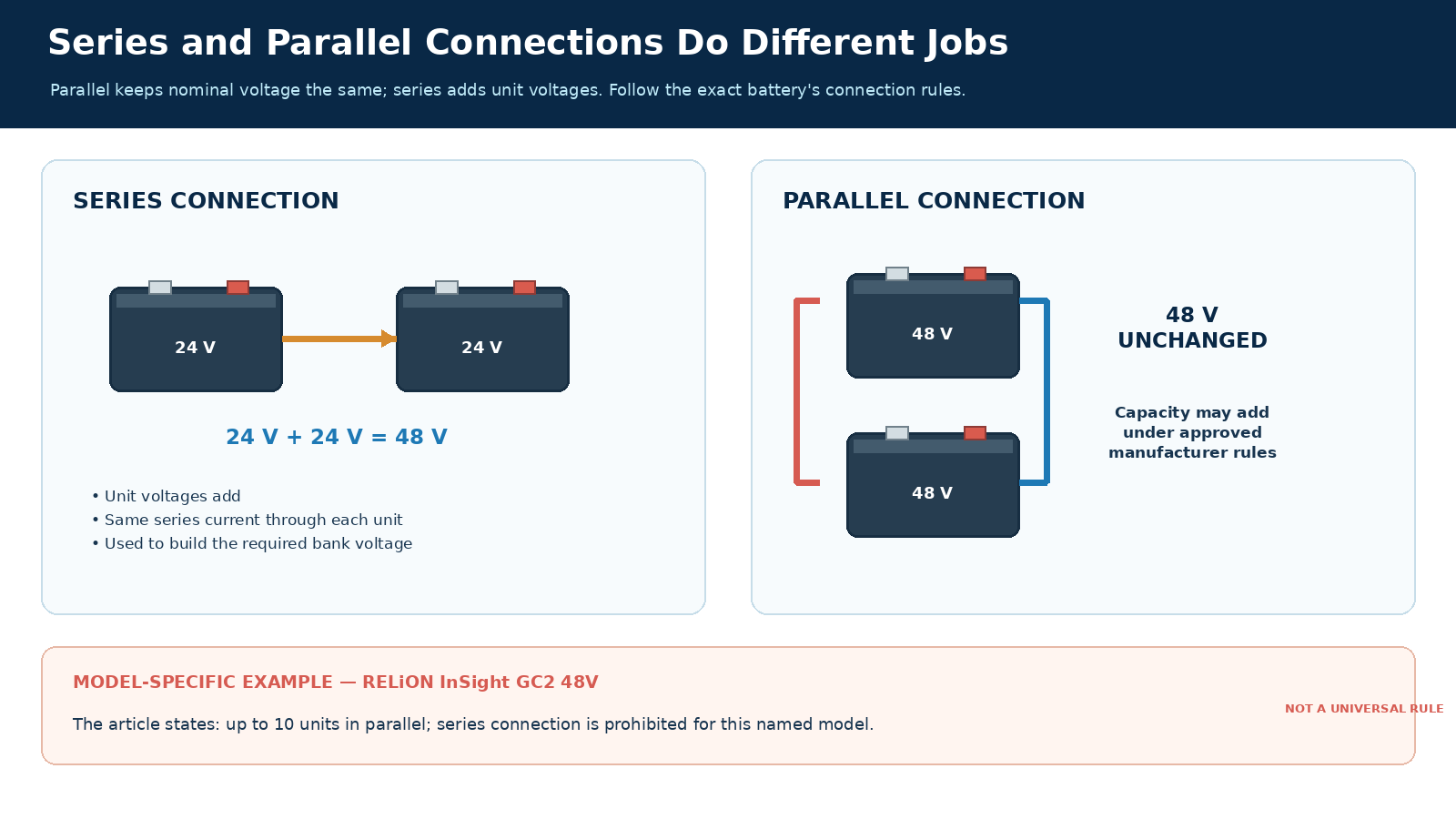
Apply the lower of the battery's permitted discharge boundary and the vehicle's practical operating boundary, under the current and temperature of the intended duty. A low-voltage protection value on a product page is a protective endpoint, not an amount of energy reserved for a safe return. The named RELiON model lists 44.8 V low-voltage protection, but another pack can have different limits and a cart may become unusable earlier under load. Do not subtract a universal percentage from every battery or treat a protection trip as an ordinary sizing target.
Reserve should cover the energy needed to complete an essential return or next scheduled duty after the measured route, with allowance for predictable variation. There is no defensible universal reserve percentage for every cart. A useful margin is tied to a real event: for example, getting from the farthest normal work point back to the charging location under a demanding load. Define that event in the same watt-hour terms as the route, then require usable battery energy to cover both the route and that margin.
Reserve is distinct from energy hidden beyond a protection cutoff. It is energy the vehicle can still use before the battery or controller reaches a boundary. A cart that finishes the course only because it approached a protective trip has not demonstrated a reliable reserve. Similarly, a nominal capacity calculation that exceeds route demand by a small amount does not prove adequacy if the route data represent an easy day. The reserve becomes meaningful only when its purpose and operating conditions are explicit.
The event is the longest necessary return or next-duty segment that must be completed when the cart has already used the planned route energy. Identify the point at which a cart might need to return, the remaining grade and load, and whether access to charging is assured. Measure that segment if possible. If the cart operates on a fixed loop, a return from its most demanding point is more concrete than a percentage selected because it sounds cautious.
This does not require every cart to carry enough energy for every imaginable detour. It requires a defined service outcome. A cart with guaranteed intermediate charging can have a different duty boundary from one that must work through an entire shift. The operator should decide whether slowing, unloading, or charging between runs is an acceptable operational response; if not, the battery must cover the full necessary duty. Reserve is thus a service decision translated into energy, not a chemistry label.
They can reduce the energy available at the same nominal size, so a candidate that barely passes when new and warm may leave too little margin later or in colder service. The amount depends on the particular battery and duty. A practical sizing check compares the demanding route against an appropriately conservative usable-energy case rather than adding several unsupported percentages for cold, age, hills, and “safety.” Double counting the same effect can make a specification meaningless; ignoring a routinely cold or heavily loaded route can make it fail.
Compare the demanding route's measured watt-hours plus the defined reserve with the candidate pack's usable watt-hours under the relevant discharge and temperature conditions. A candidate passes the energy screen only when the usable amount covers that combined demand with a credible starting charge. The same route and reserve must be used for every candidate; otherwise the table favors the product assigned an easier duty. Current capability and physical fit remain additional screens, but they should not be substituted for energy sizing.
When product information is limited to nominal voltage and Ah, calculate a nominal Wh starting point and mark the usable result as unresolved. Do not assign another product's discharge curve, range claim, or cutoff to it. The Wirentech golf-cart battery category can help a reader browse available product classes after the energy requirement is understood; its listings do not establish that a specific pack meets this route. A detailed comparison needs a selected pack's applicable limits and the measured route condition.
It covers them when its usable energy under the relevant duty is at least the energy of the representative route plus the defined remaining-service margin, with the cart starting at the assumed charge state. This is an energy comparison, not a promise of a particular distance. It also makes a failed candidate intelligible: either the pack cannot deliver enough usable energy for that duty, or the operating plan must change so the duty between charges becomes shorter.
| Duty case | Energy comparison | Decision |
|---|---|---|
| Representative measured route | Usable pack Wh must cover measured route Wh plus the defined return reserve | Keep the candidate only if the remaining usable energy covers the return event |
| Repeatable demanding route | Use that route's observed Wh, not mileage from a lighter route | Resize or change the duty plan if it fails |
| Cold, aged or next-duty case | Reassess usable energy or the required charging interval under that condition | Preserve the reserve in the condition that actually sets service risk |
The rows represent different service conditions rather than three separate formulas to add together. The same measured route can be re-evaluated with a different usable-energy assumption when temperature or age changes. If no reliable usable-energy basis exists for the proposed pack, nominal Wh cannot establish that the route and reserve will be covered.
A low return state means the nominal comparison did not capture the actual duty or usable window. Review the run's starting charge, delivered route energy, load and temperature before deciding whether the pack is undersized. A cart that began partly charged has less route energy available than the sizing case assumed; a steeper or more heavily loaded route may consume more than the representative trace. If those conditions are correctly represented and the reserve repeatedly disappears, the candidate size or charging plan is inadequate for that duty.
Run the cart through its intended duty with the selected battery, then compare energy removed and remaining usable margin with the sizing prediction. Validation is not an invented range claim: it is evidence from the actual cart, route, load, charging state, and environment. A size is operationally adequate when it repeatedly completes the necessary route and retains the defined return or next-duty reserve without approaching the battery's or vehicle's limiting state. If it fails, identify whether energy demand, usable capacity, or charging opportunity differed from the plan.
A controlled comparison keeps the duty boundary clear. Note the start state and whether the charger completed its approved cycle. Record route Wh, distance and load or passenger pattern, and the return state. Repeat on comparable days, including a demanding normal day. This is more informative than comparing one cart's mileage with a marketing claim for another cart. If monitoring is unavailable, operational observations can still reveal an inadequate plan, but they cannot support a precise Wh conclusion.
Compare start charge state, route energy, route conditions, and remaining usable energy at the same return point. Those observations let an operator separate a higher-demand day from a change in available battery energy. Distance alone is insufficient when one trip carried more load or climbed more grade. A log should be short enough to use routinely: duty identifier, start condition, delivered Wh if available, and whether the reserve event could still be completed.
Revise the size or operating plan when repeatable intended duties consume the defined reserve, when the battery or cart reaches its limiting state before the required return, or when the assumed charging opportunity is unavailable. A larger usable-energy pack is one possible answer, but shortening the interval between charges or assigning a different cart to the severe route can also solve the same service problem. The choice depends on the required outcome, not on a universal Ah threshold.
Do not respond to one surprising trip by multiplying every estimate with an arbitrary buffer. Identify the changed condition first. If the normal route is consistently more demanding than the measured sample, update the route energy. If the pack's usable window was overstated, revise that side of the comparison. If cold or aging is the recurring difference, use the corresponding conservative case. The selected equipment and schedule must cover that revised duty with reserve still available at its critical point.
Related News

Nov. 07, 2026
Can a Home Battery Start and Run High-Surge Household Loads?
Learn why battery kWh alone cannot prove motor-start backup. Compare inverter surge duration, running demand, simultaneous loads and a supervised backup test.

Nov. 07, 2026
How Much Home Battery Capacity Is Needed for Essential Loads?
Calculate home battery capacity from essential-load power, duty cycle and outage hours. See a transparent kWh example and avoid double-counting losses.

Nov. 07, 2026
How Should a Home Battery Specification Sheet Be Read for Backup and Daily Use?
Compare home battery capacity, usable energy, continuous and peak output, charging limits and rating conditions before judging daily use or backup claims.

Nov. 06, 2026
Whole-Home Battery Backup or Critical-Load Backup: Which Scope Fits the Home?
Compare whole-home and critical-load battery backup by protected circuits, peak power, outage duration and load control to choose a realistic home backup scope.
Nov. 06, 2026
Can a Home Battery Provide Backup Power Without Solar Panels?
A home battery can provide backup without solar if grid charging, outage isolation and backup circuits are configured. Learn what limits runtime and recharge.

Nov. 06, 2026
How Does a Home Battery Storage System Work for a Household?
Follow the energy path through a home battery, inverter and controls. Learn how charging, daily discharge and outage backup differ before comparing systems.

Nov. 06, 2026
How Can A Weak Battery Be Distinguished From A Weak Golf Cart Battery Bank?
Compare like-conditioned unit and bank readings to separate one weak battery from broad bank loss, charging shortfall or connection trouble.
Nov. 06, 2026
How Should A Replacement Golf Cart Battery Bank Be Planned?
Decide whether one unit or the bank needs replacement, then specify voltage, fit, connections and first-charge checks before ordering.

Nov. 06, 2026
What Changes When A Golf Cart Battery Bank Is Converted To Lithium?
Map the battery bank, tray, charger, controller, gauge and accessory interfaces that change when converting a lead-acid golf cart to lithium.

Nov. 06, 2026
When Does Lithium Make Sense Instead Of Lead Acid For A Golf Cart?
Compare lithium and lead acid for the same golf-cart duty, charging routine, maintenance capacity and ownership horizon before deciding whether a switch is worthwhile.

Nov. 06, 2026
How Can Peak Current Demand Be Matched To A Golf Cart Battery?
Compare a golf cart’s acceleration and hill-load current by duration with battery continuous, pulse and protection ratings under matching conditions.