

Nov. 07, 2026
The required home battery capacity is the energy your selected essential loads will actually use during the outage window, adjusted to the capacity boundary and starting charge of the proposed system. Add each load's power over the hours it will operate; then account for realistic cycling, conversion losses and energy that will not be available at the start or end of the event. There is no reliable universal “one day of backup” battery size. Two households with the same monthly bill can need very different backup energy because their protected circuits and outage-time behavior differ. NREL's resilience analysis identifies stored energy at outage start, critical load and PV availability as separate runtime inputs.
This method begins after the household has chosen which functions count as essential. It produces a transparent energy range for an installer or supplier to test against an actual system. It does not decide whether every appliance should be on backup, or establish that the battery/inverter can start a particular motor. Capacity in kilowatt-hours (kWh), output in kilowatts (kW), and an outage-capable electrical design are separate requirements. A correctly calculated kWh number is useful only when those other requirements are addressed in the installed configuration.
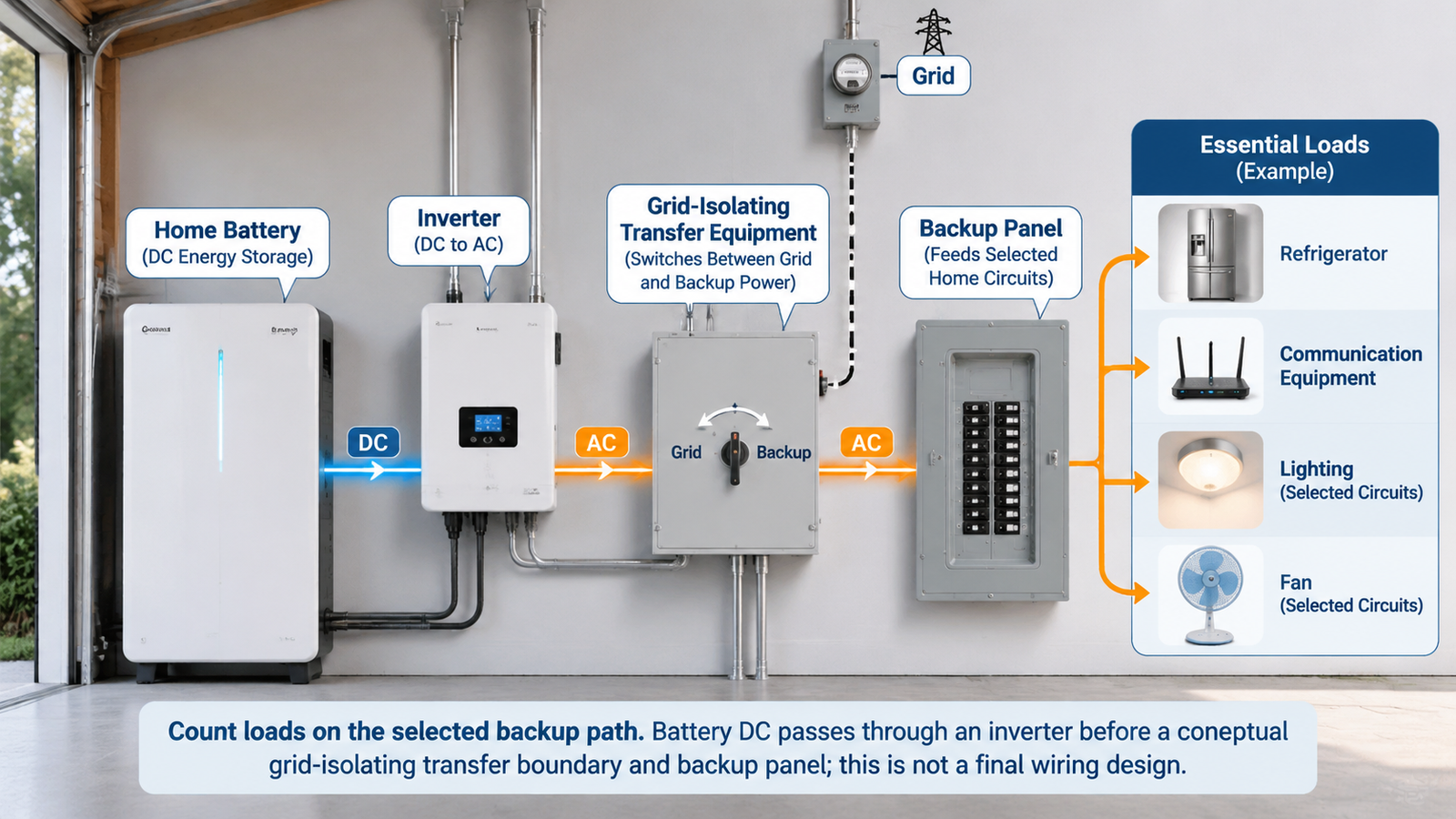
Fix the backed-up load set, the target time interval and the assumed battery state at the start of that interval. Write the desired result as a service statement, such as “keep the selected refrigerator, communication equipment, two lighting circuits and a fan available for 24 hours after grid loss.” This defines a calculation; “power the house for a day” leaves too many loads and operating choices undefined. A selected-load plan can be represented by a backed-up distribution section, a set of specific circuits or another approved system arrangement. The article's arithmetic assumes the loads listed are genuinely connected to that backup boundary. A battery in the building does not automatically energize every outlet after the grid fails.
The outage duration must be an explicit window, not an undefined promise of resilience. A four-hour evening interruption, a 24-hour interruption beginning just after ordinary battery use, and an interruption lasting through two cold nights produce different energy demands. Choose a target that matches the decision you need to make, then keep an upper-stress scenario separate if it would change the outcome. A homeowner does not need a precise probability model to start; they do need to know whether the goal is bridging a few hours, protecting one night or continuing through a longer event. The longer the period, the more consequential small continuous loads become.
Starting charge is equally important. A battery rated for a certain usable energy amount when full may be partly discharged when a random outage starts. A configured backup reserve can improve readiness, but the reserve policy and the actual state of charge are not the same thing. A battery held at a high reserve after normal operation presents a different starting condition from one used heavily for daily bill shifting. If the calculation assumes 100% charge while the actual control plan commonly leaves much less, the result is optimistic before any appliance estimate is made. If solar or another approved source can replenish the battery during the outage, model that separately and only when the actual system supports it; do not subtract hypothetical solar production from a fixed load calculation.
Multiply its active power in kilowatts by its active hours within the target window, then add those energy amounts. Continuous devices are straightforward: a 15 W communication device operating all 24 hours uses 15 × 24 ÷ 1,000, or 0.36 kWh, before system losses. For equipment that cycles, use the time it is actually drawing the stated power, not the full clock time. A refrigerator drawing 120 W when its compressor is active for a total of eight hours in a 24-hour scenario uses 120 × 8 ÷ 1,000, or 0.96 kWh in that scenario. Neither value is a typical product claim; both are made-up inputs to demonstrate the method.
The most useful evidence is a measured or well-observed load profile of the actual backed-up devices under conditions relevant to the outage. A plug-in power meter can show consumption for an appliance that can safely be measured at a plug; a qualified installer can assess fixed circuits and loads. An appliance label or annual energy figure can be a starting clue, but an average over a year cannot show whether the refrigerator cycles more in a hot afternoon or whether a heating system will run unusually hard in a winter failure. The U.S. Department of Energy's Energy Saver guide notes that labeled energy use is an estimate and actual use varies. Use a relevant observation or a justified range where the timing matters.
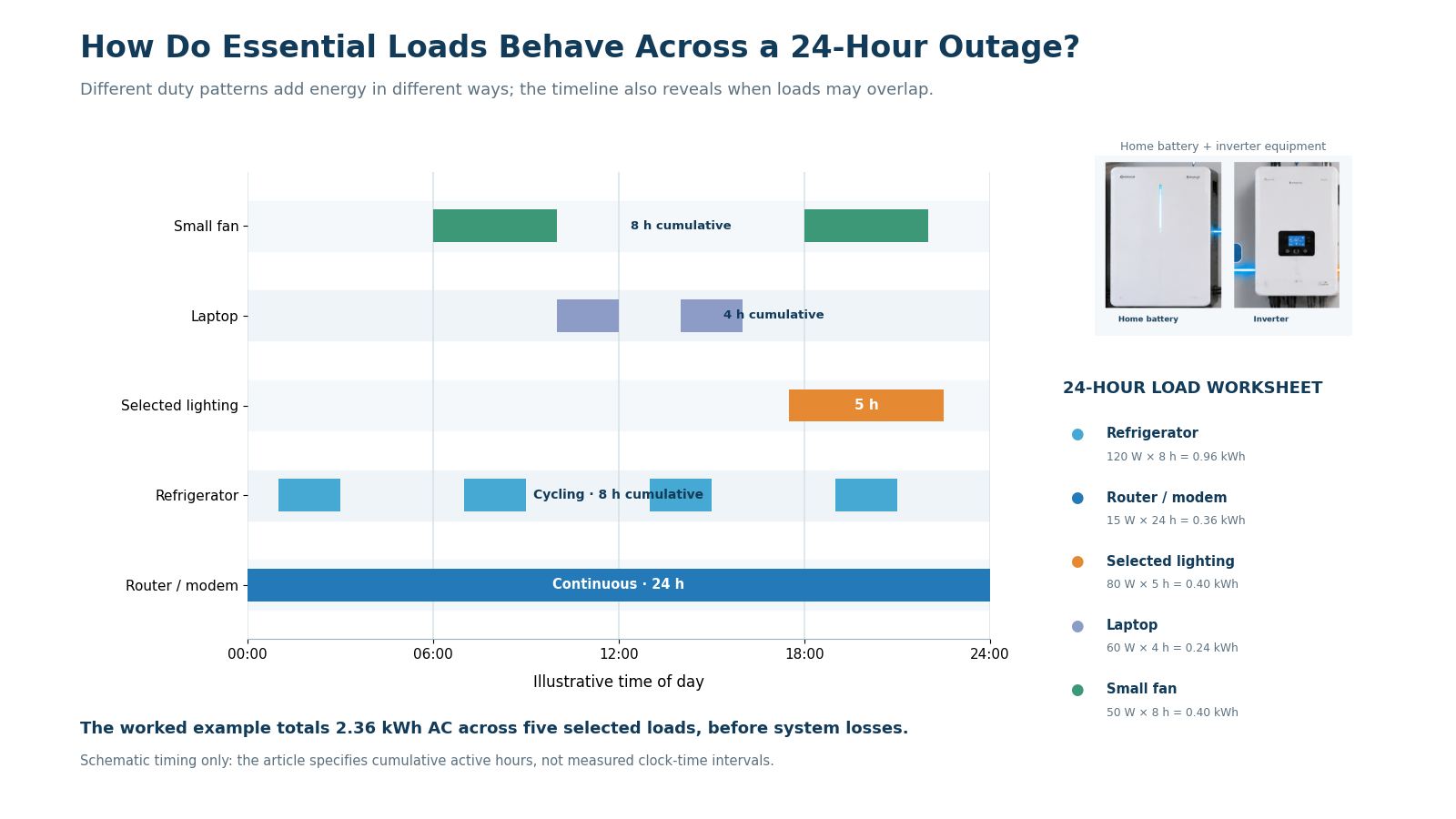
The example below is a hypothetical 24-hour essential-load schedule, not a Wirentech product design, an average household, or a recommendation to back up these exact devices. Each row uses the same calculation boundary: electricity delivered to the appliance in AC kWh. The “active hours” column is cumulative time during the 24 hours, so intermittent operation is not counted for a full day.
| Included load | Active power assumed | Active hours in 24 h | Delivered AC energy |
|---|---|---|---|
| Selected LED lighting | 80 W combined | 5 h | 0.40 kWh |
| Router and modem | 15 W combined | 24 h | 0.36 kWh |
| Refrigerator while compressor runs | 120 W | 8 h | 0.96 kWh |
| Laptop charging and use | 60 W | 4 h | 0.24 kWh |
| Small fan | 50 W | 8 h | 0.40 kWh |
| Illustrative total | — | — | 2.36 kWh AC |
The table is a worksheet, not a catalogue of appliance ratings. Replace each hypothetical power and active-hours input with a relevant observation or range and recompute the row; a load switched off partway through the outage contributes only for its planned active interval. The visible rows show which behavior changes the result, unlike an unexplained percentage applied to a household bill.
Equal kWh totals can produce different maximum power and different points at which the battery runs low. A router runs continuously, while lighting clusters in the evening; a cycling refrigerator can overlap either one. NREL's resilience analysis models outages beginning at different hours, illustrating why start time matters. A timeline reveals that coincidence, which the load-row totals cannot show.
One way to build a better estimate is to divide the target outage into intervals, such as morning, afternoon, evening and night, and list which backed-up loads operate in each. The sum of each interval's energy should agree with the load-row total if the assumptions are consistent. The interval view reveals whether an appliance is being counted twice, whether a temperature-dependent load has been omitted, and when simultaneous demand may be highest. It also gives a practical load-reduction choice: a fan used eight hours contributes 0.40 kWh in the illustration, so reducing its run time changes the energy requirement by a visible amount rather than an arbitrary “savings” percentage.
Energy is not the only gate. The inverter and battery must supply the simultaneous running power of the connected loads, and some loads demand more power briefly when starting. The table's daily kWh cannot show whether a refrigerator compressor, pump or air conditioner will start successfully while other loads are on. Record those devices for a separate output-power and surge check; do not multiply a seconds-long starting wattage by the full outage duration. Likewise, do not ignore a motor because its brief start adds little kWh. A system can hold enough energy but fail the instantaneous demand test, or pass the demand test and still empty too soon. Solar Victoria's battery explanation distinguishes capacity in kWh from output in kW.
Match the essential loads' delivered AC kWh to a capacity rating at the same boundary, applying only conversion loss and unavailable starting energy that the rating has not already included. The 2.36 kWh example is AC electricity delivered to the five loads. A battery's nameplate cell or DC pack energy is upstream of the inverter and may include energy that controls do not permit the user to discharge. A product may instead state usable battery energy or AC-deliverable usable energy under defined conditions. Those are different quantities. Comparing 2.36 kWh at the appliances directly with 2.36 kWh of gross cell energy silently assumes no conversion loss, no operating limit and full charge at the start. The result is likely optimistic. Conversely, dividing an already AC-deliverable usable rating by inverter efficiency again would count the same loss twice.
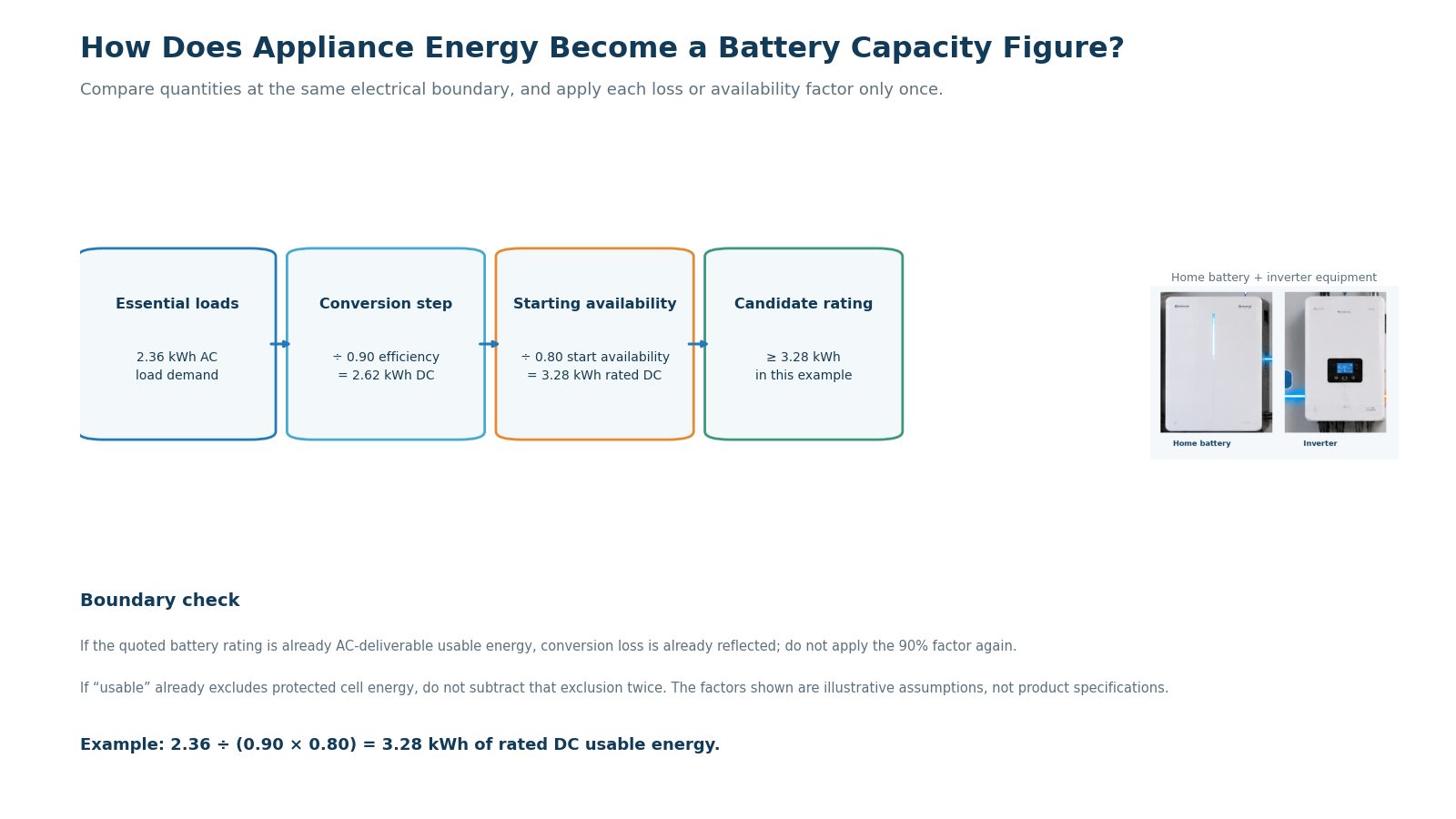
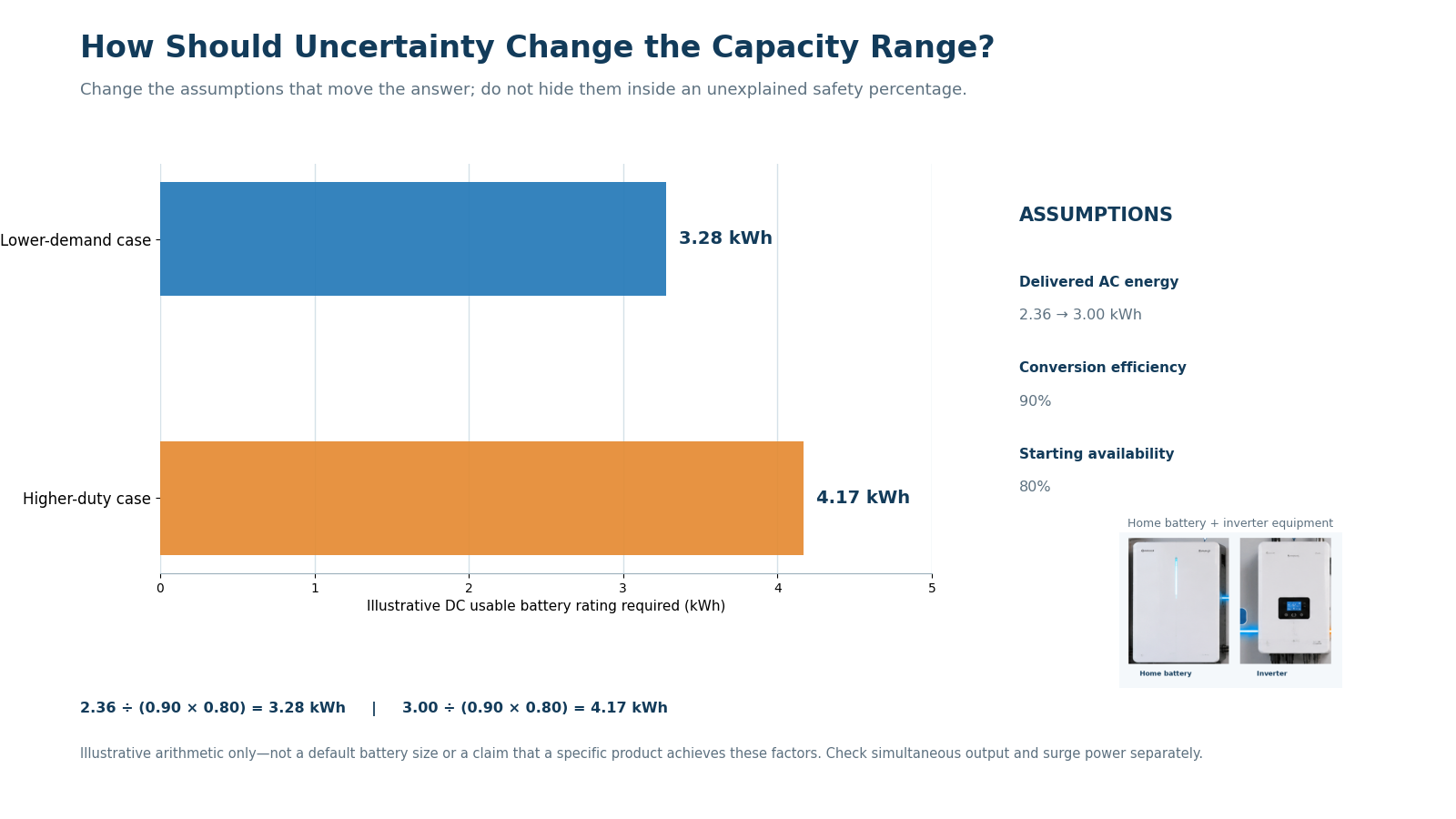
For a transparent illustration, suppose the five-load schedule represents a lower demand case of 2.36 kWh AC, while a hotter or longer-running case raises the same protected loads' demand to 3.00 kWh AC. Suppose also, solely for arithmetic, that a proposed rating is DC usable energy when full, that the discharge path delivers 90% of energy across the inverter and auxiliaries, and that 80% of the rated usable store is expected to be accessible at the start of the outage under the chosen operating plan. Then a candidate DC usable rating would need at least 2.36 ÷ (0.90 × 0.80) = 3.28 kWh for the lower case, and 3.00 ÷ (0.90 × 0.80) = 4.17 kWh for the higher case. This 3.28–4.17 kWh range is an illustrative mathematical result, not an appropriate default size or a claim that any real battery achieves those factors.
The 80% factor in that example represents starting availability relative to the stated full-charge DC usable rating. It is not a second depth-of-discharge deduction. If the seller's “usable” rating already excludes protected cell energy, do not subtract that exclusion again. If a quoted capacity is measured as AC energy deliverable to household loads at a specified state of charge, the 90% conversion factor is already reflected and should not be reapplied. If the battery is planned to begin an outage at a different charge level, change the starting-availability factor. The honest calculation states what each denominator means rather than stacking generic “safety factors” whose boundaries overlap.
The same caution applies to auxiliary consumption. A gateway, controls and inverter may use some energy while operating. If a supplied AC-deliverable rating already includes those losses under the relevant test, adding them again overstates need. If the rating excludes standby use and a long outage makes it material, include it as an additional load or in a measured system efficiency term. Long intervals can make a small continuous system draw meaningful, while a short outage may be dominated by the household loads themselves. Without the equipment's rating definition, the result is a range with an explicit unresolved boundary, not an exact model selection.
Test the assumptions that can materially move the answer: outage start time, appliance cycling, seasonal demand, starting charge and whether an approved recharge source will actually operate during the outage. A low-demand case and a credible stress case are more informative than one falsely precise number. If summer heat makes the refrigerator and fan run longer, recalculate those active hours rather than adding an unexplained 20% to everything. If winter conditions bring an essential heating load into the circuit set, add its profile as a new row and test whether that makes battery-only backup impractical. If the grid returns for only a short period between interruptions, the second outage may begin with less energy than the first. That is a different sequence from one 24-hour outage starting at full charge.
Solar charging should not be used as a generic discount against the essential-load total. If an outage-capable PV-plus-storage installation can recharge during the chosen window, model generation by time of day and weather, compare it with concurrent loads, and state what happens when the battery begins at a low state of charge. A cloudy day or a nighttime outage can change the net result. For a grid-charged battery without on-site generation, the calculation has no refill while the grid is absent.
There is also a practical limit to expansion. A battery that barely meets the lower case under ideal starting charge should not be described as covering the higher case. But simply adding more nominal kWh may not solve a load whose simultaneous or starting power exceeds the inverter's capability. The decision could instead be to revise the protected load schedule, shorten the promised service window, choose equipment with different output capability, or design a verified replenishment path. Presenting those alternatives with their conditions is more useful than rounding the answer to a neat battery size before a specific product is known.
It should state the target outage window, the included loads, their observed or assumed active power and run time, the resulting delivered AC kWh range, the maximum simultaneous demand separately, and the starting-charge assumption. It should identify whether any automatic load shedding or on-site charging is included. Compare a proposed system against that service at a clearly specified capacity boundary, including its usable-energy convention, output rating and backup configuration. The home energy storage battery category offers battery forms to browse once that requirement is defined; its listings alone do not establish a boundary-matched capacity or outage-ready configuration.
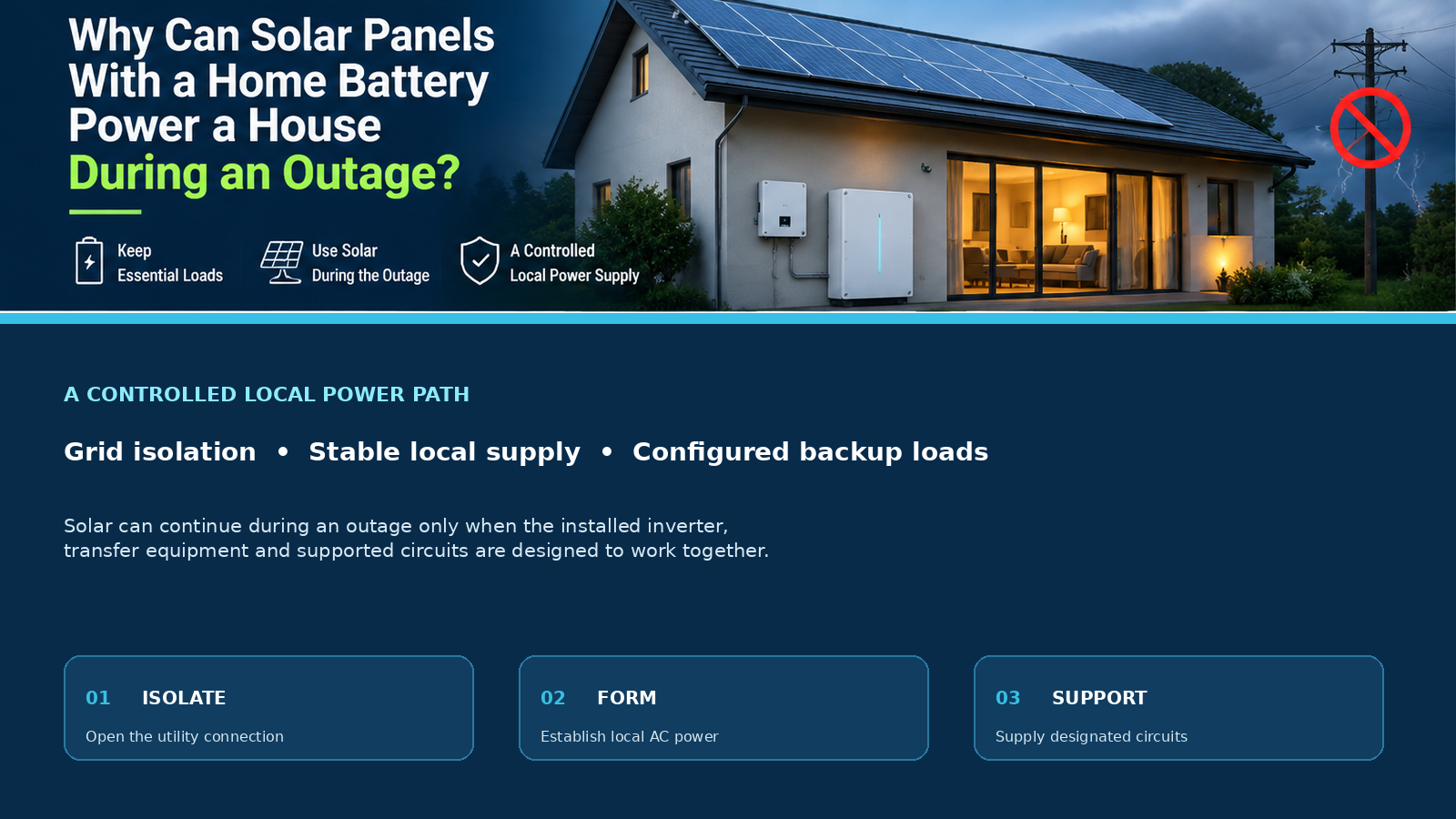
The final selection also needs an electrical design that actually serves the chosen circuits when the grid fails. Solar Victoria warns that not every battery system provides outage power; the system design and inverter matter (planning guide). A homeowner can check whether a proposal promises the service and ask for an appropriate commissioning demonstration, while wiring and protective testing belong to qualified professionals. The capacity worksheet does not authorize do-it-yourself connection changes, and it does not establish a local installation approval.
Related News
Nov. 07, 2026
Can a Home Battery Start and Run High-Surge Household Loads?
Learn why battery kWh alone cannot prove motor-start backup. Compare inverter surge duration, running demand, simultaneous loads and a supervised backup test.
Nov. 07, 2026
How Should a Home Battery Specification Sheet Be Read for Backup and Daily Use?
Compare home battery capacity, usable energy, continuous and peak output, charging limits and rating conditions before judging daily use or backup claims.
Nov. 06, 2026
Whole-Home Battery Backup or Critical-Load Backup: Which Scope Fits the Home?
Compare whole-home and critical-load battery backup by protected circuits, peak power, outage duration and load control to choose a realistic home backup scope.
Nov. 06, 2026
Can a Home Battery Provide Backup Power Without Solar Panels?
A home battery can provide backup without solar if grid charging, outage isolation and backup circuits are configured. Learn what limits runtime and recharge.
Nov. 06, 2026
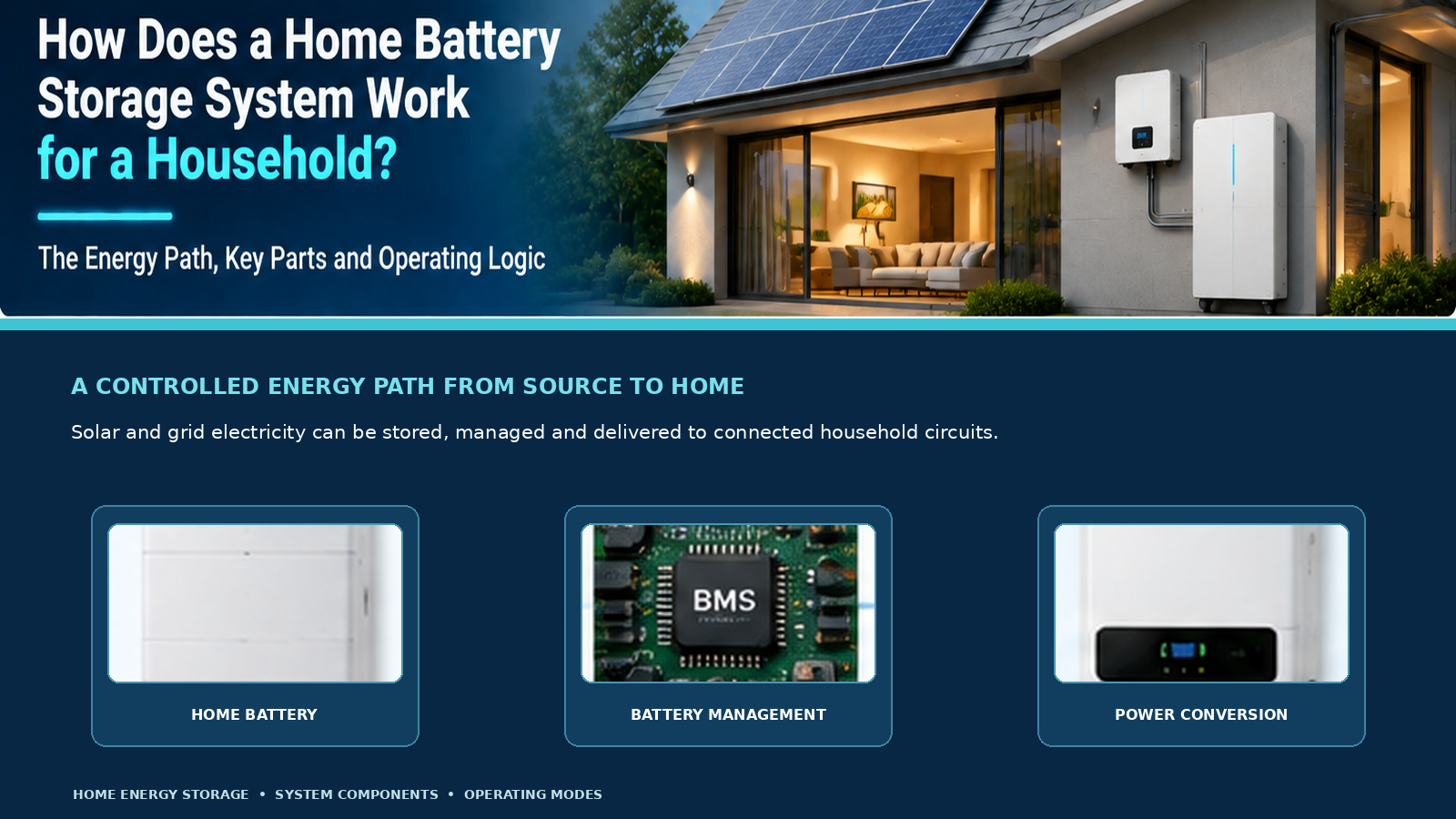
How Does a Home Battery Storage System Work for a Household?
Follow the energy path through a home battery, inverter and controls. Learn how charging, daily discharge and outage backup differ before comparing systems.
Nov. 06, 2026
How Can A Weak Battery Be Distinguished From A Weak Golf Cart Battery Bank?
Compare like-conditioned unit and bank readings to separate one weak battery from broad bank loss, charging shortfall or connection trouble.
Nov. 06, 2026
How Should A Replacement Golf Cart Battery Bank Be Planned?
Decide whether one unit or the bank needs replacement, then specify voltage, fit, connections and first-charge checks before ordering.
Nov. 06, 2026
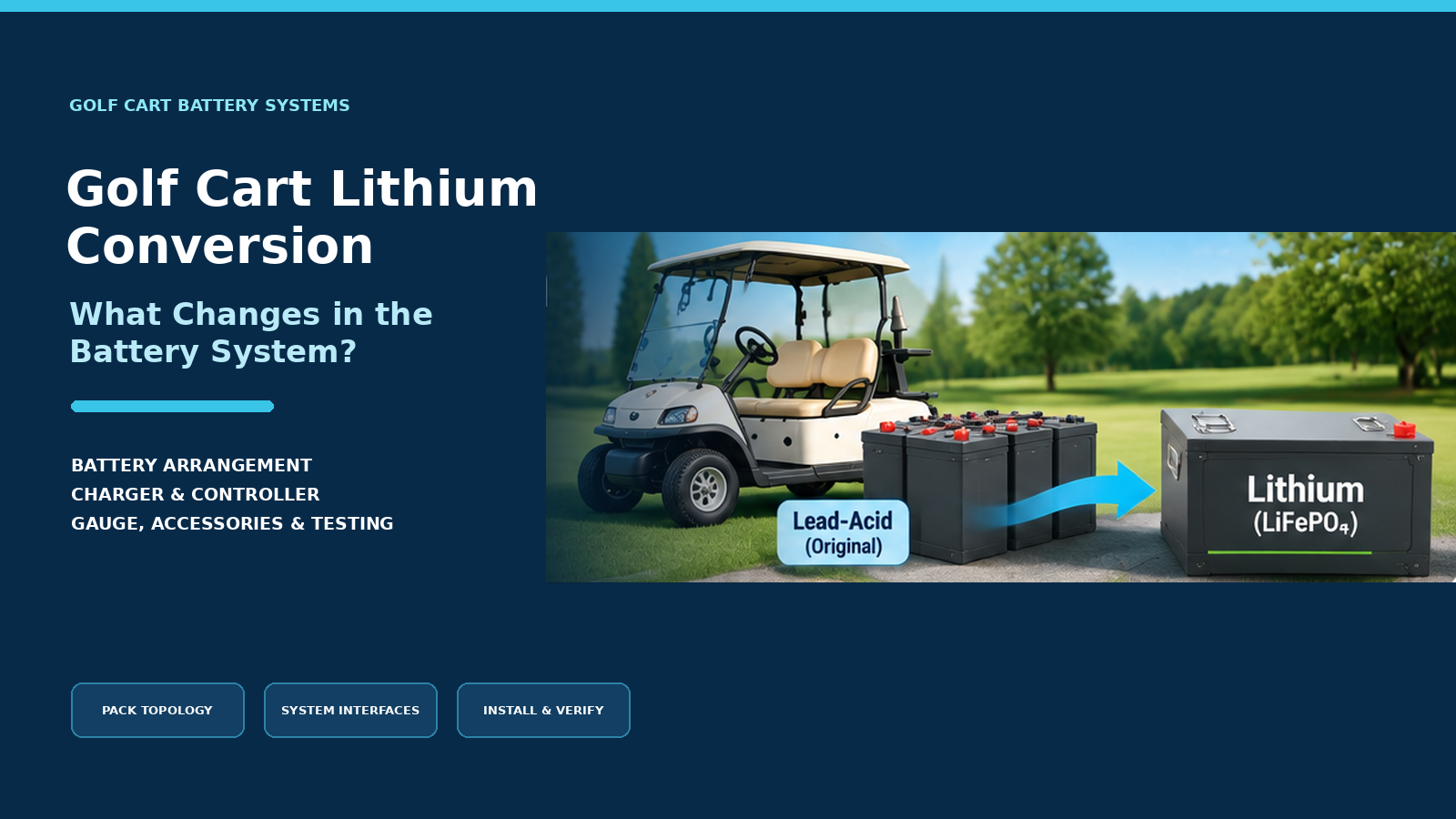
What Changes When A Golf Cart Battery Bank Is Converted To Lithium?
Map the battery bank, tray, charger, controller, gauge and accessory interfaces that change when converting a lead-acid golf cart to lithium.
Nov. 06, 2026
When Does Lithium Make Sense Instead Of Lead Acid For A Golf Cart?
Compare lithium and lead acid for the same golf-cart duty, charging routine, maintenance capacity and ownership horizon before deciding whether a switch is worthwhile.

Nov. 06, 2026
How Can Peak Current Demand Be Matched To A Golf Cart Battery?
Compare a golf cart’s acceleration and hill-load current by duration with battery continuous, pulse and protection ratings under matching conditions.
Nov. 06, 2026
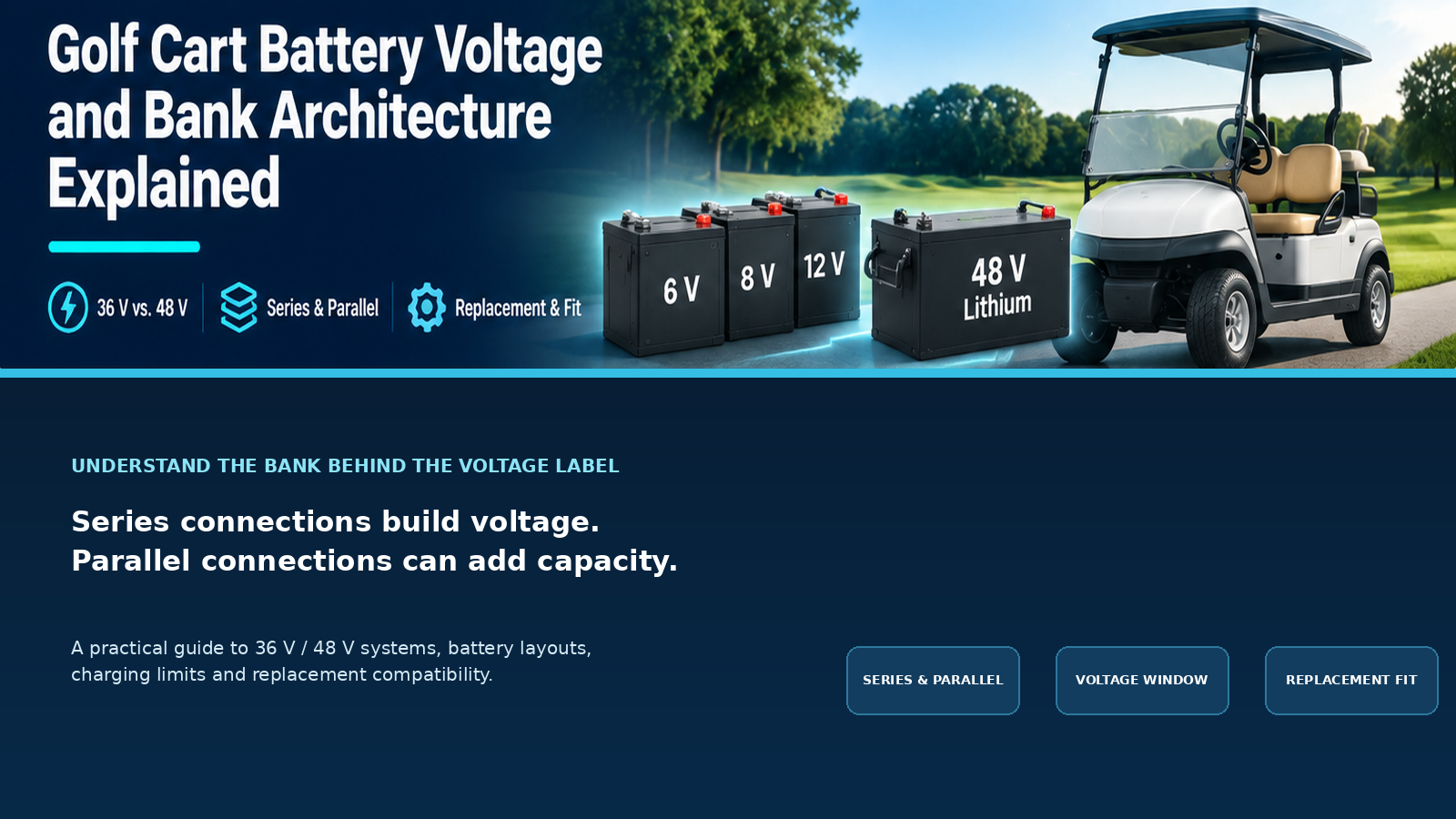
How should a golf cart battery be sized for route energy and reserve?
Use measured route energy, usable battery capacity and a defined return reserve to plan golf cart battery size without treating Ah as guaranteed range.