

Nov. 06, 2026
A home battery stores electricity for later use, but the battery alone does not decide when a house charges, which appliances receive power, or whether the lights stay on during an outage. A working home battery system combines battery cells, protective battery controls, power conversion equipment, a connection to the home electrical system, and operating rules. Those parts move energy between a source, the battery, and household loads. Whether that movement reduces a bill or supplies backup power depends on the installed configuration and the conditions at the time.
For a homeowner, the useful mental model is a controlled energy path. The grid or rooftop solar can supply the house and, when the equipment permits, charge the battery. Later, stored energy leaves the battery, passes through an inverter, and reaches connected household circuits. A controller checks the battery's limits and follows a selected operating mode. During a grid outage, a separate ability to isolate the home from the grid and supply an approved set of circuits determines whether that stored energy can actually be used. This article explains that path and its limits; the design of a particular outage connection belongs to a qualified installer.
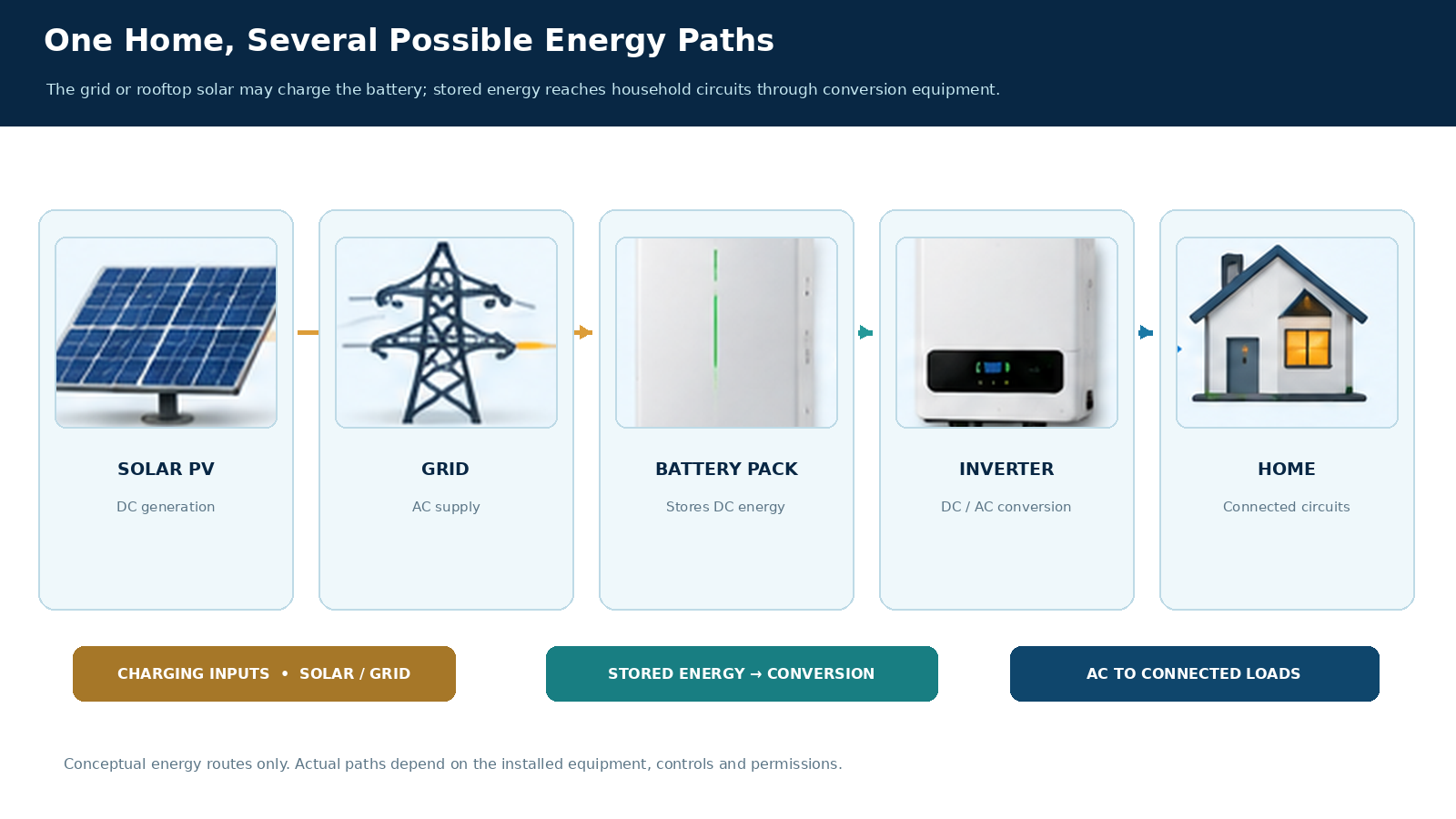
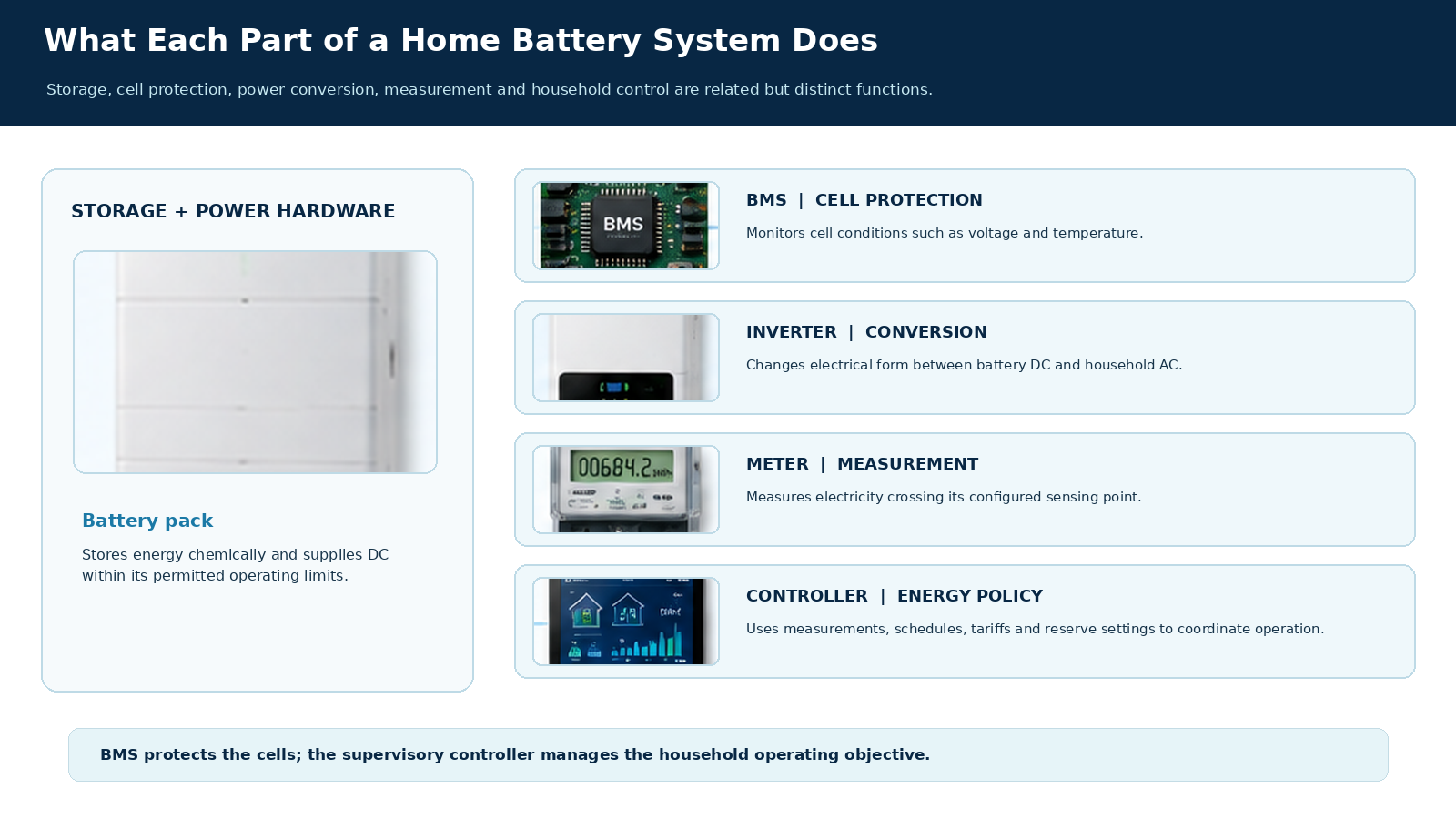
The battery stores energy chemically, while the rest of the system makes that energy usable and decides where it goes. Inside a common lithium-ion home battery, electrical energy entering the cells becomes stored chemical energy; discharging reverses that process. The pack supplies direct current (DC), not the alternating current (AC) used by most household circuits. A battery management system monitors conditions such as cell voltage and temperature to keep the pack within its operating limits. Energy Safe Victoria's battery safety guide distinguishes battery-level monitoring from installation-level management. An inverter or other power conversion equipment changes electricity between the form needed by the battery and the form used in the home. These functions may share an enclosure or occupy separate units; the enclosure alone does not tell you what functions it includes. The Australian Government's YourHome battery guide describes the main residential connection arrangements and notes that some all-in-one units integrate an inverter while others use a separate inverter.
The home electrical panel distributes AC electricity to circuits. A meter or energy monitor can report electricity crossing a measured point, but its display is only as complete as its sensor placement and setup. A supervisory controller may use those measurements, a schedule, an electricity tariff, a reserve setting, and battery limits to decide whether to charge, discharge, or wait. The controller cannot create more stored energy or power than the installed equipment permits. It can, however, change when available energy is used. Think of the controller as selecting a route and the inverter as making the selected electrical exchange possible.
The battery management system and the household operating controller serve different purposes. The first protects the cells within their allowed range. The second coordinates the system's behavior for a household objective, such as using more daytime solar energy after sunset or retaining charge for an outage. Their functions may be integrated in one product, but a homeowner should still distinguish cell protection from the policy that allocates energy. If a monitoring app shows that the system stopped charging, the cause could be a full battery, a charge limit, a schedule, unavailable generation, or a protective condition. The displayed result alone cannot identify which one.
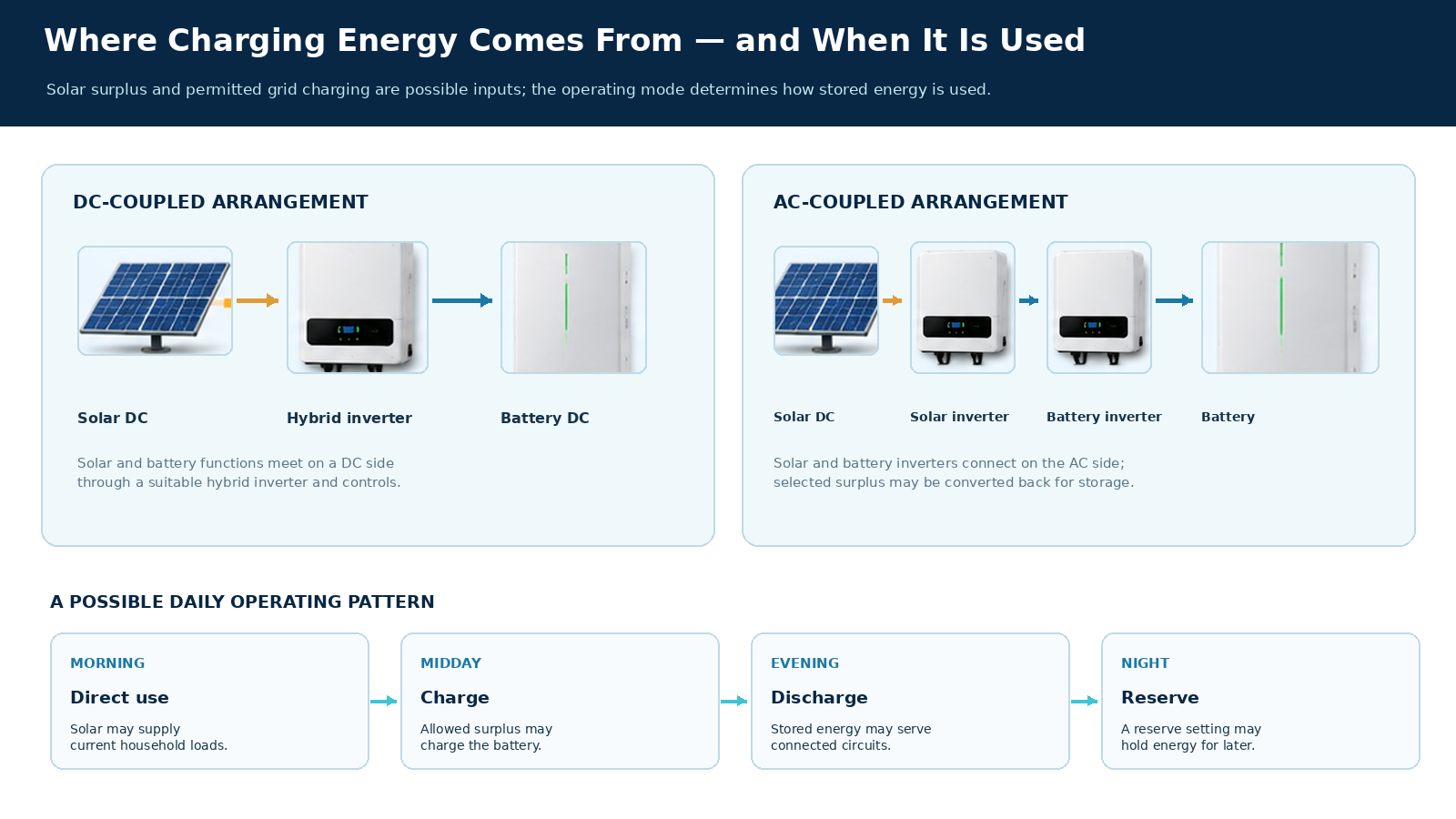
It comes from an allowed source connected through the appropriate conversion and control equipment. In a solar-equipped home, panels produce DC electricity when sunlight is available. The house may use that electricity immediately; energy not needed at that moment may be sent to the battery if the system is configured to do so. A grid-connected battery can also charge from purchased electricity where its equipment, utility rules, and operating settings allow. The source changes the energy and financial story, but it does not change the basic job of the battery: storing electricity now and releasing it later. The YourHome guide describes both solar-connected and grid-charged residential arrangements.
The exact route depends on how the equipment is coupled. In an AC-coupled arrangement, a solar inverter and a battery inverter connect on the AC side. Solar DC becomes AC before a battery inverter can convert any selected surplus back to DC for storage. In a DC-coupled arrangement, solar and battery functions can meet on a DC side associated with a suitable hybrid inverter, with controls governing the battery charge path. These descriptions explain conversion routes; neither layout by itself guarantees a particular backup function, efficiency, compatibility, or financial result. Equipment ratings, wiring, controls, and permissions still govern what a real installation can do.
Solar output is not battery charging because the home may consume the generation first and charge controls may limit what remains. In a self-consumption arrangement, eligible surplus can charge the battery when the system allows it. The controller may stop at a configured full level, adjust charging for a forecast or tariff objective, limit charging because the equipment or cells are at an operating boundary, or follow rules about grid charging and export. Solar output also changes through the day. If generation is lower than household demand, there may be no solar surplus to store even while the roof is producing electricity. Similarly, an off-peak grid schedule does not guarantee a full battery by morning if the charging window, charge power, or starting level is insufficient. A charge source is a possible input; the system's constraints decide how much becomes stored energy.
When the controller calls for discharge, the cells deliver DC within their permitted voltage, current, and state-of-charge range. Power conversion equipment produces AC at the connection used by the house. Electricity then reaches only those circuits that are connected and allowed to receive that supply. If the system is grid connected and the grid is healthy, the home may draw from the battery, the grid, solar production, or a combination at the same time. The measured flow at the meter can be the net result of several simultaneous paths, so a screen showing “battery discharging” does not prove the battery alone is supplying every appliance.
The distinction between power and energy helps explain what the battery can do at that moment. Power, commonly shown in kilowatts (kW), is the rate at which electricity is supplied. Energy, commonly shown in kilowatt-hours (kWh), is the amount available over time. A battery with stored energy may still be unable to supply a combined appliance load above the system's current output limit. Conversely, an appliance may be within the power limit yet run for less time than a homeowner expects because the usable stored energy is finite. The U.S. Department of Energy distinguishes storage power from storage energy in its solar and storage basics. Detailed specification interpretation and household sizing are separate tasks; here the two measures explain why “charged” is not the same as “able to serve everything.”
The inverter also uses some energy, and charging and discharging are not perfectly efficient. Each conversion and time spent in the system can reduce the energy eventually delivered to appliances compared with the electricity taken in. This is why an energy flow diagram should show conversion steps instead of treating the pack's nameplate kWh as a direct promise of AC energy at a socket. Losses vary with equipment and conditions, so a generic diagram cannot state the delivered energy for a particular home. To understand an actual display, compare measurements at matching boundaries: electricity entering the battery, electricity leaving its DC terminals, inverter AC output, and electricity used by the house are different quantities.
| Household state | Main energy route | What the battery does | What that state does not establish |
|---|---|---|---|
| Solar output exceeds current home use | Solar supplies loads; allowed surplus may charge the battery | Accepts charge within control and cell limits | That all surplus is stored or that the pack is full |
| Evening use with stored energy available | Battery DC passes through conversion equipment to connected AC circuits | Discharges when the selected mode permits | That every circuit is served or that this saves money |
| Grid power available with a charging schedule | Grid AC can be converted to battery DC where enabled | Stores purchased electricity for later use | That local tariffs make the cycle worthwhile |
| Grid outage | A backup-capable system may isolate and feed designated loads | Supplies finite stored energy within its limits | That a battery-only installation has outage capability |
The table separates a possible route from a guaranteed outcome. For example, a solar array can be producing while the battery remains idle because loads consume production or a control limit blocks charging. The flow is determined by measurements and system rules, not by the simple presence of a panel and a battery.
The selected operating objective sets a preference, and the installed system's safety and electrical limits set the boundary. A self-consumption mode may favor storing solar energy that the home does not use immediately and releasing it after solar production falls. A time-based mode may favor charging in one tariff period and discharging in another. A backup-oriented setting may hold part of the available energy in reserve instead of spending it on normal evening use. Some systems blend these objectives, but not every product supports every mode and local export or charging rules may constrain them. A homeowner therefore needs the actual supported modes, not only a sales label such as “smart battery.”
State of charge is a useful indicator of the remaining portion of the battery's allowed operating window. It is not a universal promise of hours of power. Duration depends on what loads run, their changes over time, system conversion losses, the allowed discharge window, and whether another source recharges the pack. A reserve setting may be expressed as a displayed percentage, but the actual energy behind that percentage depends on the product's usable capacity and its current condition. Likewise, a displayed “100%” means the system has reached its configured full point; it does not reveal the electrical energy that would reach home circuits in every operating condition.
Monitoring is most helpful when it shows flows and state together. For a daylight period, a homeowner can ask: Is solar going directly to loads? Is the battery charging? Is energy entering or leaving the grid? For an evening period, the same display can show whether the battery is discharging and whether grid import continues. A nonzero grid import while the battery discharges is not automatically a fault; loads may exceed the inverter's output, a circuit may be outside the battery's supply path, or control settings may intentionally limit discharge. The diagram of the house's measured connections is needed before interpreting a single app number as whole-house behavior.
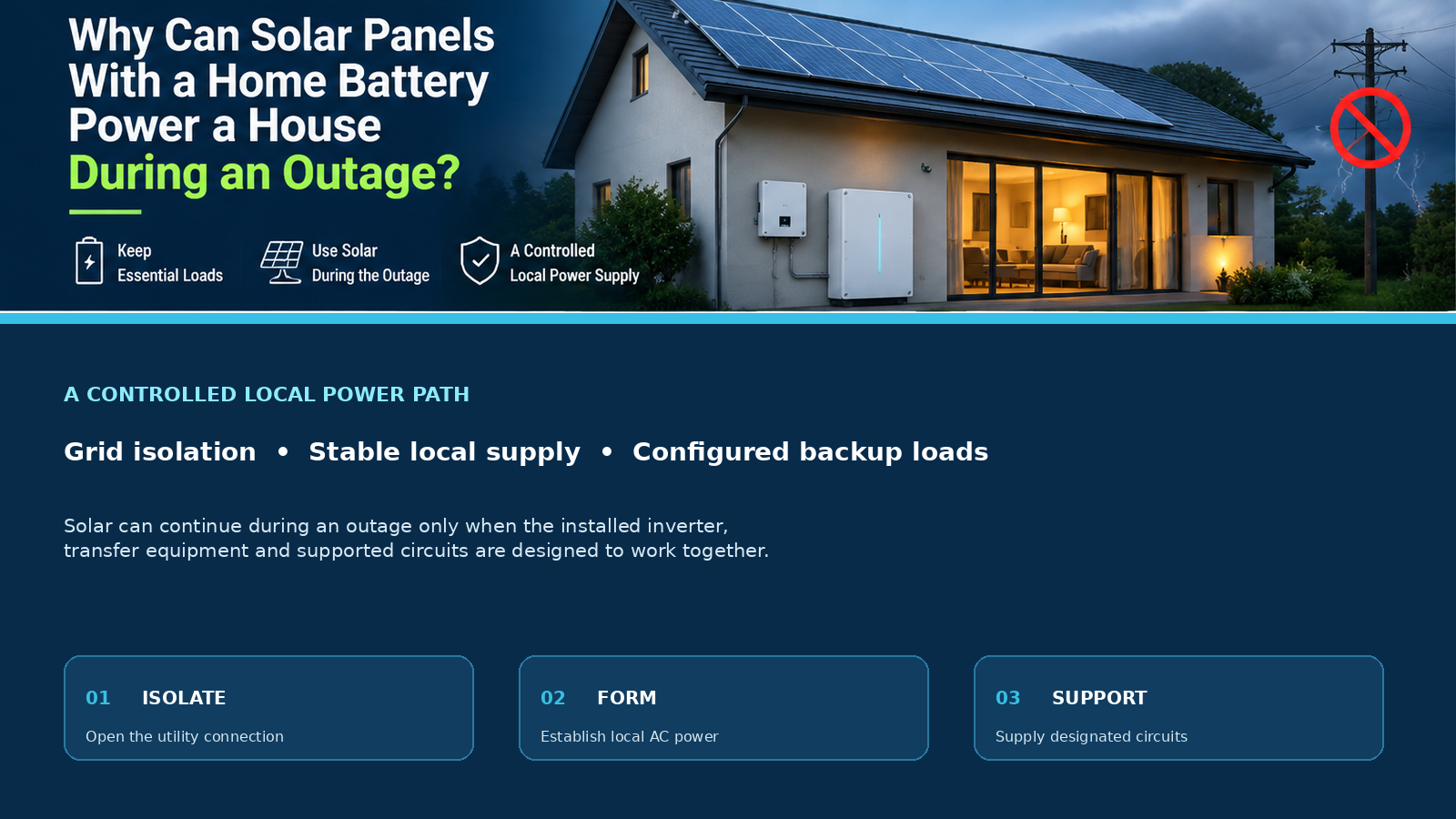
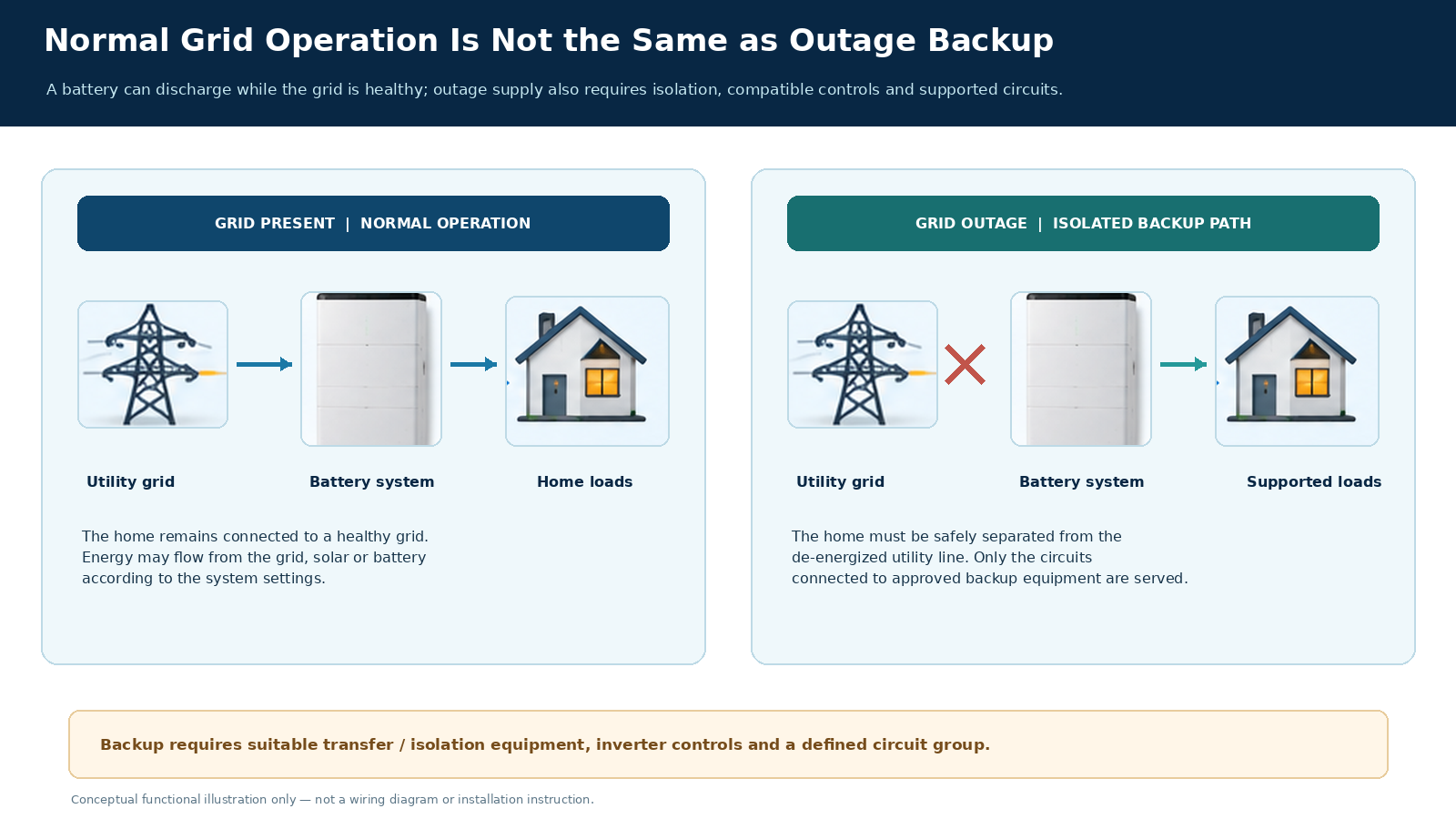
Normal bill management works while the home remains connected to a healthy grid. The battery changes when the house imports electricity or how much solar generation it uses on site. An outage removes that external supply and requires the home to operate safely as a separate electrical source if it is to remain energized. The ability to store and discharge energy during ordinary grid operation does not by itself provide that separation. Backup requires a suitable transfer or isolation arrangement, compatible inverter controls, and a defined group of circuits that the backup equipment can serve. The Australian YourHome guide explicitly distinguishes ordinary grid-connected batteries from systems designed to provide energy during a grid outage.
In a configured outage, the system must keep power from feeding into a de-energized utility line and establish a usable local supply for the supported circuits. The control may also change its behavior: preserving energy, curtailing loads, or managing solar production differently from a normal grid-connected day. Some appliances may be outside the supported circuit group even though they worked normally before the outage. The point for this overview is the functional boundary: stored energy is a necessary resource for battery backup, but a battery pack alone is not a complete backup supply. The detailed behavior of solar-backed outage operation and grid-charged backup without solar is covered by separate household tasks, because those situations have different energy paths after disconnection.
Trace each promised function to its source, conversion equipment, controls, and connected circuits. This reveals whether a proposal actually includes the route needed for that function; a battery's chemistry or headline capacity cannot establish the route on its own.
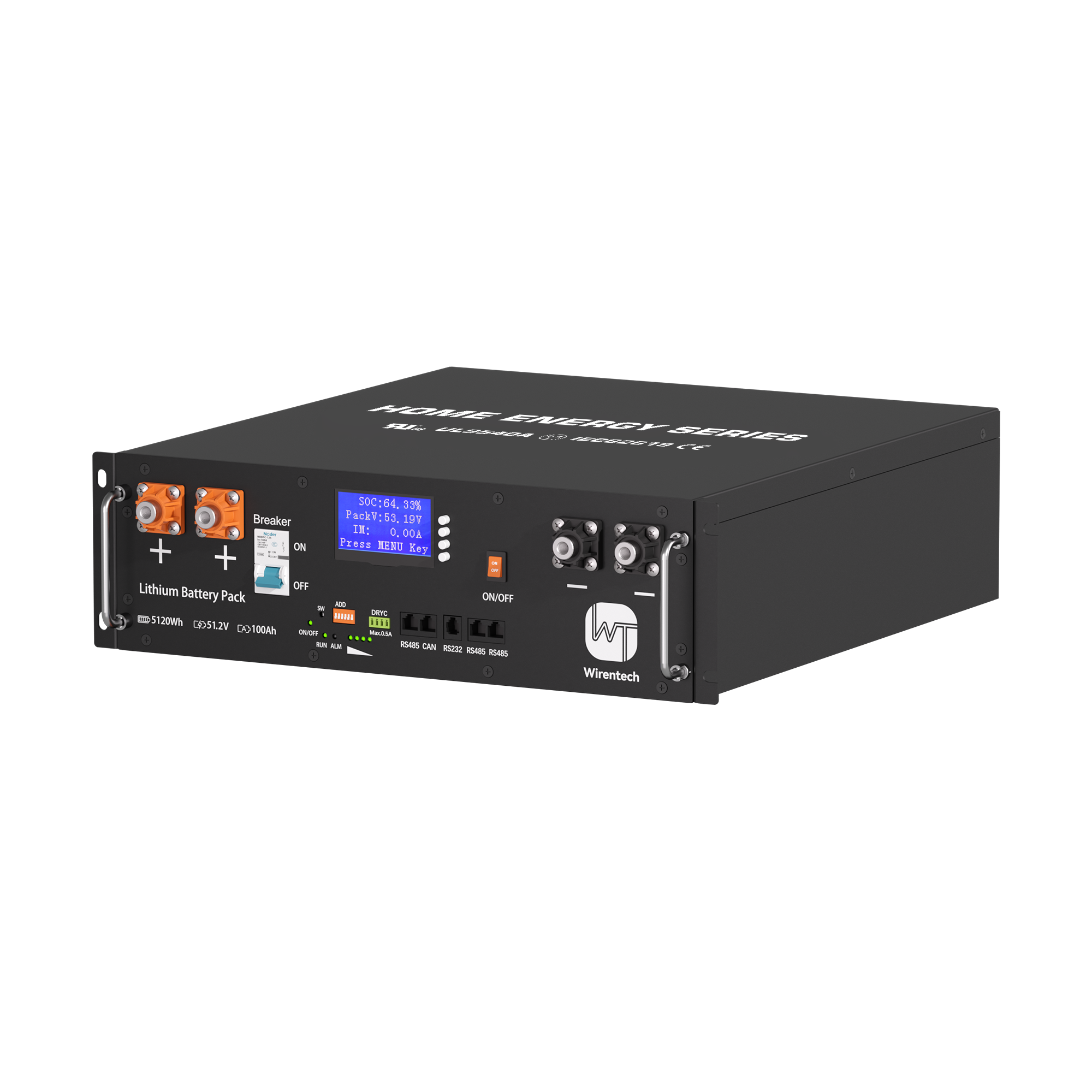
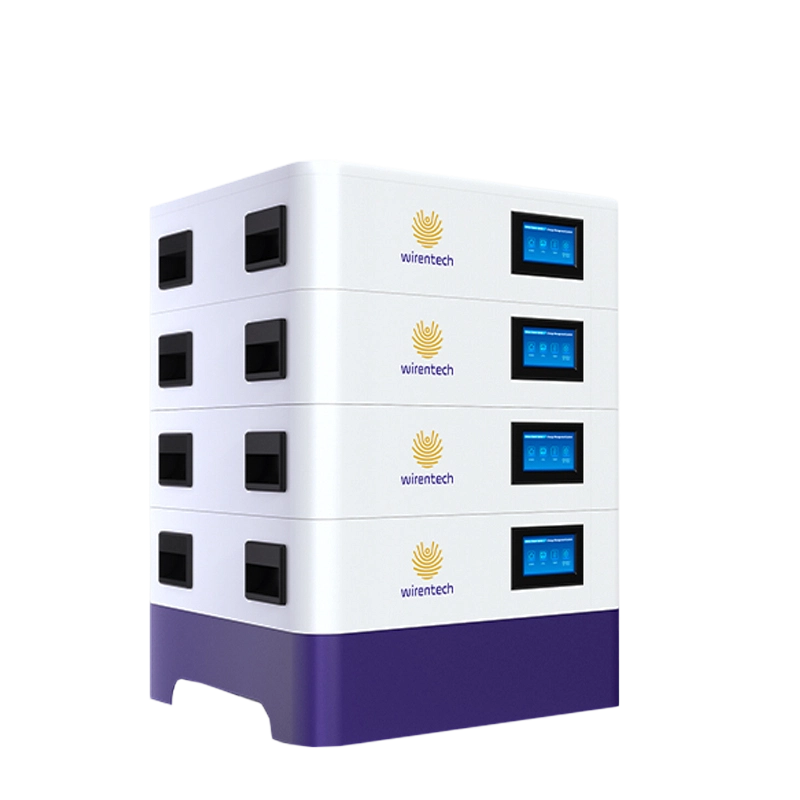
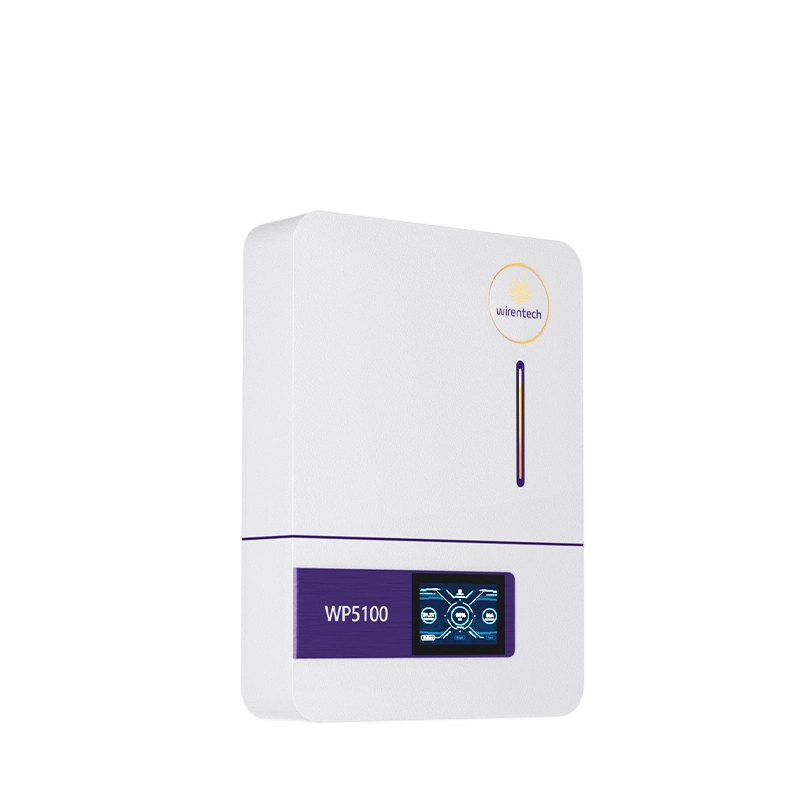
The physical product form can help orient a discussion without settling system suitability. Wirentech's currently accessible home energy storage battery category shows rack, stackable, and wall-mounted battery forms. Those pages are useful for seeing what kinds of storage units are listed; the presence of a unit in a category is not proof that it provides a particular inverter, transfer device, backup circuit arrangement, grid-charge mode, or local approval. A genuine comparison must use the exact product's verified electrical information and the proposed whole-system design. This article makes no claim that a listed battery will work in a specific household configuration.
There is a simple way to read any proposed system diagram: follow the arrows in both directions and name the component that makes each change possible. Where does charging energy enter? Which component limits battery charge? Where does DC become household AC? Which circuits receive that AC? What measurement tells the controller to charge or discharge? What physical and control function changes the path when the grid fails? If a proposed function cannot be traced to a real component and connection, a battery capacity figure cannot fill the gap. A labeled diagram may still be simplified, but these questions reveal whether its promised behavior has an actual path.
For a real-home inquiry, state whether the objective is later use of solar, scheduled grid charging, outage supply, or a combination, and identify the existing solar and intended backup circuits. That lets the proposed diagram be judged against the function the household actually needs.
Related News
Nov. 07, 2026
Can a Home Battery Start and Run High-Surge Household Loads?
Learn why battery kWh alone cannot prove motor-start backup. Compare inverter surge duration, running demand, simultaneous loads and a supervised backup test.
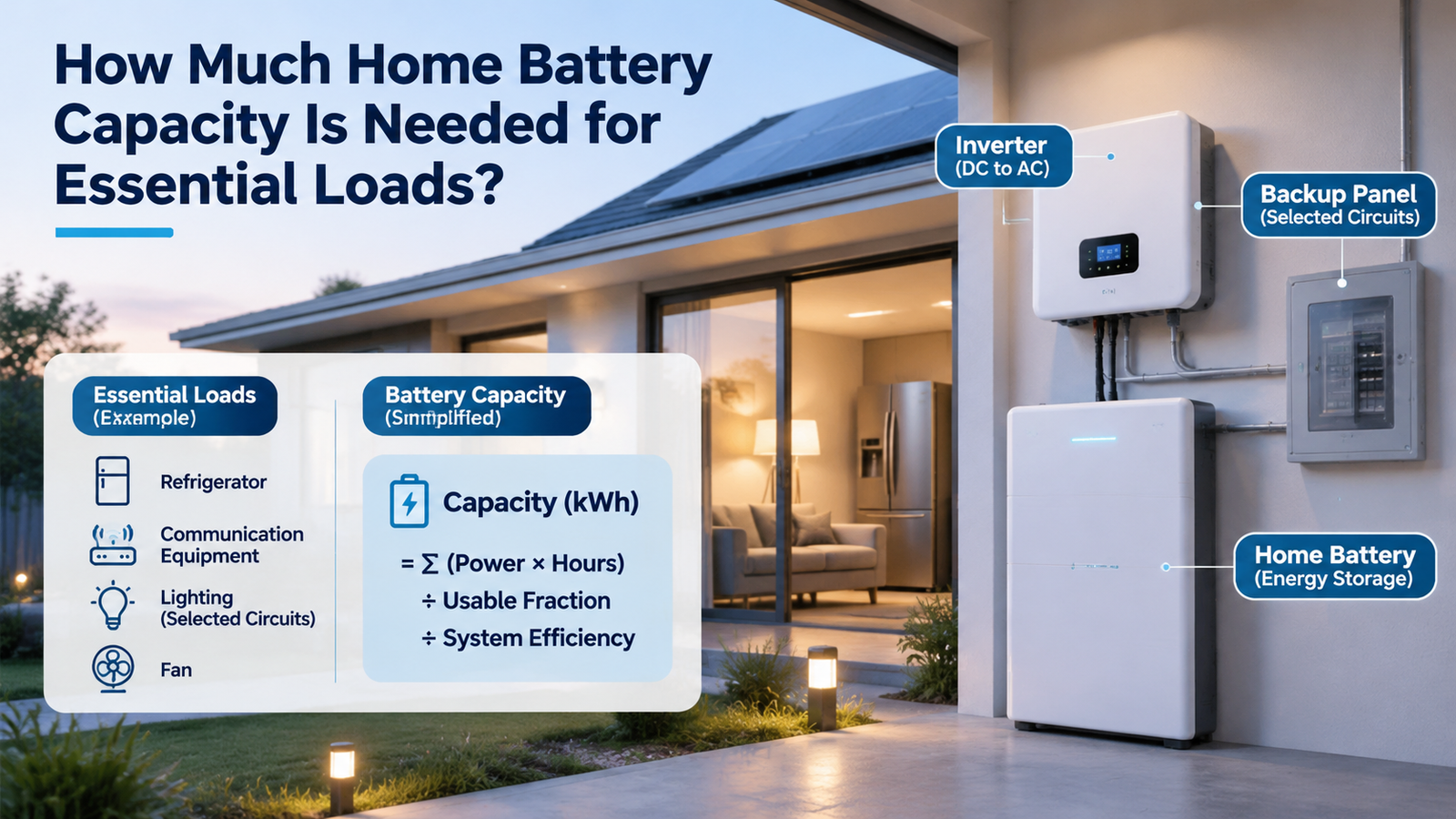
Nov. 07, 2026
How Much Home Battery Capacity Is Needed for Essential Loads?
Calculate home battery capacity from essential-load power, duty cycle and outage hours. See a transparent kWh example and avoid double-counting losses.
Nov. 07, 2026
How Should a Home Battery Specification Sheet Be Read for Backup and Daily Use?
Compare home battery capacity, usable energy, continuous and peak output, charging limits and rating conditions before judging daily use or backup claims.
Nov. 06, 2026
Whole-Home Battery Backup or Critical-Load Backup: Which Scope Fits the Home?
Compare whole-home and critical-load battery backup by protected circuits, peak power, outage duration and load control to choose a realistic home backup scope.
Nov. 06, 2026
Can a Home Battery Provide Backup Power Without Solar Panels?
A home battery can provide backup without solar if grid charging, outage isolation and backup circuits are configured. Learn what limits runtime and recharge.
Nov. 06, 2026
How Can A Weak Battery Be Distinguished From A Weak Golf Cart Battery Bank?
Compare like-conditioned unit and bank readings to separate one weak battery from broad bank loss, charging shortfall or connection trouble.
Nov. 06, 2026
How Should A Replacement Golf Cart Battery Bank Be Planned?
Decide whether one unit or the bank needs replacement, then specify voltage, fit, connections and first-charge checks before ordering.
Nov. 06, 2026
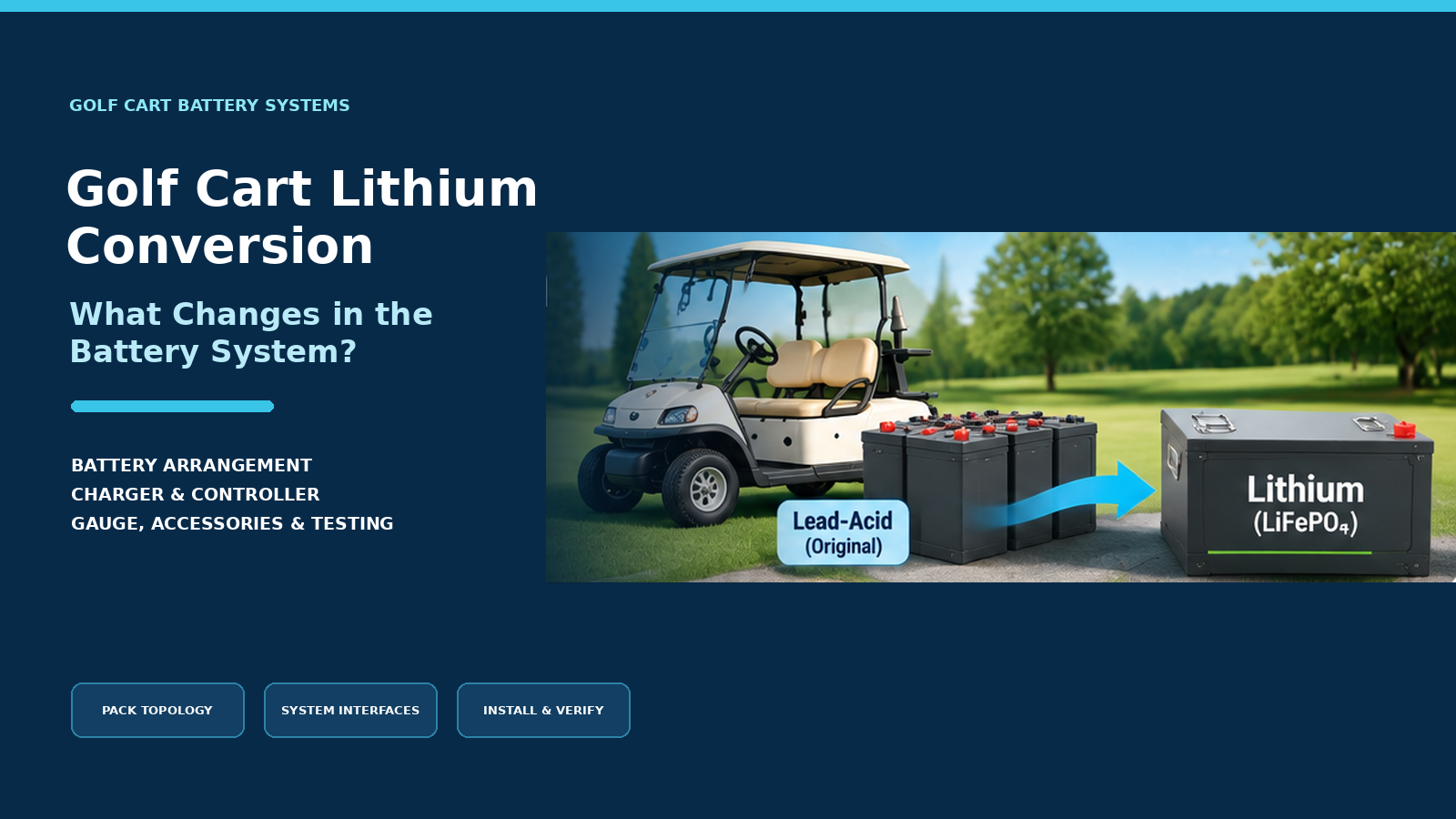
What Changes When A Golf Cart Battery Bank Is Converted To Lithium?
Map the battery bank, tray, charger, controller, gauge and accessory interfaces that change when converting a lead-acid golf cart to lithium.
Nov. 06, 2026
When Does Lithium Make Sense Instead Of Lead Acid For A Golf Cart?
Compare lithium and lead acid for the same golf-cart duty, charging routine, maintenance capacity and ownership horizon before deciding whether a switch is worthwhile.
Nov. 06, 2026
How Can Peak Current Demand Be Matched To A Golf Cart Battery?
Compare a golf cart’s acceleration and hill-load current by duration with battery continuous, pulse and protection ratings under matching conditions.
Nov. 06, 2026
How should a golf cart battery be sized for route energy and reserve?
Use measured route energy, usable battery capacity and a defined return reserve to plan golf cart battery size without treating Ah as guaranteed range.