

Nov. 06, 2026
A golf cart's nominal battery voltage is the sum of the rated voltages of batteries connected in series. Eight 6 V units, six 8 V units, or four 12 V units can each make a nominal 48 V bank. That number describes the bank's voltage class, not its capacity, current capability, charging limits, or fit in the cart. To understand an installed bank, trace its connections from the main negative to the main positive terminal, identify each unit and any complete parallel strings, then compare a proposed replacement's entire operating range and physical layout with the cart's electrical and mechanical interfaces. A “48 V” label alone cannot settle that comparison.
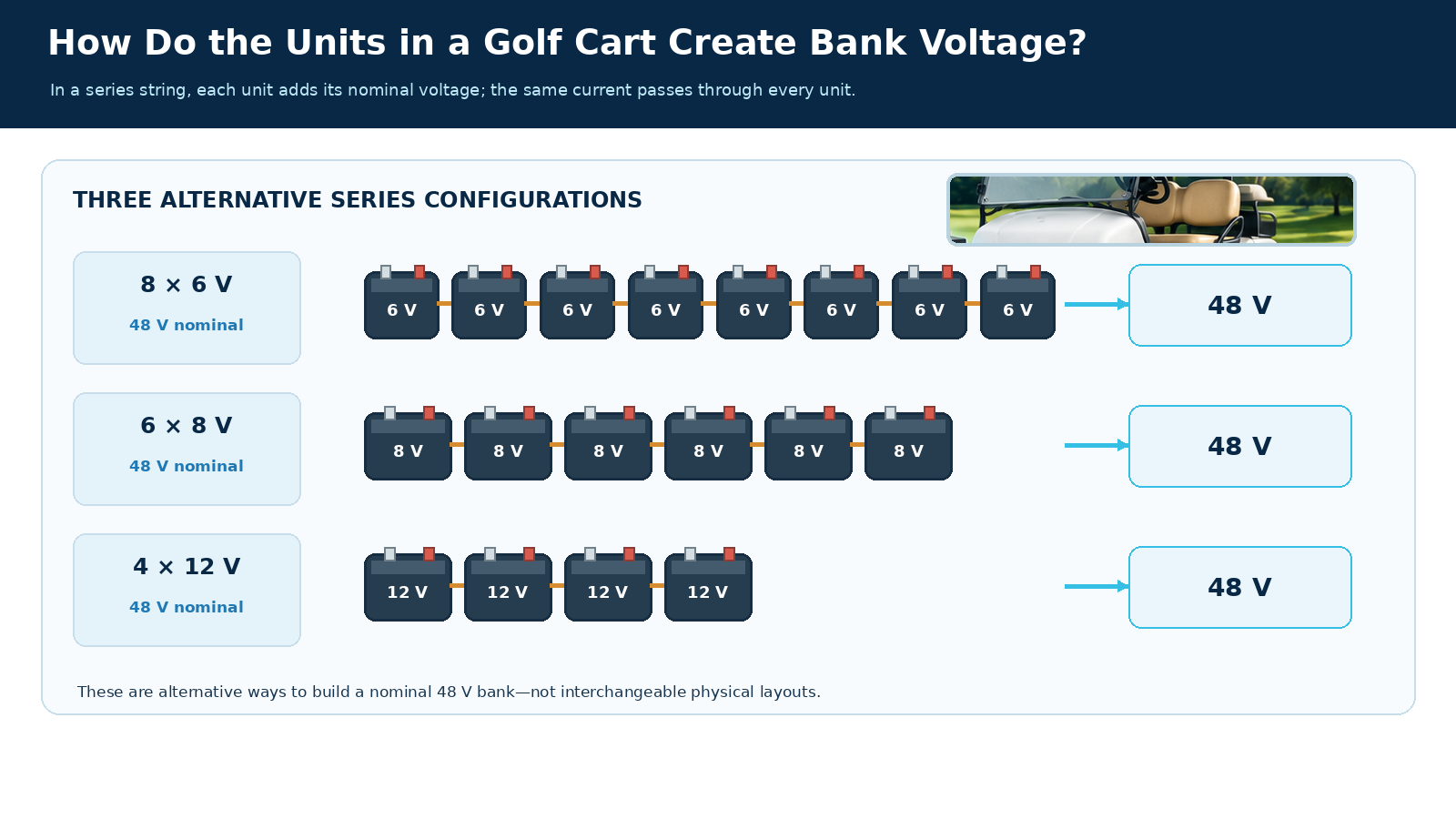
Units connected end to end in one series path add their nominal voltages. The cart sees the voltage between the two outer bank terminals, while the short cables between adjacent units carry the same series current. Trojan Battery's installation guidance gives the 48 V examples of eight 6 V, six 8 V, and four 12 V batteries. These are alternative architectures, not eight batteries that are individually rated 48 V. A 36 V bank can likewise be assembled from a suitable series combination, but its exact count must be read from the installed units rather than inferred from a dashboard label.
The word battery can refer to a single case, an integrated pack, or the whole vehicle bank. Keeping these levels separate prevents a common arithmetic error: six cases marked 8 V belong to one 48 V series bank, while a single integrated module sold for the 48 V system class has already been assembled internally. The cart connects to the whole bank or module at its output terminals. How many cases are visible tells you something about architecture, but not yet whether another arrangement can be installed.
In a series string, the same current passes through every unit. Voltage contributions add, but the string's amp-hour rating remains approximately that of its matched units; it is not the sum of their Ah labels. Six matched 8 V, 170 Ah batteries therefore describe a nominal 48 V, 170 Ah string, not a 1,020 Ah string. Multiplying nominal voltage by Ah gives a nominal energy comparison of 8,160 Wh in this illustrative arithmetic, not a guaranteed usable energy or driving distance. Actual discharge rate, condition, voltage limits, and temperature change what can be delivered.
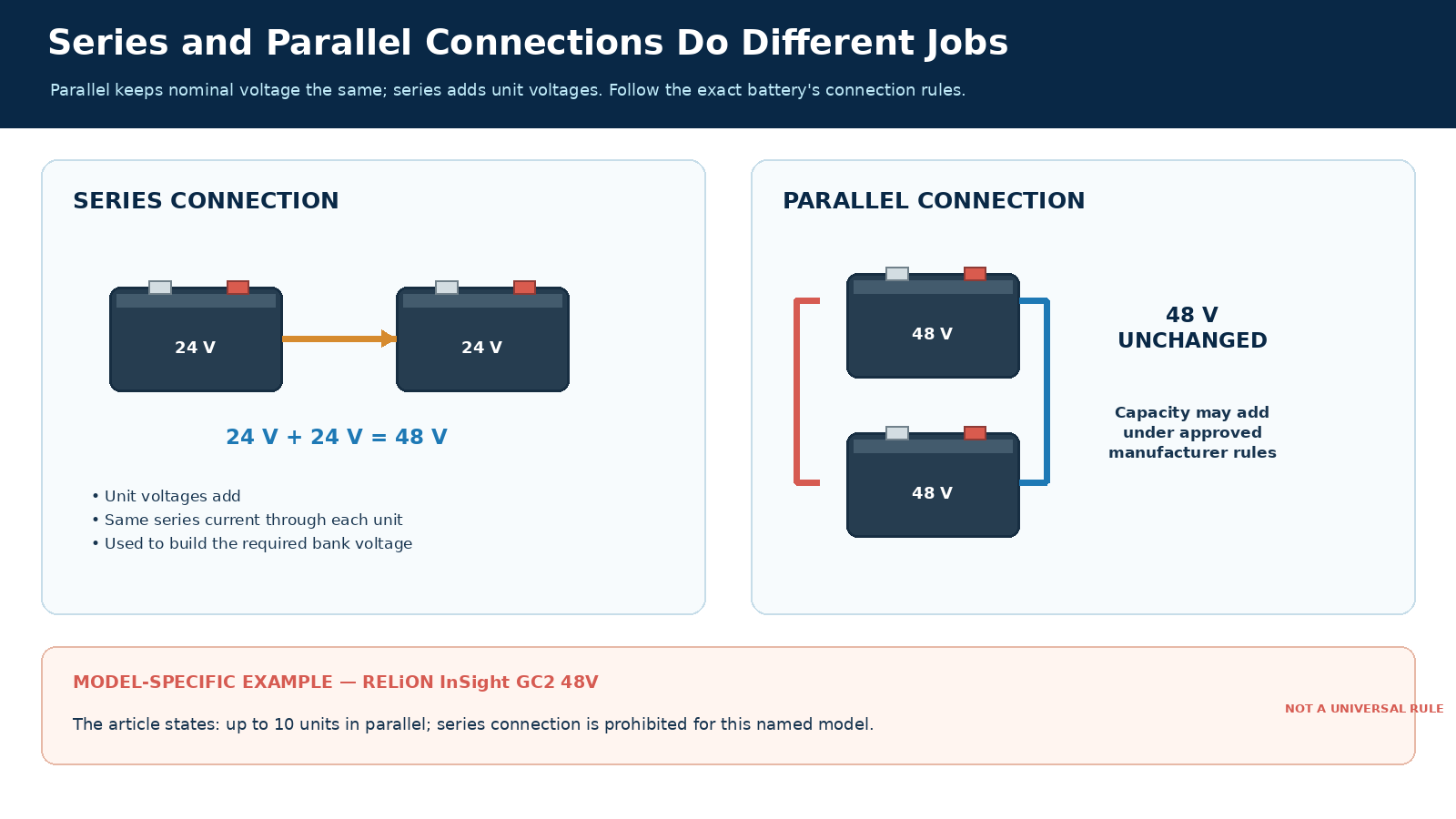
Parallel connection keeps the same nominal voltage while allowing approved, equal-voltage strings or modules to supply more capacity and potentially more current. The parallel branches meet at the same positive and negative output nodes; they do not become a higher-voltage string. If two compatible 48 V strings are paralleled, the cart still sees a 48 V class output, while their capacity can add under the maker's connection rules. Unequal states or unsupported combinations can produce poor current sharing, so the general arithmetic is not permission to parallel arbitrary batteries.
The product design can reverse the familiar pattern of many low-voltage cases in series. The RELiON InSight GC2 48V specifications allow up to ten units in parallel but prohibit connecting that named model in series. Its rule applies to that model; another battery may permit a different topology. Thus, replacing a six-unit lead-acid string with lithium modules does not mean copying the old jumper arrangement. First identify whether the proposed modules already produce the full system voltage, then use only the manufacturer-approved way of increasing capacity. This distinguishes the cart's required bank voltage from the internal and external architecture that produces it.
Two banks can share a 48 V nominal label yet differ in stored energy, available current, voltage during operation, and physical arrangement. Nominal voltage identifies the system class; it does not prescribe the number, chemistry, or rating of its cases. For example, U.S. Battery's Club Car replacement listings show six 8 V units for one configuration and four 12 V units for another. Neither listing makes those layouts interchangeable in a particular cart. The tray, terminals, charger, and vehicle variant still matter.
Changing from eight 6 V cases to six 8 V cases or four 12 V cases changes the number of case positions and the path between them, even when the series sum remains 48 V. It also changes where terminals sit, how many jumpers are needed, and where restraints and service access must work. Those consequences are visible in a battery tray, not in the voltage arithmetic. A replacement should preserve an electrically coherent output and fit the available bay without strained cables, exposed terminals, or unsupported cases.
| Architecture | Nominal result | What the label leaves unresolved |
|---|---|---|
| Eight 6 V, six 8 V, or four 12 V units in series | Each example totals 48 V | Ah rating, operating window, tray position, terminals, charger and controller limits |
| One integrated module sold for the 48 V class | One module supplies the system-class output; a named example is 51.2 V nominal | Its charge and discharge limits and the cart's acceptance of them |
| Manufacturer-approved equal-voltage modules in parallel | System-class voltage stays the same while capacity can add | Model permission, current sharing, wiring and mounting |
An existing tray designed for six cases may need a different restraint or cable layout for one module, and even two products with the same nominal rating can have different allowable voltages. Trojan's bank-selection advice also calls attention to compartment and performance considerations alongside voltage and count. Those differences explain why the arithmetic alone cannot establish a replacement fit.
“48 V” can be a system-class description while the battery's own nominal rating is 51.2 V. The RELiON InSight GC2 48V page gives 51.2 V nominal and 30 Ah, or 1,536 Wh, for a product in its 48 V family. This example shows why the class name and the exact nominal value should not be treated as identical numbers. It does not prove that any 48 V golf cart accepts that product.
Chemistry and cell arrangement determine the module's stated nominal value. The cart experiences a range of voltage during charge and discharge rather than a constant 51.2 V or 48 V. A proposed replacement has to be judged by that range and its interaction with the charger and controller. An owner who rejects every 51.2 V nominal label as “wrong” or accepts every 48 V class label as “right” would miss the actual compatibility question. Use the precise product specification to describe the module, and the vehicle's documented limits to decide whether it can serve the system.
The charging high end and loaded low end matter because the cart and charger experience those conditions, not just the nominal midpoint. A battery whose class label matches the cart can still need a charge voltage or cutoff behavior that the existing equipment does not support. The named RELiON module, for example, lists a 57 V charging peak and 58.4 V high-voltage protection even though its nominal value is 51.2 V. Those are model-specific figures, not universal settings for lithium batteries. The decisive comparison is the proposed battery's specified operating and protection window against the particular cart and charger windows.
Voltage is also measured at different places: a battery at rest, a charger output, and the vehicle controller under load do not necessarily show the same value. Cable loss and current draw can lower the voltage presented to the controller during a demanding event. The bank can have a sound nominal architecture and still fail the cart's operation at a boundary. That is why a voltage-label match is only the starting screen for replacement.
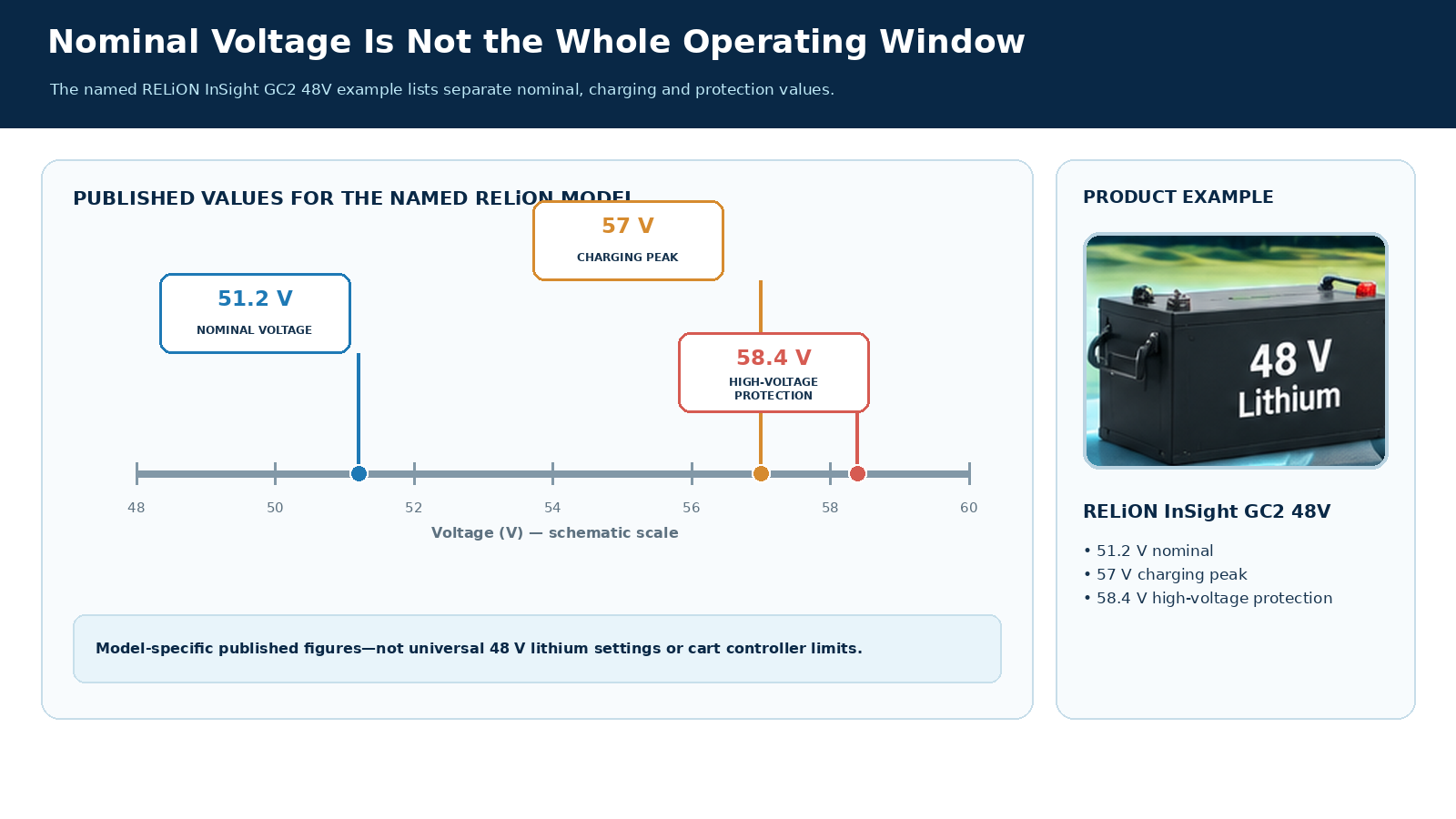
The charger must apply a profile and voltage that the selected battery permits while respecting the connected system's limits. A matching nominal class does not establish that the old charger can complete charge without overvoltage, early termination, or refusal by a battery protection system. The named RELiON specification's 57 V charging peak makes the difference concrete: compare that value with the actual charger output and the selected battery's full charge instructions, not with the single “48 V” badge on the charger.
This is a comparison of published limits and observed equipment behavior, not an invitation to set a charger to a guessed number. If the existing charger cannot implement the selected battery's charge method, the replacement architecture may require another approved charging path. If a vehicle has auxiliary loads or control electronics connected to the bank, their allowed voltage also matters during charging. A general article cannot certify those components for an unnamed cart, but it can establish the exact relationship that makes them relevant. A buyer can reject an unsupported pairing before treating the installation as complete.
Near depletion, the battery's terminal voltage can approach a protection cutoff, while the controller may see still less during a high-current demand because of voltage sag and interconnect loss. The relevant outcome is whether the vehicle remains within its usable input range during the required duty, not whether the resting bank once read near its nominal value. The named RELiON page publishes its own protection levels, but those levels cannot be copied to another module or treated as the cart's controller threshold.
An integrated pack can replace several visible series cases as the source of the cart's system voltage, but the old external jumper pattern no longer describes its internal architecture. Instead of choosing six cases and connecting them in series, the installation presents the cart with a pack output, a different enclosure, possibly different monitoring and protection behavior, and the pack's own approved charging limits. The need to match the cart's bank voltage remains; how that output is built and secured changes.
The replacement's case must fit the usable compartment, remain restrained, and leave safe clearance for terminals and cables. The output terminals must be reachable without forcing a cable across moving parts or leaving exposed conductors where the existing layout protected them. The RELiON example gives case dimensions of 260 × 180 × 276 mm, which illustrates what an envelope comparison uses; those dimensions do not describe a Wirentech product or establish fit in any cart. A drawing or measurement of the actual battery bay is the corresponding side of that comparison.
Arrangement also controls where jumpers or external connectors are needed. Multiple small cases can occupy separate tray slots; one module may need a new hold-down position; approved parallel modules may need a distribution arrangement specified by their maker. Keep the polarity and accessible output points clear in a proposed layout. These observations explain why a voltage-equivalent design can be physically incoherent without making this a step-by-step installation guide. If a pack cannot be retained or its terminals cannot be protected with an approved arrangement, nominal voltage does not rescue the proposal.
The old jumper pattern connects lower-voltage units in series to produce the bank output. A module that already produces the system-class voltage needs no identical external series chain; copying those jumpers could violate its connection rules. For the named RELiON InSight GC2 48V, the maker allows parallel connection of approved units but says not to connect them in series. That precise limit demonstrates the principle without implying that every lithium model has the same rule.
The correct layout begins with the selected module's permitted architecture. If several modules are needed for energy or current, their number and branch connections must follow that model's documented rules. The cart's existing cables still have a role at the main positive and negative output, but their original intermediate connection points may disappear. An installer should also distinguish a power conductor from a monitoring or communication connection; similar-looking plugs do not make identical electrical paths. What matters for this H1 is that both the output voltage and the permitted topology remain coherent after the visible bank changes.
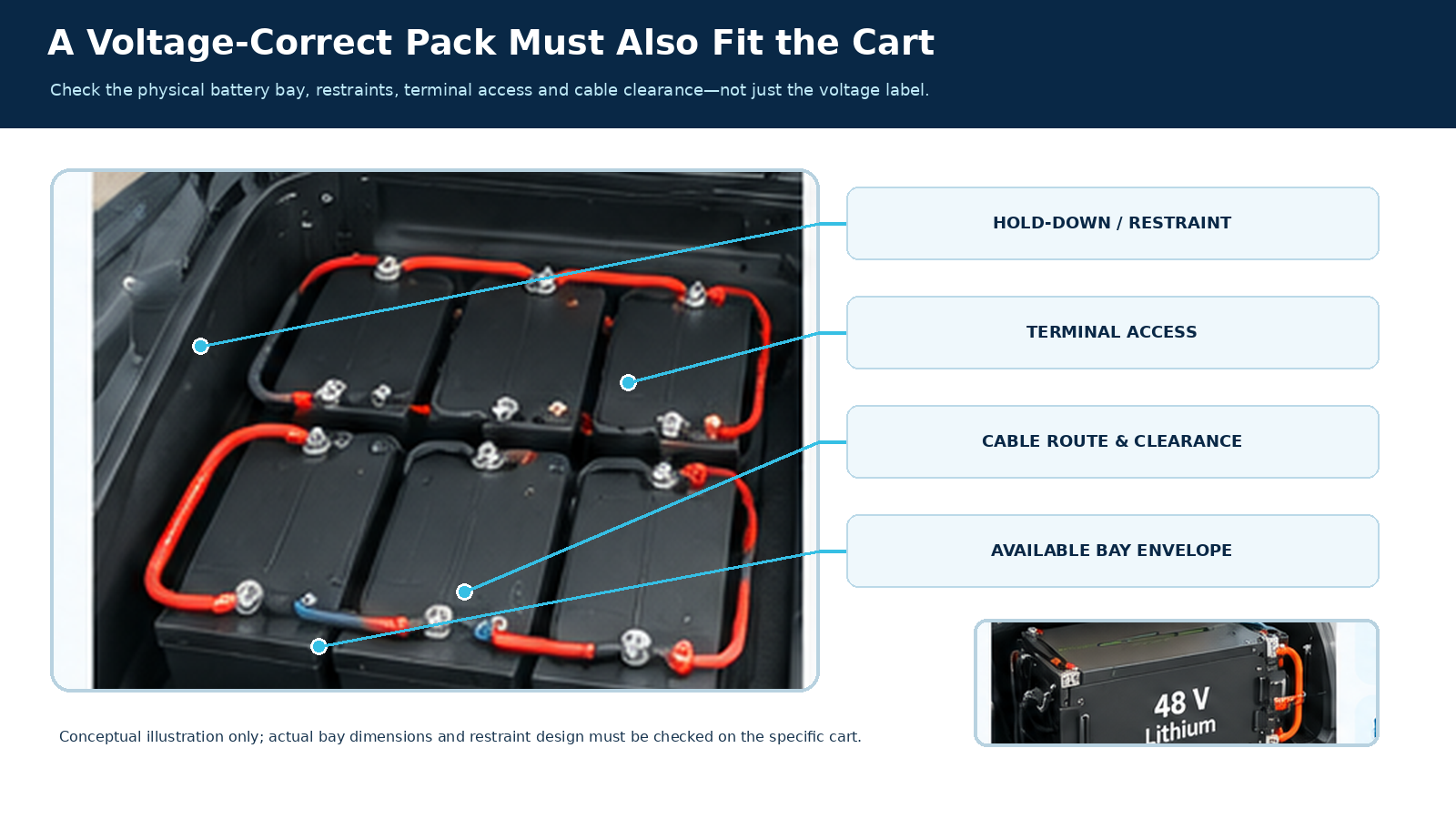
Map the existing main output and each case's rated voltage, count the series path and any full parallel branches, then compare a proposed layout across nominal output, full voltage window, connection permission, and physical envelope. The result should be a diagram that shows what produces the cart's bank voltage and how the cart attaches to it. If one of those comparisons fails, the proposed architecture is not yet a defensible replacement, even if its marketing label matches.
Start at the main negative cable, follow each interconnect to the next case, and finish at the main positive cable. Record the rating printed on each unit and distinguish an external jumper from a cable leaving for the vehicle. The arithmetic of that path establishes the current bank class. A second complete path joining the same output nodes identifies a parallel branch; do not confuse an accessory tap with a full battery string. This mapping is a way to understand the installed system, not a claim that an owner should rearrange live battery cables without the proper equipment and instructions.
Six matched 8 V cases connected in series establish a nominal 48 V bank with six case positions and five intermediate connections. They do not establish the Ah rating, discharge behavior, charger profile, or whether a different integrated pack fits. U.S. Battery's Club Car examples show that real configurations can vary by vehicle variant; the six-unit example is a way to read one architecture, not a universal Club Car or Wirentech specification.
Suppose a cart has six 8 V flooded units and the owner considers a single 48 V class module. First, the proposal must produce the correct system-class output; second, its charge and discharge window must be acceptable to the cart and charger; third, the module must have an approved connection and retention scheme. The unit count will change from six to one, and the existing five jumpers will no longer describe the battery's internal voltage build. Those conclusions follow from topology without assuming any measured range, performance improvement, or completed installation. They also show why buying six replacement 8 V units and selecting one lithium module are different architecture decisions under the same nominal system label.
Reject an arrangement that cannot make the cart's required bank voltage with the selected units or that requires a series or parallel connection the chosen battery explicitly forbids. Defer a proposed exact fit when the battery's charge and discharge window, the cart's controller acceptance, or the physical restraint cannot be established for the named equipment. A missing answer on those decisive interfaces is not evidence that the architecture works.
Related News

Nov. 07, 2026
Can a Home Battery Start and Run High-Surge Household Loads?
Learn why battery kWh alone cannot prove motor-start backup. Compare inverter surge duration, running demand, simultaneous loads and a supervised backup test.

Nov. 07, 2026
How Much Home Battery Capacity Is Needed for Essential Loads?
Calculate home battery capacity from essential-load power, duty cycle and outage hours. See a transparent kWh example and avoid double-counting losses.

Nov. 07, 2026
How Should a Home Battery Specification Sheet Be Read for Backup and Daily Use?
Compare home battery capacity, usable energy, continuous and peak output, charging limits and rating conditions before judging daily use or backup claims.

Nov. 06, 2026
Whole-Home Battery Backup or Critical-Load Backup: Which Scope Fits the Home?
Compare whole-home and critical-load battery backup by protected circuits, peak power, outage duration and load control to choose a realistic home backup scope.
Nov. 06, 2026
Can a Home Battery Provide Backup Power Without Solar Panels?
A home battery can provide backup without solar if grid charging, outage isolation and backup circuits are configured. Learn what limits runtime and recharge.

Nov. 06, 2026
How Does a Home Battery Storage System Work for a Household?
Follow the energy path through a home battery, inverter and controls. Learn how charging, daily discharge and outage backup differ before comparing systems.

Nov. 06, 2026
How Can A Weak Battery Be Distinguished From A Weak Golf Cart Battery Bank?
Compare like-conditioned unit and bank readings to separate one weak battery from broad bank loss, charging shortfall or connection trouble.
Nov. 06, 2026
How Should A Replacement Golf Cart Battery Bank Be Planned?
Decide whether one unit or the bank needs replacement, then specify voltage, fit, connections and first-charge checks before ordering.

Nov. 06, 2026
What Changes When A Golf Cart Battery Bank Is Converted To Lithium?
Map the battery bank, tray, charger, controller, gauge and accessory interfaces that change when converting a lead-acid golf cart to lithium.
Nov. 06, 2026
When Does Lithium Make Sense Instead Of Lead Acid For A Golf Cart?
Compare lithium and lead acid for the same golf-cart duty, charging routine, maintenance capacity and ownership horizon before deciding whether a switch is worthwhile.

Nov. 06, 2026
How Can Peak Current Demand Be Matched To A Golf Cart Battery?
Compare a golf cart’s acceleration and hill-load current by duration with battery continuous, pulse and protection ratings under matching conditions.