

Nov. 06, 2026
Match a golf cart battery to the cart's current demand by comparing both amperes and time. A sustained climb must fit the battery's continuous operating rating; a brief acceleration or hill start must fit a pulse allowance for at least that event's duration. A protection-trip threshold is not a normal operating rating, and amp-hours do not tell whether the battery can deliver a demanding peak. Use a representative loaded event, the selected battery's conditions and limits, and the voltage seen by the controller to judge the match. If the cart's current trace or the product's timed rating is unknown, a specific match remains unproven even though the comparison method is clear.
The events that require the most current for their actual duration set the battery's discharge requirement. A cart may cruise with modest demand yet ask for a short high-current burst when starting on a grade or carrying a heavy load. Another route may impose a lower peak but hold it through a long climb. Both matter, because a battery can pass one event and fail the other. The intended payload, terrain, driving pattern and controller behavior determine which events are representative; an idle reading or a flat, unloaded test can miss the limiting condition.
A hill start may require a high burst while the cart accelerates from rest, whereas a sustained climb can maintain a lower but demanding draw over much longer time. The first calls for an appropriate timed pulse capability; the second calls for a continuous or long-duration operating capability. A pack that tolerates a one-second burst cannot be assumed to tolerate that same current for minutes. Conversely, a continuous rating alone may not describe its short-event behavior. Both ratings must be interpreted for the time scale of the actual load.
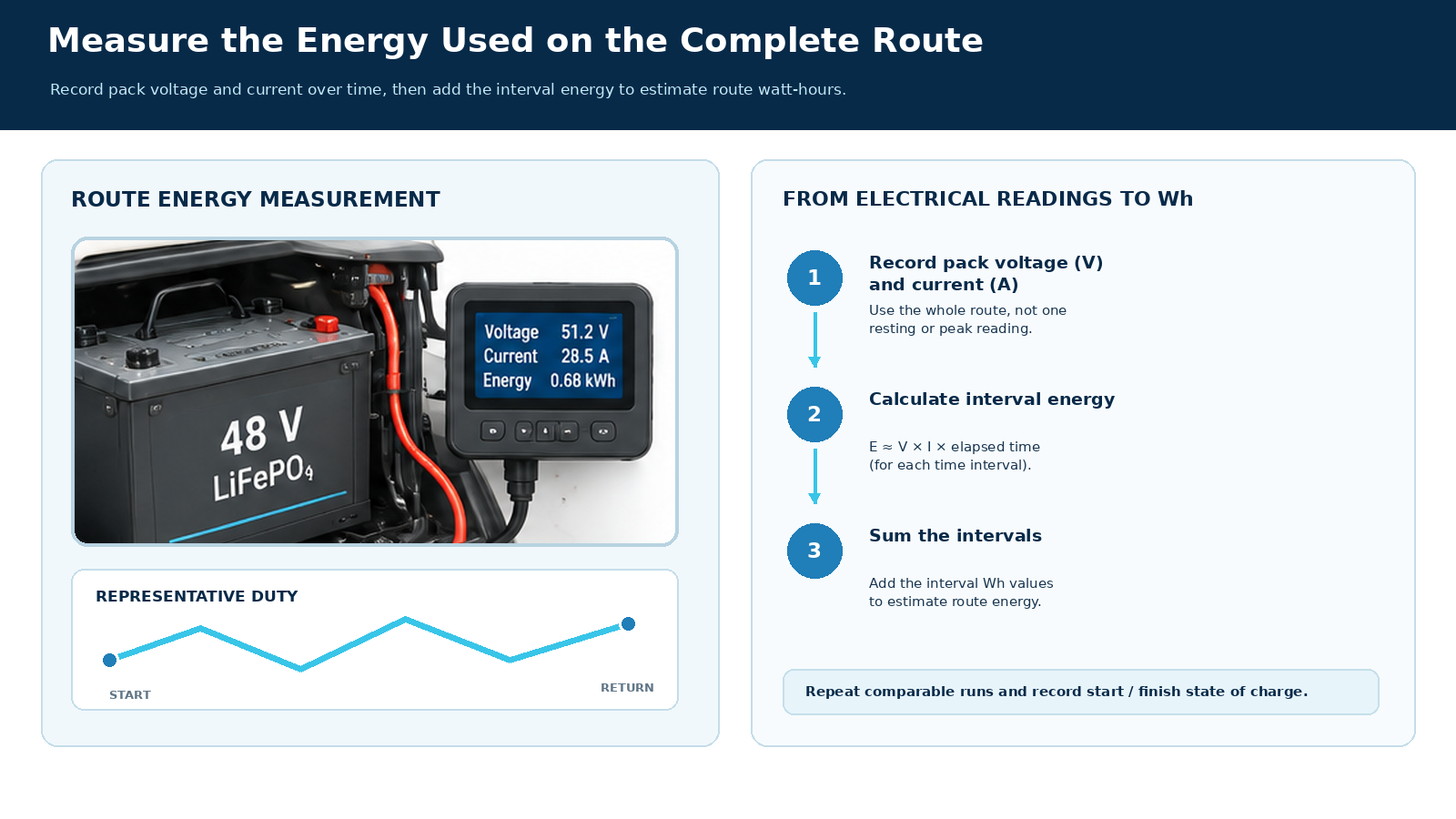
Represent it as current versus elapsed time, with pack terminal voltage recorded over the same interval. A single maximum value discards duration; an average over the entire trip smooths away the peak. For a hill start, the trace shows how high the current rises and how soon it falls. For a climb, it shows whether elevated current persists. Include the initial battery state, load and ambient conditions because an event near the end of a shift can challenge a pack differently from the same maneuver just after charging.
The trace is an input to a rating comparison, not a performance claim by itself. An unsafe connection or unsuitable instrument can distort measurements, and a protective trip ends the event rather than proving that the cart can operate there. If a reliable trace cannot be obtained, a vehicle maker's matching current information may still support an initial screen. An owner's impression that the cart “feels powerful” cannot establish a current margin. The object to compare is a time-bounded electrical demand under the intended duty.
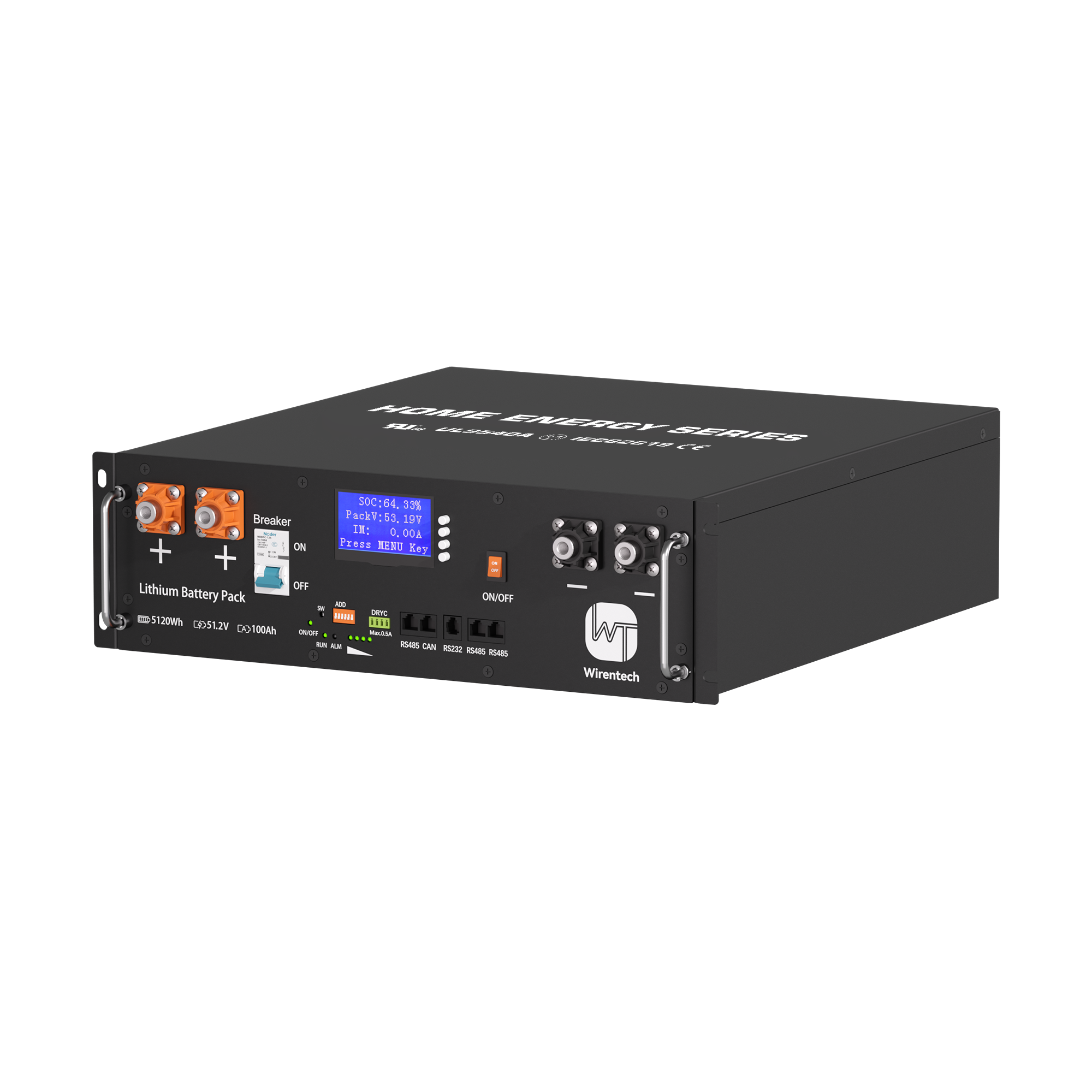
Read every current rating with its duration, operating conditions and stated purpose. Continuous current is intended for sustained operation under the maker's conditions. A pulse figure applies only for its specified short interval, while a trip or short-circuit figure describes protection. The RELiON InSight GC2 48V specifications make these categories visible: the page lists a recommended 45 A continuous current, a 100 A maximum continuous value, several timed overcurrent windows and higher protective thresholds. Those numbers describe that named model, not every 48 V lithium battery.
A timed pulse value permits a specified current for no longer than its stated interval and under the product's stated conditions. The named RELiON page lists, for example, overcurrent windows of 100–120 A for ten seconds, 150–180 A for five seconds and 180–250 A for one second. These are bands and timings in that product's data, not a general recipe for golf-cart motors. A measured five-second event should be compared with the applicable five-second band, not with the higher one-second value.
The event may recur. A repeated series of starts can warm components or reduce the recovery between pulses, so a single isolated pulse rating should not be interpreted as unlimited repetition. The actual source conditions and manufacturer instructions decide what repeated operation is permitted. If a data sheet gives only an isolated maximum with no timing, it does not provide enough evidence to accept the event. The missing technical value is an allowable current at or beyond the observed duration, at the relevant state and temperature.
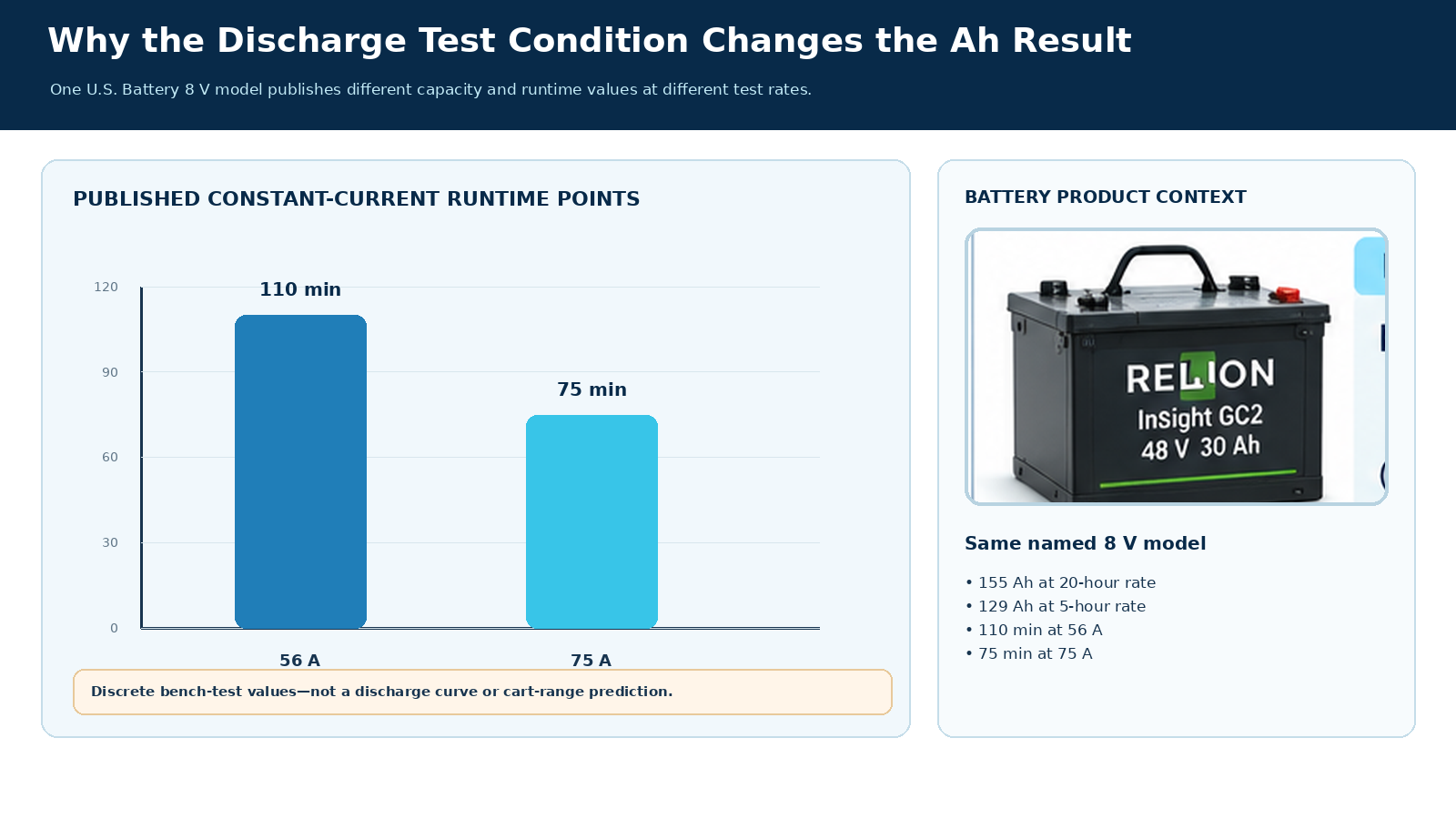
A battery management system trip threshold marks a protective response, not a recommended load. The same RELiON model lists a >250 A overcurrent trip after 0.5 second and short-circuit protection at 350 A. Those values do not mean the cart can repeatedly use 250 or 350 A as normal drive current. Protection may disconnect the pack precisely when the cart needs power; even a trip that does not occur in one test does not demonstrate continuous margin.
Compare the duty with the recommended and maximum operating ratings first. Use a trip threshold only to understand the failure boundary and diagnose why a particular event shut the pack down. The distinction changes the decision: a candidate that survives an isolated acceleration while approaching its protection threshold is not necessarily a reliable match for repeated starts. This applies conceptually to protected packs in general, but the actual trip values, delay, temperature response and reset behavior belong to each model's documentation. Do not copy one module's protection settings into another pack's specification.
Amp-hours describe capacity at stated conditions; they do not establish the current a pack can supply for a particular event. The battery can have enough nominal energy for the whole route yet sag in voltage or reach a current protection limit during a hill start. Trojan's published OnePack XR and HP specifications illustrate the distinction: models with the same nominal voltage and 171 Ah capacity list different continuous and instantaneous current capabilities. Their maker's ratings apply to those models, not to a Wirentech pack or a generic lithium chemistry.
They can reduce the voltage that reaches the controller while current rises, making a demanding event fail earlier than a resting voltage check suggests. A pack may show a plausible voltage before the cart moves yet drop sharply under load because of its state, internal behavior or connection loss. Record voltage and current during the same event. Their timing helps distinguish an ordinary load response from a boundary reached just before power falls away. It does not, by itself, prove which component is faulty.
The named RELiON page publishes a low-voltage protection point for its model, but a controller can have its own limit and the loaded voltage at the controller may differ from battery terminal voltage. One cannot use the battery's nominal 51.2 V label or its charge-temperature cutoffs to infer discharge peak-current derating. Those are different specifications. A specific recommendation must use the selected pack's discharge conditions and the cart's accepted voltage range at the intended state of charge. Here, the important causal relationship is that a current event and a voltage boundary interact.
Manufacturer-approved parallel modules can share load and may raise the system's available current without changing its nominal voltage, but the result depends on the chosen model's rules and current-sharing arrangement. The named RELiON InSight GC2 48V page permits up to ten units in parallel and forbids series connection. That permission is not a promise that any arbitrary number of modules automatically gives proportional real-world current in a cart. Wiring, protection and the maker's configuration instructions still define the usable arrangement.
This matters when one module does not meet the event demand. Additional approved modules may be one path, while choosing a different single pack with a suitable timed rating is another. Neither follows from Ah arithmetic alone. A parallel layout must be judged as a complete battery system, including each branch's allowed current and the common output path. Architecture can change current capability while leaving the nominal voltage class unchanged.
Compare the measured or documented event current and duration with the selected battery's applicable continuous or pulse allowance under matching conditions, then check that loaded voltage remains within the vehicle and battery operating windows. Use the same cart event for every candidate. Do not let one product be judged by a mild cruise while another is judged by a loaded climb. A candidate is acceptable for the current screen only when the relevant limit covers the event with a credible operating margin rather than merely avoiding an immediate trip.
The body table turns this into a repeatable comparison. It is not a substitute for the causal explanation: a high pulse number can be irrelevant to a longer event, and a protection threshold can be higher than the proper operating limit. The numbers in a named manufacturer's document are examples of how to read categories, not values to fill into an unnamed battery's row.
A sustained climb belongs against a continuous or explicitly long-duration rating; short acceleration belongs against a pulse allowance of at least the observed duration; a protective trip value belongs in a fault boundary check, not a normal-duty acceptance column. The battery's stated temperature, state and connection conditions must also match the event. If a rating applies only to one module, do not apply it to a different model or to a multi-module arrangement without the maker's system rule.
| Observed cart event | Relevant battery specification | Decision consequence |
|---|---|---|
| Sustained loaded climb | Continuous or stated long-duration current under comparable conditions | A short pulse label cannot establish that the climb is supported |
| Brief hill start or acceleration | Timed pulse current at least as long as the observed event | The higher one-second rating cannot pass a longer event |
| Event approaches a protection threshold | Normal operating rating and protective trip are separate | Investigate the boundary; do not treat trip current as usable drive capability |
The comparison may reveal that current is adequate but loaded voltage is not, or that one short start passes while a longer climb fails. Those outcomes lead to different technical questions. They do not justify a generic “more Ah” answer.
A lone maximum without duration, operating conditions or whether it is an operating or protective value cannot establish a match. It may be an instantaneous figure, a one-time limit or a BMS trip threshold. The candidate remains unqualified for the specific event until a timed operating allowance is available. This is narrower than saying the battery is incapable; the published information is simply insufficient for that conclusion.
The required answer can be stated precisely: for the cart's identified event, what current is permitted for at least that long at the relevant battery state and temperature? A maximum continuous rating can answer a sustained-load question if its conditions are appropriate. A maximum pulse label cannot answer it. The reader can compare alternative candidates with complete rating data rather than infer the missing duration from an Ah number, a different product family, or a marketing adjective.
A loaded check should show the selected pack supplying the cart's representative demanding event without reaching a protective trip, while terminal and controller voltage remain within their allowed ranges. Record the event's current, duration and voltage, and repeat where the duty normally repeats. A check performed only with the wheels unloaded or immediately after a full charge cannot establish behavior at the end of a working shift. The result should be compared with the product's published operating limit, not with a trip value.
This is an acceptance check for a chosen configuration, not a substitute for installation and electrical safety instructions. A failed event should be interpreted by its pattern: current exceeding an allowed duration, voltage falling before the limit, or a protection alarm can lead to different next actions. A success on one cart and one route does not prove every cart of that model will behave alike under heavier load or different temperature. The check is valuable because it tests the precise event that drove the current decision.
Compare the current-time trace with voltage and any documented protection indication. If current rises beyond a permitted timed window before a trip, the pack's current allowance is a plausible limiting factor. If current stays within that allowance but voltage collapses, investigate battery state and the external connection path rather than assuming insufficient pulse rating. If the charger left the pack partly charged, the failure may reflect the start state. Each branch changes what should be tested next; none can be diagnosed from the nominal Ah label alone.
Do not defeat a BMS or repeat a hard trip to force a pass. A hot connector, damaged cable or other unsafe condition ends the test. The general method uses synchronized observations and the named equipment's instructions; exact alarm meaning and reset behavior remain model-specific. This preserves a practical reader answer without pretending that every lithium pack reports faults in the same way.
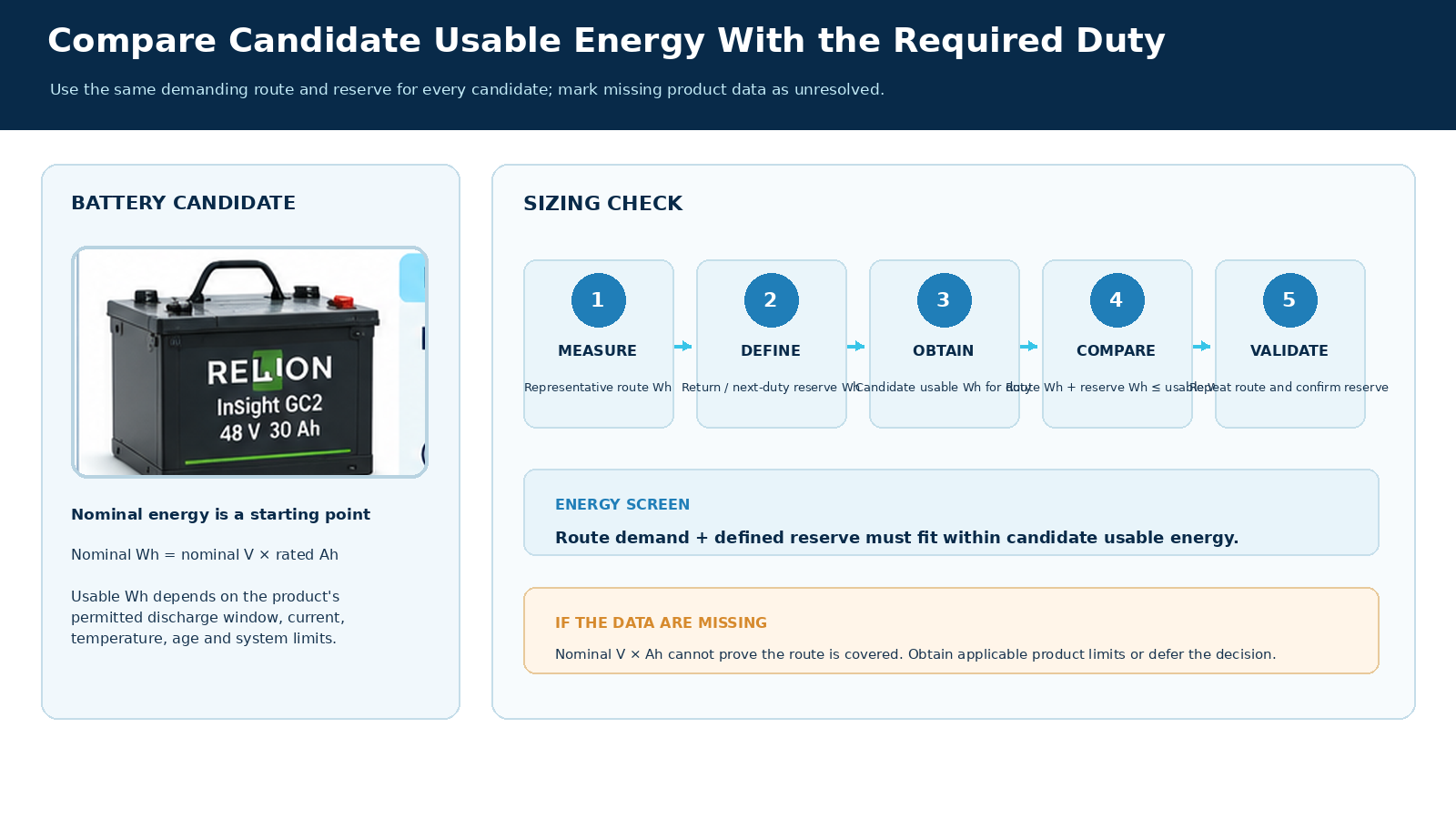
It remains conditional when the cart's worst repeatable event has not been measured or credibly specified, when the battery supplies only an untimed maximum, or when the loaded voltage and environmental conditions differ from the rating. A candidate may look promising from its nominal voltage, capacity and a high “peak amps” number, but those facts cannot prove it covers a five-second loaded hill start or a long ascent. State which side of the comparison lacks evidence instead of declaring a fit.
Related News

Nov. 07, 2026
Can a Home Battery Start and Run High-Surge Household Loads?
Learn why battery kWh alone cannot prove motor-start backup. Compare inverter surge duration, running demand, simultaneous loads and a supervised backup test.

Nov. 07, 2026
How Much Home Battery Capacity Is Needed for Essential Loads?
Calculate home battery capacity from essential-load power, duty cycle and outage hours. See a transparent kWh example and avoid double-counting losses.

Nov. 07, 2026
How Should a Home Battery Specification Sheet Be Read for Backup and Daily Use?
Compare home battery capacity, usable energy, continuous and peak output, charging limits and rating conditions before judging daily use or backup claims.

Nov. 06, 2026
Whole-Home Battery Backup or Critical-Load Backup: Which Scope Fits the Home?
Compare whole-home and critical-load battery backup by protected circuits, peak power, outage duration and load control to choose a realistic home backup scope.
Nov. 06, 2026
Can a Home Battery Provide Backup Power Without Solar Panels?
A home battery can provide backup without solar if grid charging, outage isolation and backup circuits are configured. Learn what limits runtime and recharge.

Nov. 06, 2026
How Does a Home Battery Storage System Work for a Household?
Follow the energy path through a home battery, inverter and controls. Learn how charging, daily discharge and outage backup differ before comparing systems.
Nov. 06, 2026
How Can A Weak Battery Be Distinguished From A Weak Golf Cart Battery Bank?
Compare like-conditioned unit and bank readings to separate one weak battery from broad bank loss, charging shortfall or connection trouble.
Nov. 06, 2026
How Should A Replacement Golf Cart Battery Bank Be Planned?
Decide whether one unit or the bank needs replacement, then specify voltage, fit, connections and first-charge checks before ordering.
Nov. 06, 2026
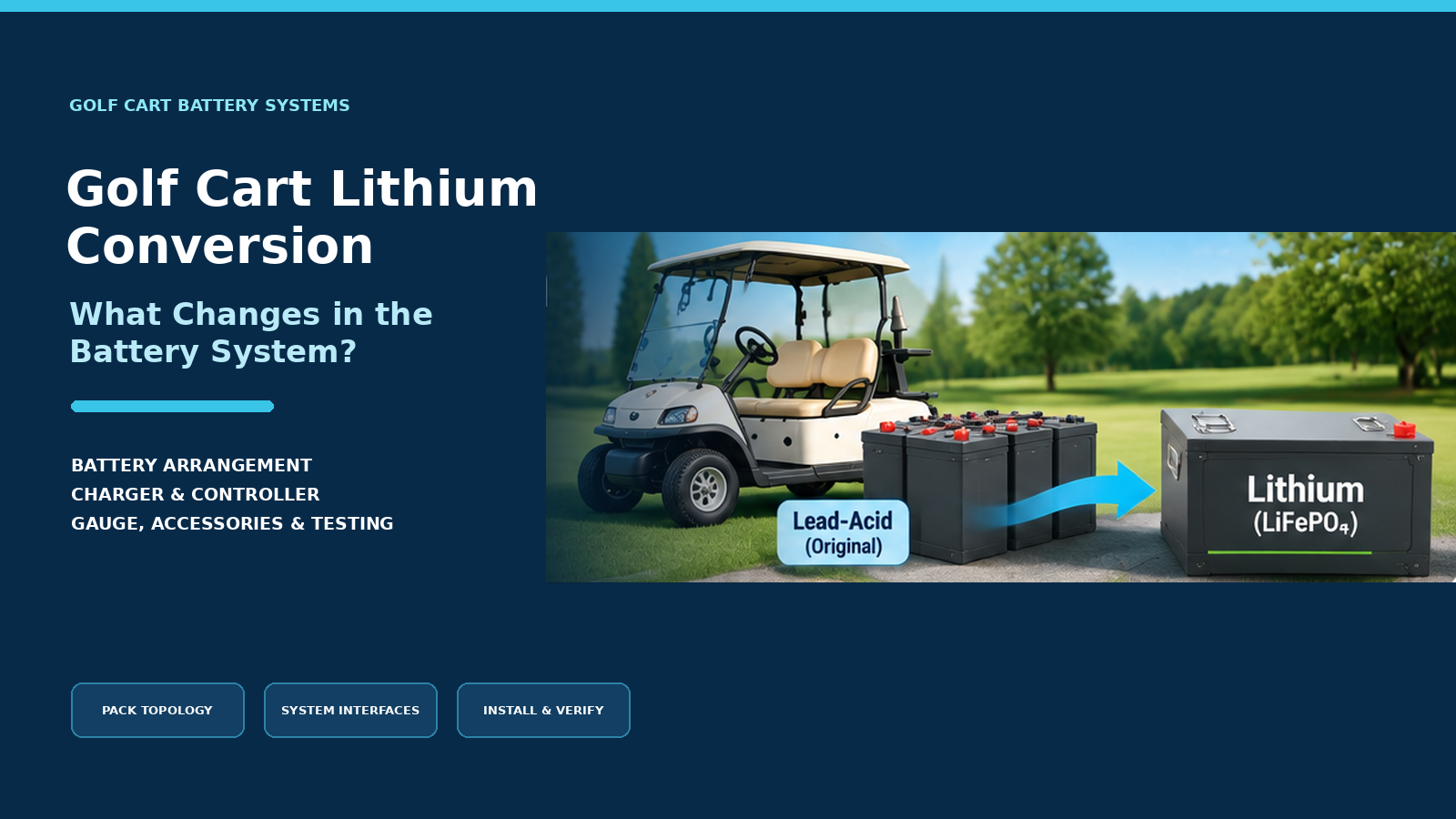
What Changes When A Golf Cart Battery Bank Is Converted To Lithium?
Map the battery bank, tray, charger, controller, gauge and accessory interfaces that change when converting a lead-acid golf cart to lithium.
Nov. 06, 2026
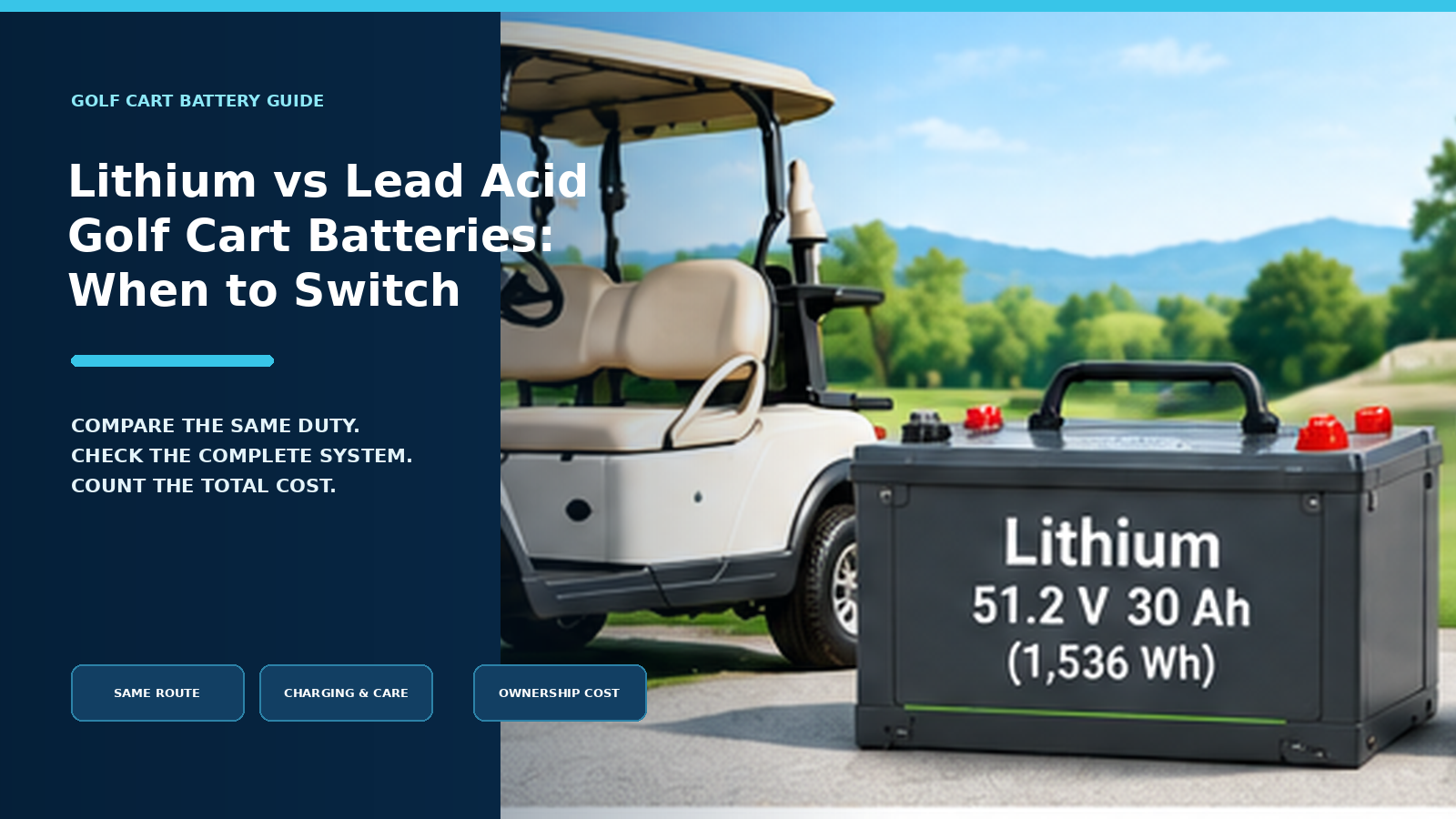
When Does Lithium Make Sense Instead Of Lead Acid For A Golf Cart?
Compare lithium and lead acid for the same golf-cart duty, charging routine, maintenance capacity and ownership horizon before deciding whether a switch is worthwhile.

Nov. 06, 2026
How should a golf cart battery be sized for route energy and reserve?
Use measured route energy, usable battery capacity and a defined return reserve to plan golf cart battery size without treating Ah as guaranteed range.