

Nov. 07, 2026
A home battery can start a well pump, air conditioner, refrigerator compressor, or another high-surge household load during an outage only if the complete backup system can supply that load's starting event and then continue to carry its running demand. Battery energy in kilowatt-hours describes how much electricity is stored; it does not show whether the battery inverter can deliver the current and apparent power needed for a motor to accelerate. The inverter's continuous output, its short-duration overload or load-start capability, the battery's discharge limits, other loads already operating, and the way the motor starts all affect the result. Victron's inverter selection guidance explicitly separates continuous demand from startup surge and combined loads.
This matters most when a household plans to keep a particular motor-driven service available during a blackout. A pump that runs comfortably from the utility may trip a smaller backup inverter as it starts. A large battery may have energy for many pump cycles but still fail the first one. Conversely, a backup system may start the motor successfully but lack enough stored energy for repeated operation over a long outage. This article is about the first question: whether the chosen home-battery system can start and sustain a known high-surge load under realistic conditions. A full circuit-priority choice and an outage-duration capacity calculation are separate decisions.
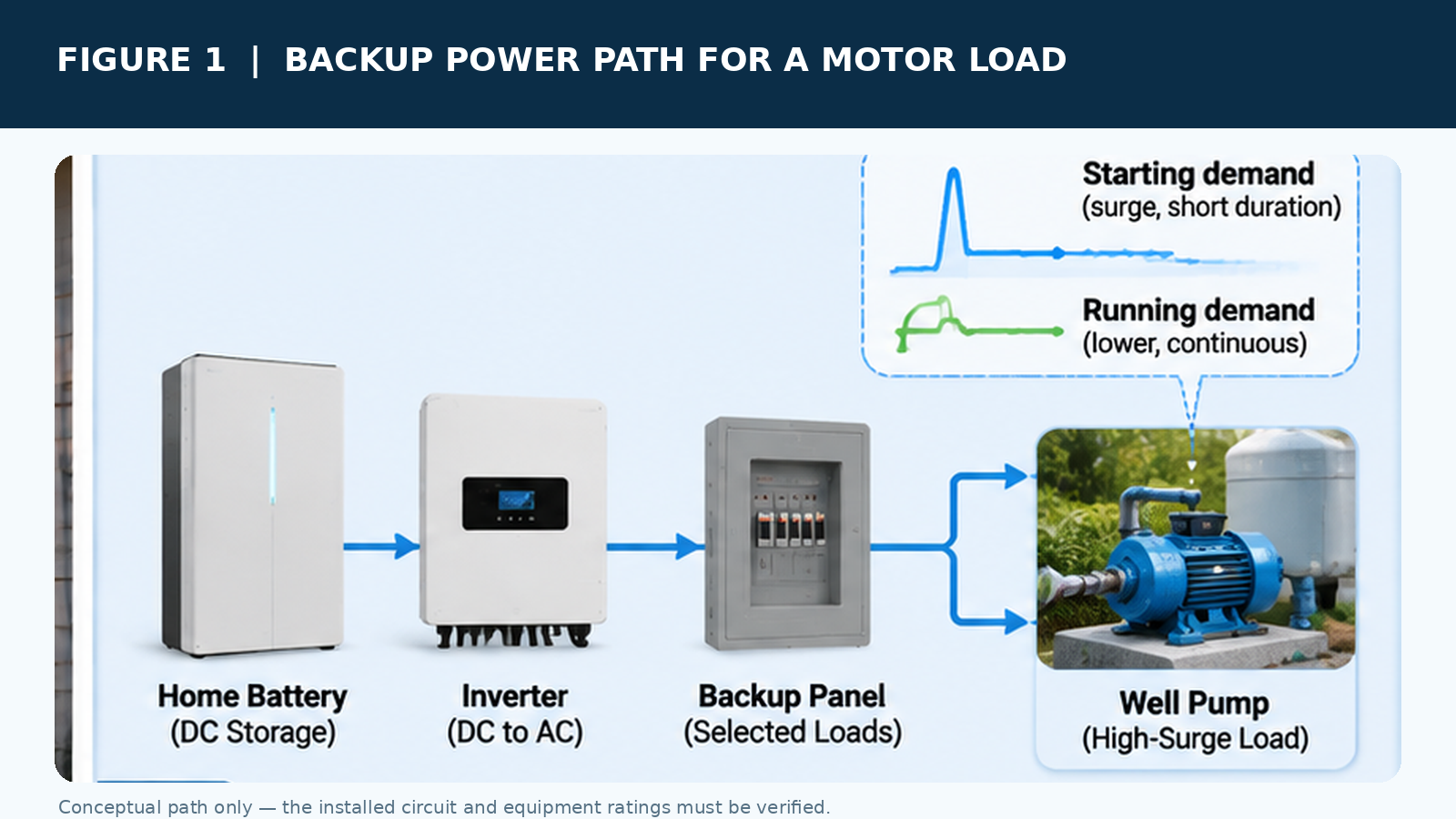
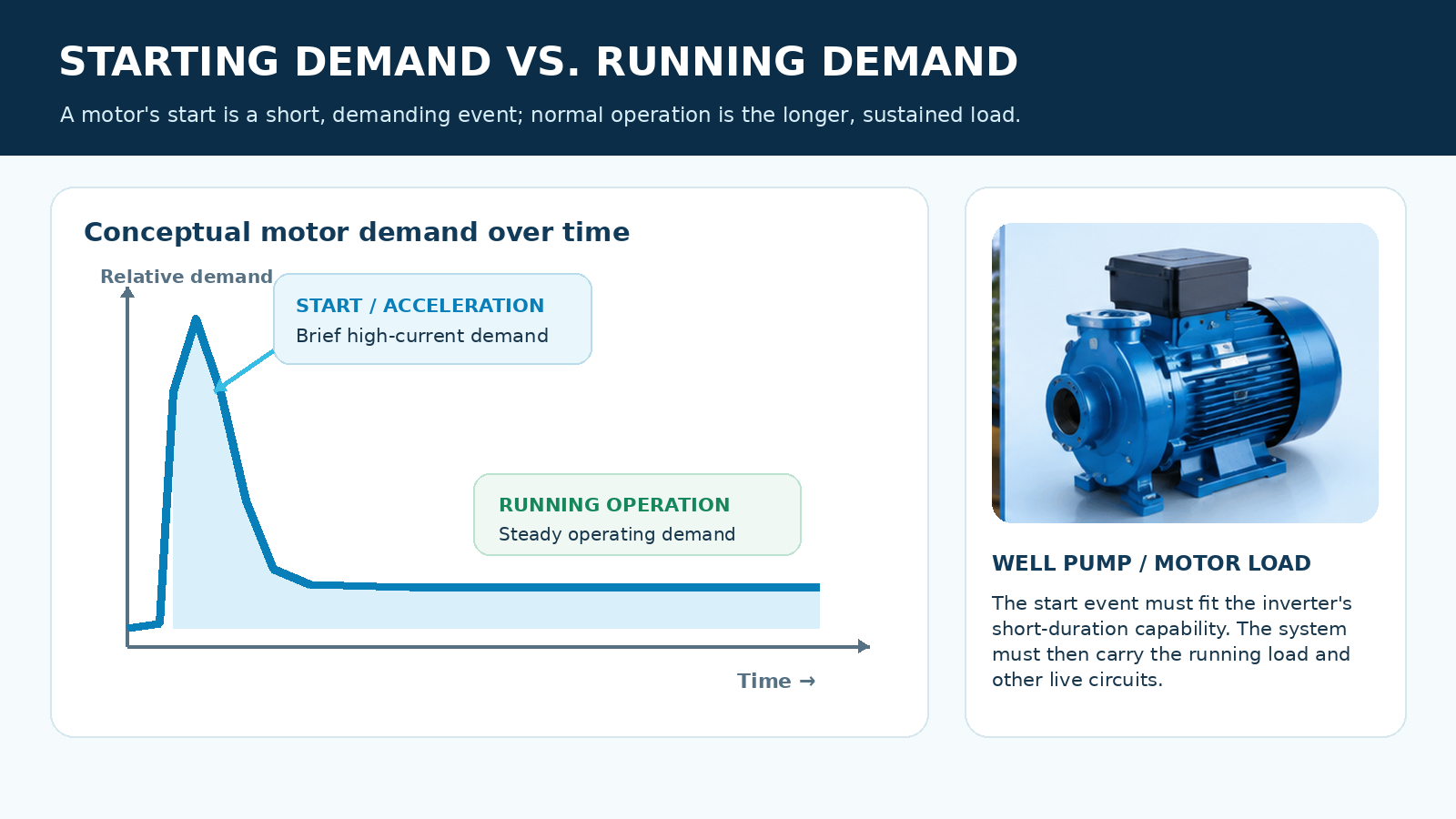
The start is a brief but demanding electrical event. At standstill, many induction motors draw much more current than after they reach operating speed. That current can cause a voltage dip in the supply path or exceed an inverter's protective threshold. If the motor fails to accelerate promptly, the elevated demand can persist until protection trips. Victron's selection guide identifies pump and compressor startup surge as a sizing concern; its inverter operating manual separately describes overload warning and shutdown for that inverter family. Neither source predicts the response of every home-backup device.
Energy and power answer different questions. Kilowatt-hours are the accumulated amount the battery can supply over time. Kilowatts describe the rate of real-power delivery. An inverter also has current and apparent-power constraints, often expressed in amperes or volt-amperes, which matter when a motor's current and voltage are not perfectly in phase. A ten-kilowatt-hour battery could have more than enough stored energy for a few minutes of pump operation but be paired with an inverter whose instantaneous output is too low for the pump's start. Increasing storage energy alone does not necessarily raise inverter surge capacity; adding modules helps only if the selected architecture and manufacturer ratings actually increase the relevant output.
The start cannot be judged from the motor's running watts alone. A compressor or pump may have a modest steady running load after it reaches speed, while its first fraction of a second requires a much higher electrical input. Copeland's compressor starting-method guidance distinguishes locked-rotor current from operating current for its compressor equipment. That relationship varies with the motor, starting method, and mechanical load; multiplying a running-watt figure by a universal factor is not a reliable design proof.
The comparison needs two time scales: the transient start and the longer running period. For the start, the relevant backup specification may be a peak current, surge power, load-start current, or short-duration apparent-power rating, with a defined duration and operating condition. For the run, compare the continuous inverter output and battery discharge capability with the motor and all other loads expected to remain on. A peak figure without a time window cannot establish that a motor will accelerate; a continuous rating alone may understate a system's short surge capability.
Manufacturer documents show why these fields cannot be flattened into one generic “surge watt” number. The Tesla Powerwall 3 technical specifications separately list nominal battery energy, continuous AC output, and a one-second load-start capability. Those figures apply to that named product and its stated configuration and conditions. They cannot be copied onto a Wirentech battery or used to infer a different inverter's result.
The load side must be described with equal care. Running current or rated load current helps identify normal operation. Locked-rotor amperes (LRA), where provided for a compressor, describes the current under a specified locked-rotor test condition; it is a serious starting-demand input but does not describe the complete acceleration event. Copeland's starting-method guidance distinguishes LRA from operating current and explains how motor starting method, voltage, torque, and load affect the event. A nameplate LRA should therefore be assessed with the exact inverter's stated method and limits, not treated as a universal stand-alone pass/fail number.
The table organizes the fields by the question they answer. The appropriate values must come from the exact motor and backup configuration being evaluated.
| Field or observation | What it tells the reader | Why it is insufficient alone |
|---|---|---|
| Battery usable energy, kWh | How much energy may be available across repeated running cycles | Does not establish instantaneous start current or inverter output |
| Inverter continuous output, kW or kVA | Load it can serve after startup, with stated conditions | May not describe its short surge or voltage behavior |
| Inverter peak or load-start rating with duration | Short event it is designed to withstand | Must be interpreted with the motor's start time, voltage and other live loads |
| Motor running current or power | Ongoing demand after the motor reaches speed | Usually understates the electrical start event |
| Motor LRA, start trace or manufacturer data | Size and character of the starting challenge | Nameplate LRA is not a universal one-number feasibility test |
| Actual backed-up-circuit test | Whether the installed combination starts and keeps the load running | One successful test does not cover every temperature, pressure or simultaneous-load condition |
The battery's DC-side limit can also matter. The AC inverter may have a published surge rating while battery management limits discharge under low charge, extreme temperature, or a protective condition. A proposal should therefore identify the complete operating configuration, not pair the largest number from one brochure with an unrelated battery module. The target is a supported start and run at the actual backed-up output, not an abstract comparison of catalog maxima.
Starting demand depends on the mechanical condition at the moment of energization. A pump can start against pressure in its line; a compressor can face refrigerant pressure conditions; a motor driving a loaded mechanism can take longer to accelerate. A longer acceleration period keeps high current present for longer and can exceed an inverter's short-duration overload window even if an instantaneous spike is tolerated. Voltage sag can worsen the situation because a motor may produce less starting torque at reduced voltage, prolonging the start. Schneider's motor-starting calculation guidance connects motor inrush to voltage fluctuation through circuit impedance; its network example explains the relationship but does not predict a particular battery inverter's response.
The home is not a laboratory bench with only one motor connected. A refrigerator may restart just as a well pump or air conditioner calls for power. Lighting, networking, controls, and other backed-up loads already consume some inverter output. Adding the nameplate running wattages may look comfortable, yet the simultaneous start events can briefly demand much more. Victron's selection guide stresses combined connected demand and startup surge. A design that starts a compressor with every other load off may not start it after those other loads are on.
Phase and voltage are part of the fit, too. A motor at a different supply voltage or phase arrangement cannot be judged by simply comparing one total wattage to the battery system's headline rating. The backed-up output must actually supply the motor's circuit in the required electrical form, and any transformer, panel or control arrangement must be included in the design. A statement that a battery is “whole-home capable” does not establish that every motor circuit or starting event has been supported in the specified installation.
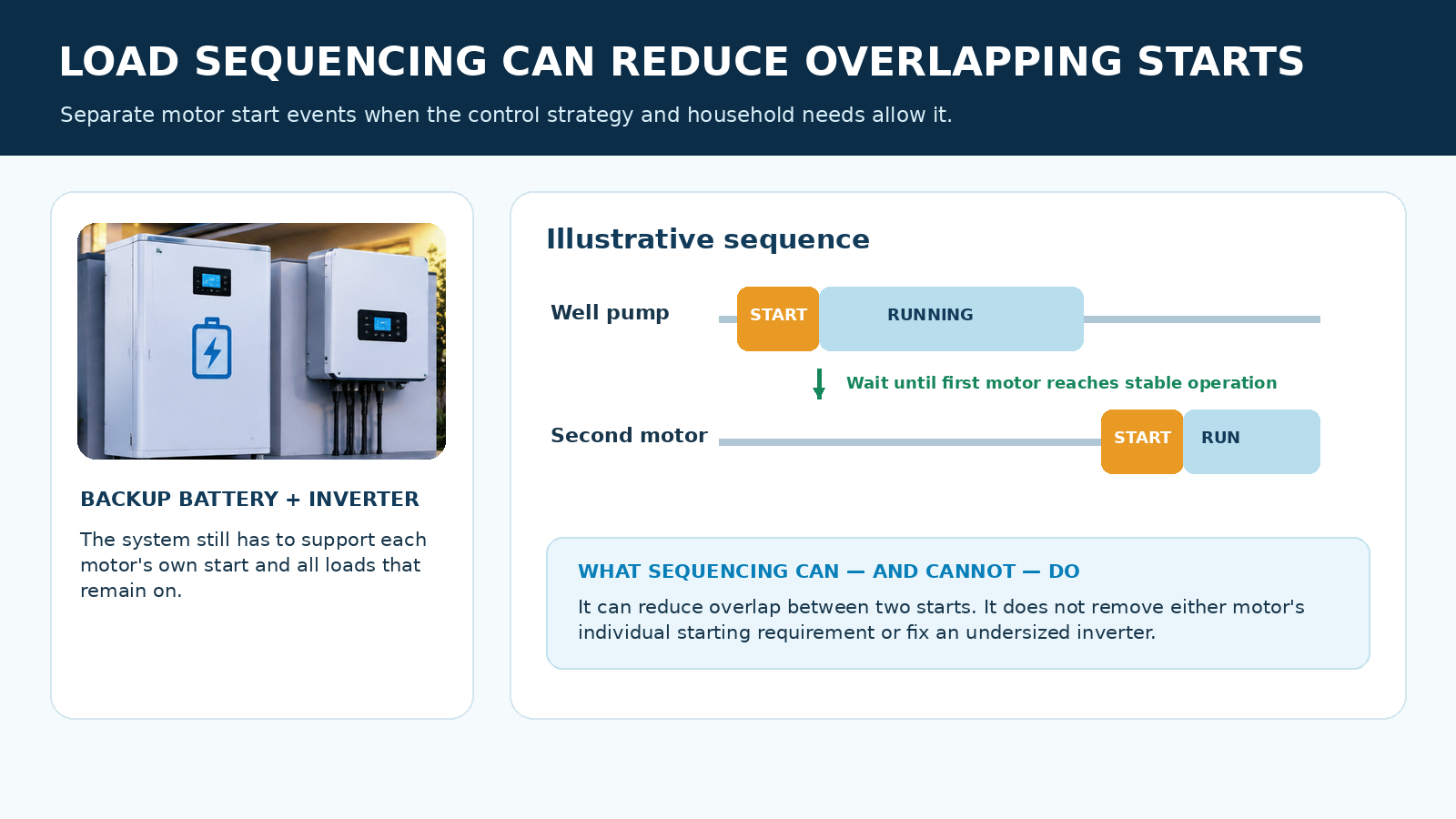
Sequencing can improve feasibility when the problem is overlapping starts rather than one motor's unavoidable individual demand. If a pump is allowed to start only after an air conditioner has reached steady operation, the backup inverter no longer sees both start events at once. Controls can postpone, shed, or prioritize selected loads while off-grid. That changes the maximum simultaneous demand presented to the battery system without pretending the motor's own start has disappeared. The actual control logic and acceptable delays must be designed for the household's purpose.
Sequencing is less useful when the motor alone already exceeds the supported start envelope. Turning off lights may free a little continuous headroom but not enough current for a hard-starting compressor. Nor does sequencing correct the wrong output voltage, an excluded circuit, or a low-charge battery that cannot sustain the start. A design proposal should therefore state which case it is solving: one motor versus inverter limit, two starts colliding, or high background load. Those lead to different remedies.
Load shedding can be an intentional, honest outcome. If a large compressor is not essential during an outage, excluding it or disconnecting it while off-grid protects the other backed-up circuits. Tesla's Powerwall 3 load-design guidance describes product-specific options including load shedding, more units, or moving a motor outside the backed-up circuit when its start exceeds that system's design allowance. The transferable principle is to declare the backed-up outcome clearly. It does not prove those options are available with another brand's controls.
It can reduce the start challenge when it is suitable for that motor and installed configuration, but the result must be checked rather than assumed. A soft starter or drive changes how voltage, current, or frequency is applied as the motor accelerates. Reduced inrush can bring the event inside an inverter's supported envelope. Yet the motor still needs enough torque to accelerate its mechanical load. If a device reduces current so aggressively that the motor cannot start under pressure, the high-current interval may last longer or protection may trip. The Copeland starting-method guidance discusses the tradeoff between current reduction and available starting torque for compressor motors.
Some air conditioners and pumps already have electronically controlled or variable-speed drives. Their startup pattern can differ substantially from a fixed-speed, direct-on-line motor. Adding a generic aftermarket soft-start device to such equipment may be unnecessary or incompatible. Manufacturer instructions for the exact appliance matter, as do warranty and electrical approval conditions. This article cannot prescribe a retrofit from a motor label alone; a qualified installer should confirm that the selected device is allowed and then demonstrate the start on the actual backup output.
There is also no universal percentage reduction that can be safely applied to every household motor. Advertised reductions are usually measured for particular products and conditions. A soft starter changes a physical trajectory, not merely a spreadsheet cell. If the new current trace is documented, compare that trace with inverter voltage/current behavior and the other connected loads. If the trace is unknown, a realistic supervised test is stronger evidence than a claimed generic multiplier.
Start with the specific appliance and its actual backup circuit. Identify its supply voltage and phase, running demand, available start information such as LRA or manufacturer guidance, and whether it uses a fixed-speed motor, electronic drive, or approved soft starter. The aim is to characterize the load that must operate, not to compile every household device. A label can establish useful bounds, while a suitable inrush-capable measurement can reveal the installed start behavior if documentation is incomplete. The measurement should be done by a qualified person with equipment appropriate to the short event; a standard slow-reading current display may miss the peak.
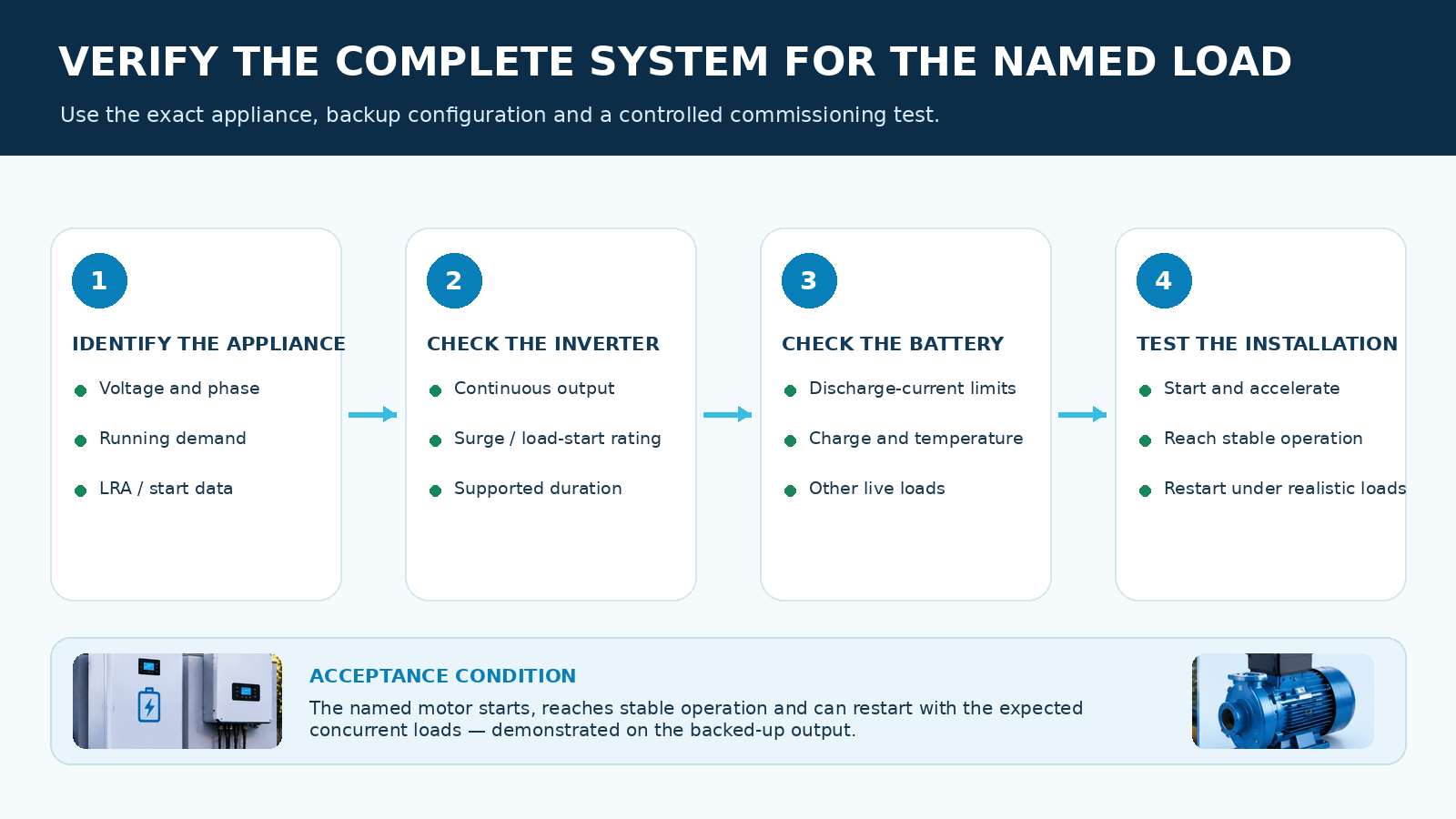
Next, compare those inputs with the exact backup inverter and battery combination: continuous AC output, surge or load-start capability and duration, battery discharge limits, phase/voltage, and behavior when the grid is absent. Include existing loads at the moment the motor may start. If a brochure says “peak power” without its applicable time and conditions, the number is insufficient to decide. Apply a manufacturer's motor-start design rule only to the system it covers.
Finally, a qualified installer should perform a controlled commissioning test on the backed-up output with realistic concurrent loads. The installer should demonstrate that the named motor starts, reaches stable operation, and can restart under plausible conditions. They should record whether the inverter reports overload, voltage reduction, a failed start, or load shedding. A successful single start is encouraging but not proof for all pressure, temperature, state-of-charge, and simultaneous-load conditions; the test plan should cover the conditions that actually drive the decision. If the system fails, the observed failure mode points to a specific next action: adjust the supported load plan, change sequencing, assess an approved soft-start solution, or select a backup system with adequate verified start capability.
Make motor availability an explicit acceptance condition in the proposal: name the appliance, the background loads that may be on, and the off-grid start and run behavior that the installer will demonstrate. If the proposed configuration cannot support that demonstration, treat the motor as outside the backup service until the design changes. This gives the household a clear decision before relying on the battery during an outage.

Previous:
None

Related News
Nov. 07, 2026
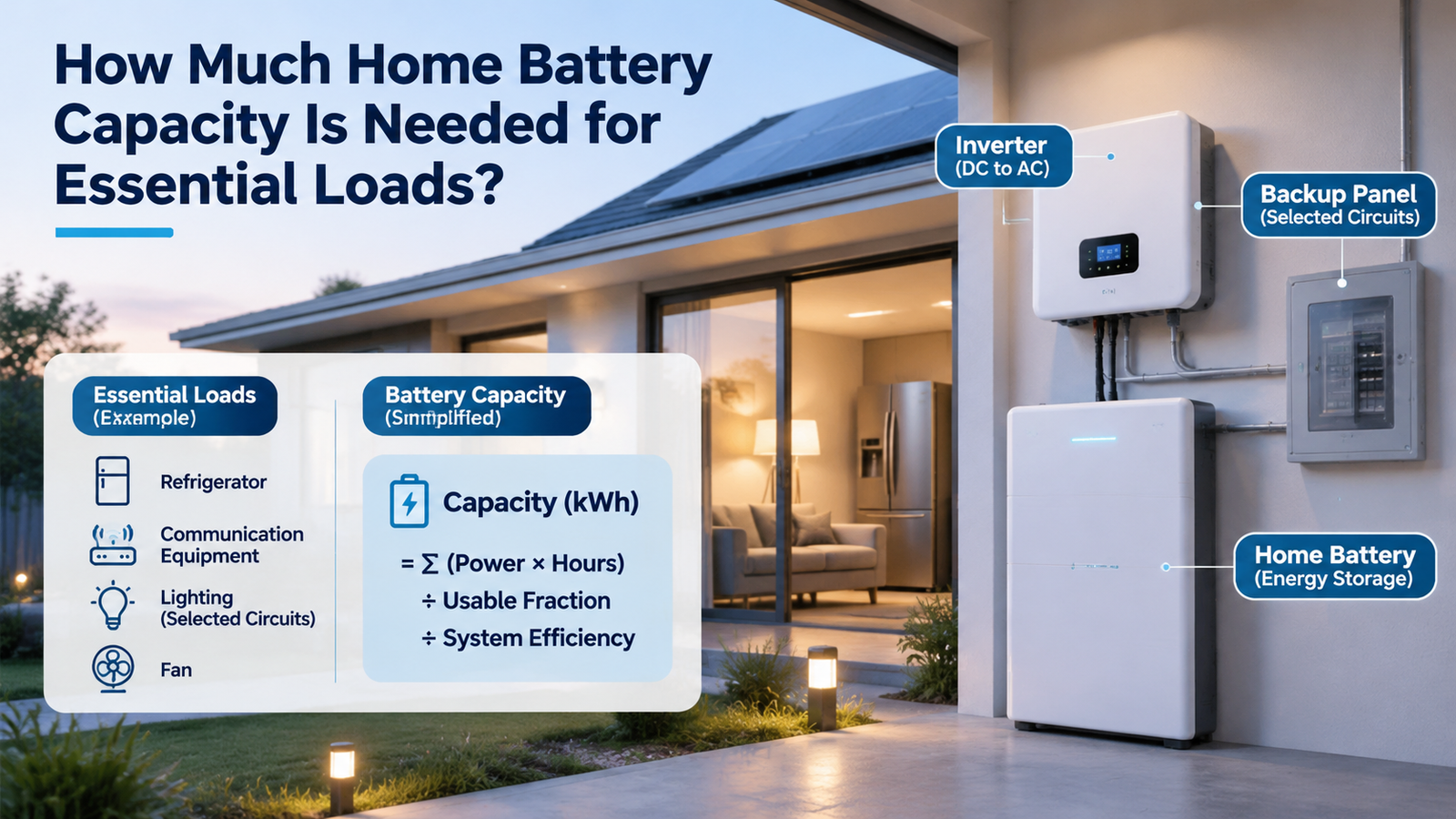
How Much Home Battery Capacity Is Needed for Essential Loads?
Calculate home battery capacity from essential-load power, duty cycle and outage hours. See a transparent kWh example and avoid double-counting losses.

Nov. 07, 2026
How Should a Home Battery Specification Sheet Be Read for Backup and Daily Use?
Compare home battery capacity, usable energy, continuous and peak output, charging limits and rating conditions before judging daily use or backup claims.

Nov. 06, 2026
Whole-Home Battery Backup or Critical-Load Backup: Which Scope Fits the Home?
Compare whole-home and critical-load battery backup by protected circuits, peak power, outage duration and load control to choose a realistic home backup scope.
Nov. 06, 2026
Can a Home Battery Provide Backup Power Without Solar Panels?
A home battery can provide backup without solar if grid charging, outage isolation and backup circuits are configured. Learn what limits runtime and recharge.
Nov. 06, 2026
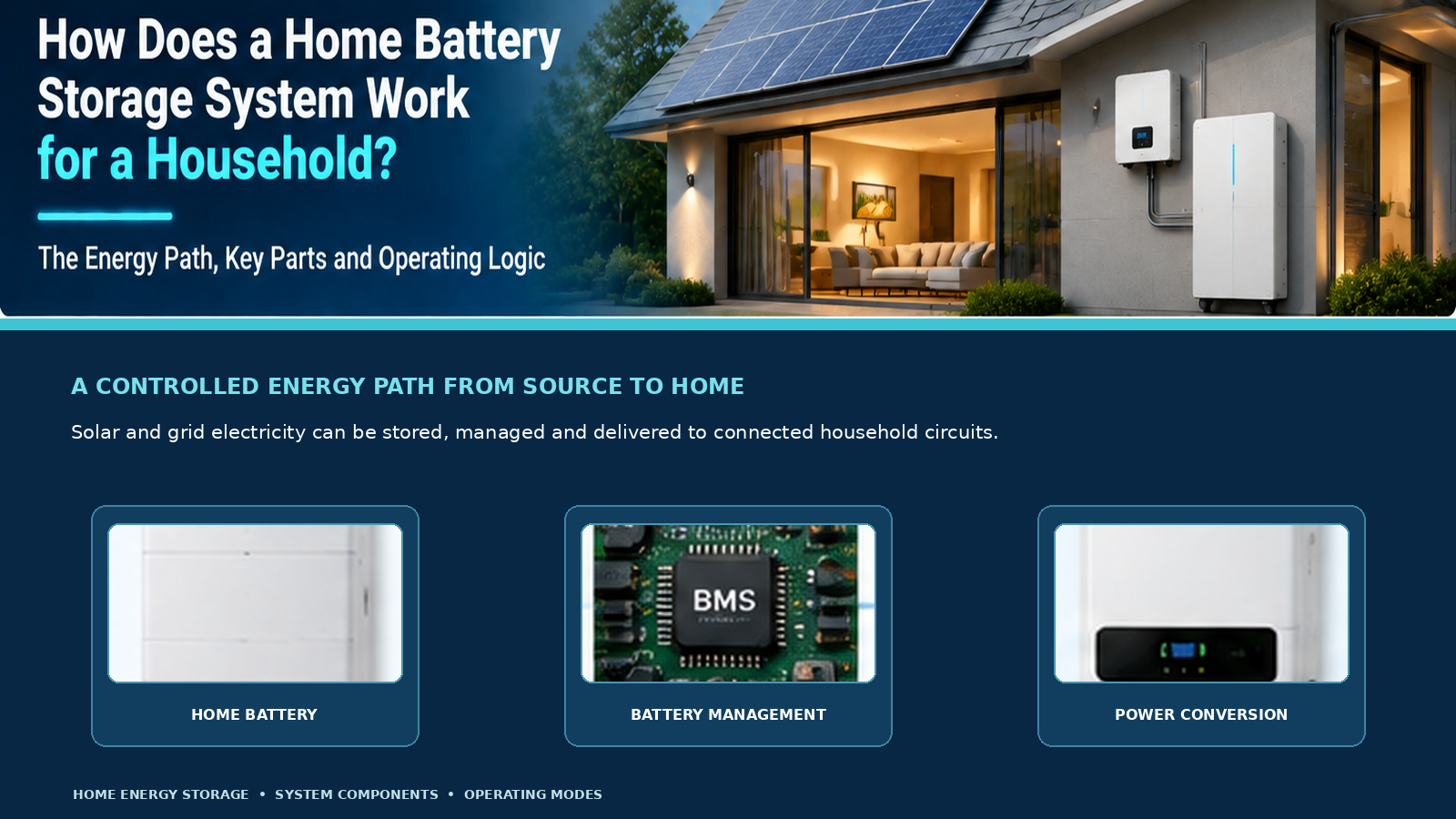
How Does a Home Battery Storage System Work for a Household?
Follow the energy path through a home battery, inverter and controls. Learn how charging, daily discharge and outage backup differ before comparing systems.
Nov. 06, 2026
How Can A Weak Battery Be Distinguished From A Weak Golf Cart Battery Bank?
Compare like-conditioned unit and bank readings to separate one weak battery from broad bank loss, charging shortfall or connection trouble.
Nov. 06, 2026
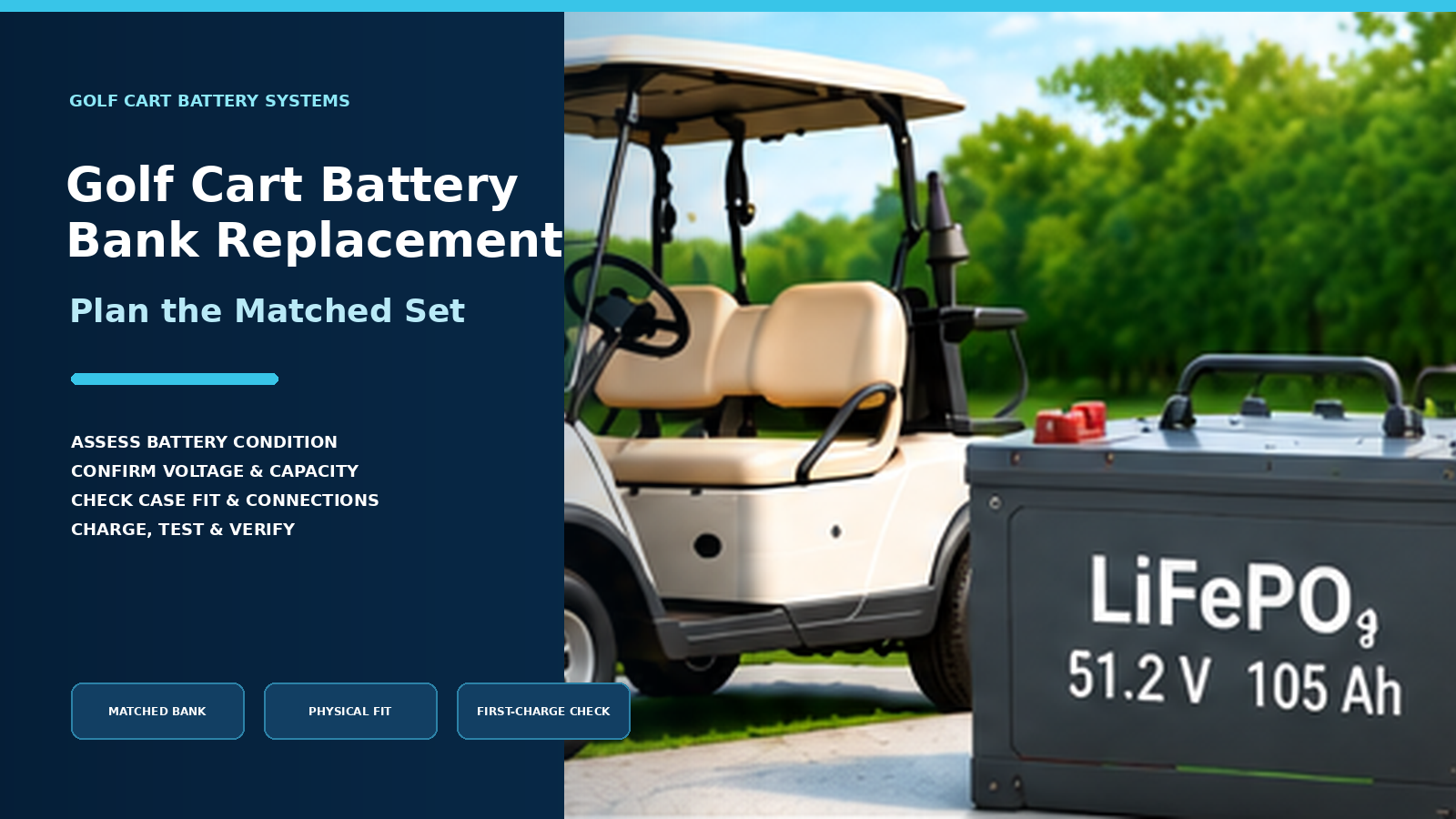
How Should A Replacement Golf Cart Battery Bank Be Planned?
Decide whether one unit or the bank needs replacement, then specify voltage, fit, connections and first-charge checks before ordering.
Nov. 06, 2026
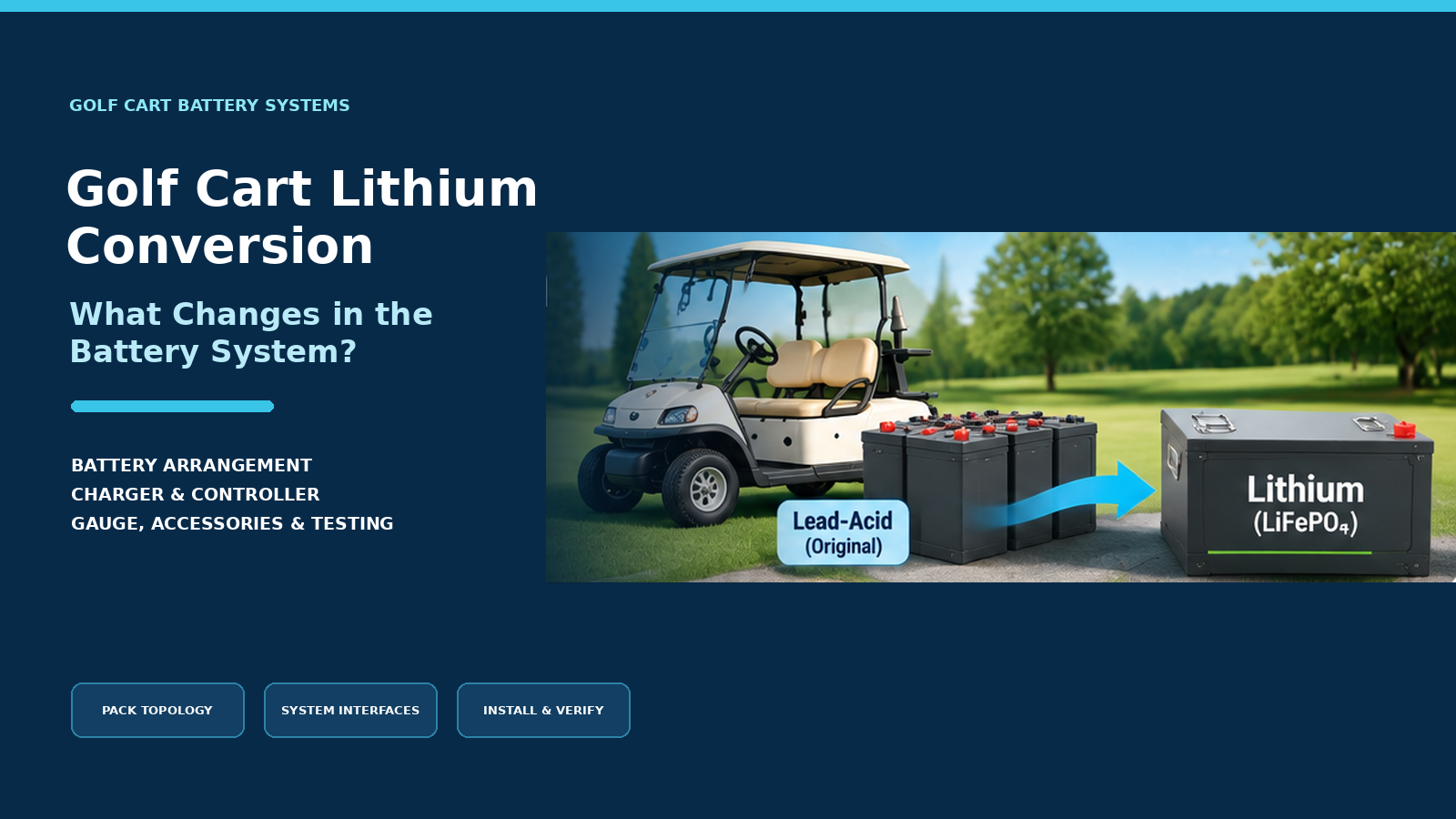
What Changes When A Golf Cart Battery Bank Is Converted To Lithium?
Map the battery bank, tray, charger, controller, gauge and accessory interfaces that change when converting a lead-acid golf cart to lithium.
Nov. 06, 2026
When Does Lithium Make Sense Instead Of Lead Acid For A Golf Cart?
Compare lithium and lead acid for the same golf-cart duty, charging routine, maintenance capacity and ownership horizon before deciding whether a switch is worthwhile.
Nov. 06, 2026
How Can Peak Current Demand Be Matched To A Golf Cart Battery?
Compare a golf cart’s acceleration and hill-load current by duration with battery continuous, pulse and protection ratings under matching conditions.
Nov. 06, 2026
How should a golf cart battery be sized for route energy and reserve?
Use measured route energy, usable battery capacity and a defined return reserve to plan golf cart battery size without treating Ah as guaranteed range.