

Nov. 06, 2026
Yes. A fixed home battery can be charged from the utility grid and then supply selected household circuits when the grid fails, even if the house has no solar panels. The installed system must allow grid charging and have the inverter, controls and electrical switching needed for safe backup operation. A battery that merely stores electricity for use while the grid is present may shut down with the grid. With no on-site generation, an outage also has a hard energy limit: once the available stored energy is consumed, the battery cannot refill until an approved charging source returns. Solar Victoria makes this distinction between storage and designed backup explicit in its battery system guide.
That answer changes the buying question. The issue is not whether a battery needs sunlight to work. It is whether the proposed grid-charged installation can disconnect from the failed grid, energize the circuits you care about, and preserve enough energy for the interruption you expect. Those are separate capabilities, and the absence of solar makes the time until grid restoration especially important.
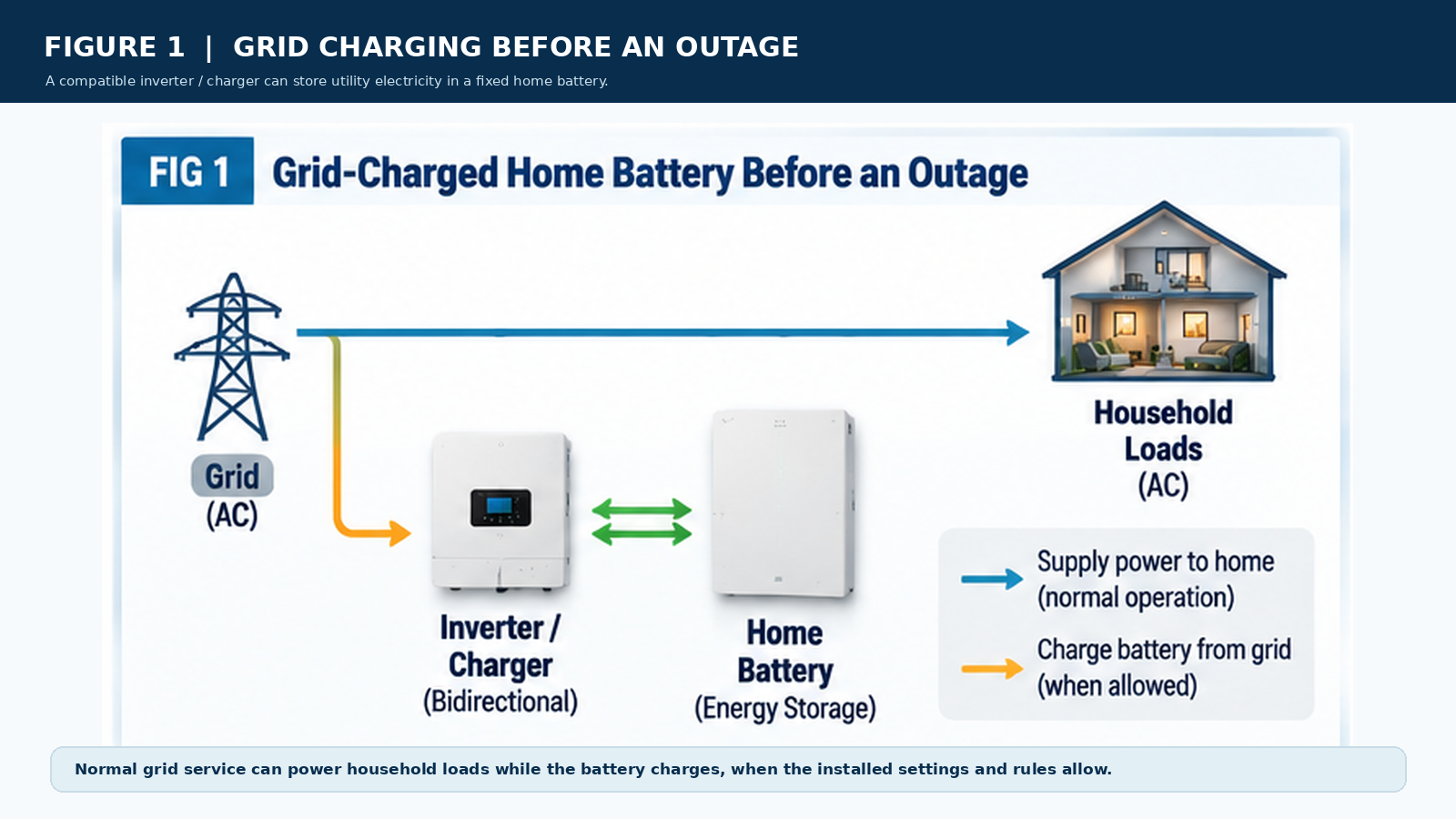
It charges from the grid before the interruption, subject to the equipment's settings and any utility or ownership restrictions. During ordinary service, grid AC reaches a compatible charger or bidirectional inverter, which transfers energy into the battery. The battery management system limits charging according to its operating conditions. Later, the system can convert stored battery energy back to household AC. The charging path does not require a PV array, but it must be explicitly available in the installed product and configuration. Solar Victoria notes that some batteries can charge from the grid; it does not imply that every battery can do so in every installation.
The same hardware may be set up for different priorities. A system intended mainly to move electricity from one tariff period to another may discharge during normal evenings. A system intended mainly for resilience may hold a larger backup reserve. A battery can serve both purposes only to the extent its controls allow; energy spent on ordinary household use is no longer available if a failure follows immediately. In one manufacturer example, grid-charging permissions and reserve settings are separate controls, and the installer may limit the available charging setting. That is evidence of why the proposal must identify the actual enabled mode, not a promise about any other brand or utility (Tesla support).
Reserve creates no extra capacity. A higher setting may preserve more charge for a surprise outage at the cost of less ordinary discharge; a lower one reverses that tradeoff. The relevant value is the state of charge when the outage starts, not nameplate capacity.
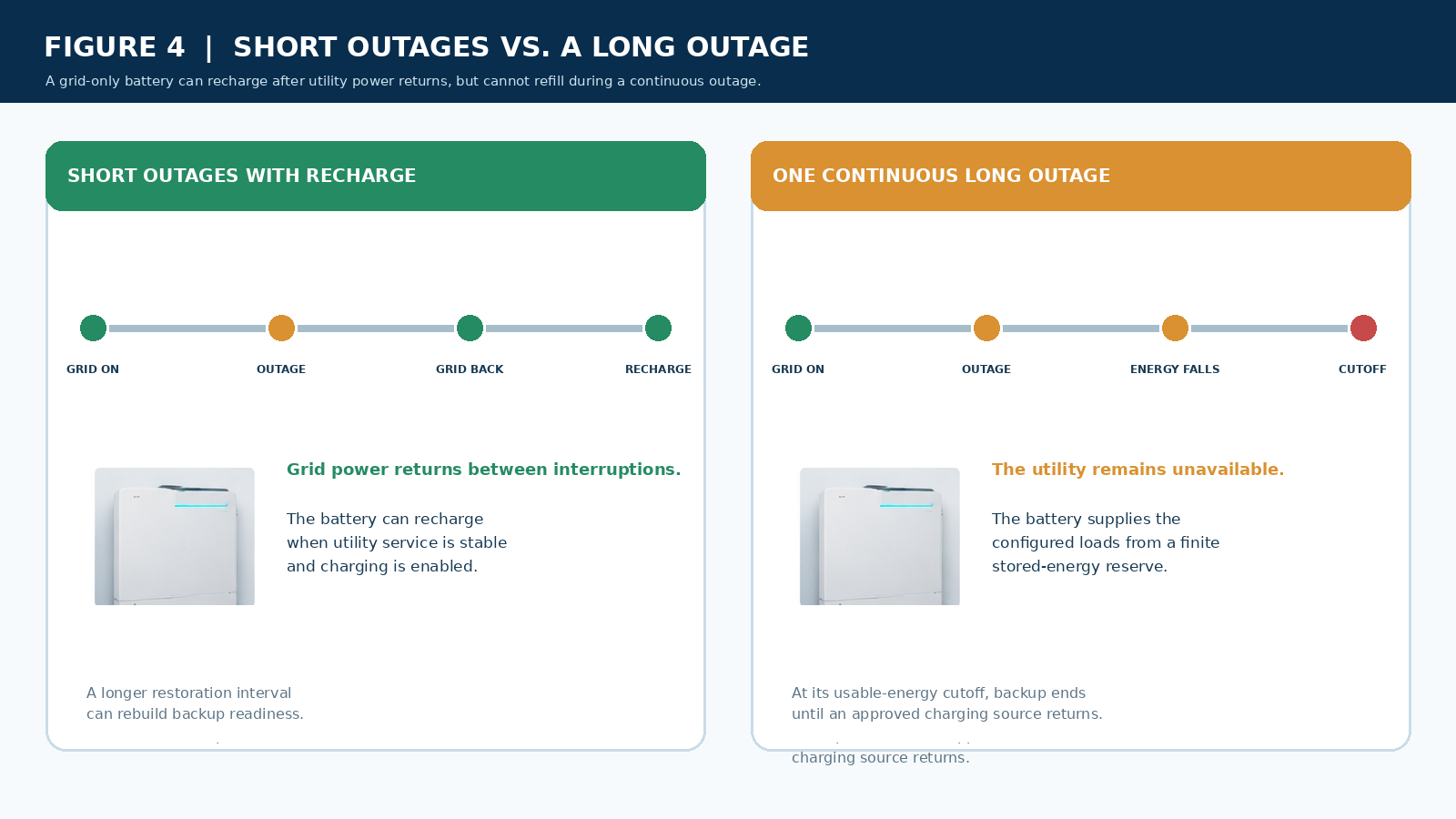
Charging also takes time. After a previous outage or a routine discharge, a short interval of restored grid power may be insufficient to refill the battery. The recharge rate may be restricted by the charger, battery, household electrical service, operating temperature or control setting. A series of outages separated by brief restoration therefore behaves differently from a single outage followed by a long, stable recharge period. The system should be evaluated against the likely sequence of interruptions rather than a diagram that always starts with a full battery.
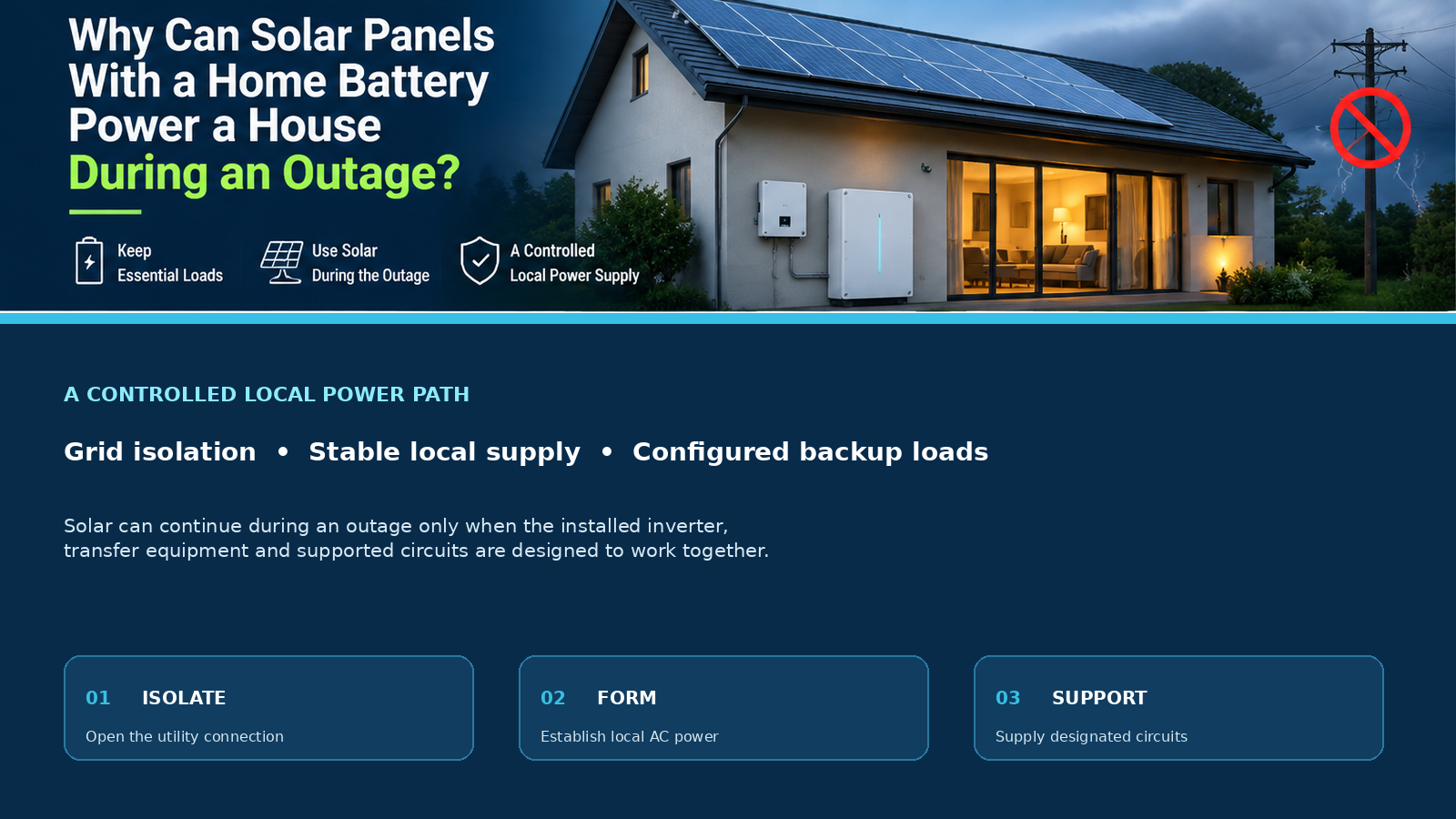
The backup system must recognize the grid failure, isolate the home's backed-up electrical section from the utility, and form an acceptable local AC supply from the battery. An inverter and suitable transfer or switching arrangement perform those functions in the installed design. The battery cells alone do not make a safe household backup system. Isolation protects utility workers and prevents the house from unintentionally energizing an external line; it also establishes a defined electrical boundary for the circuits that will remain supplied. The exact equipment and required tests depend on product design and local rules, so a homeowner should treat a drawing here as an explanation of the operating relationship, not an installation instruction.
An important counterexample is a grid-connected battery installed without backup switching. It can charge and discharge while utility power is available yet provide no household electricity after a failure. Tesla documents both a battery arrangement that charges from the grid without solar and supplies outage power, and a separate non-backup configuration that does not do so (combining systems; non-backup configuration). These are product-specific examples, but they expose the general mistake in the phrase “battery backup without solar”: charging source and outage service are different specifications.
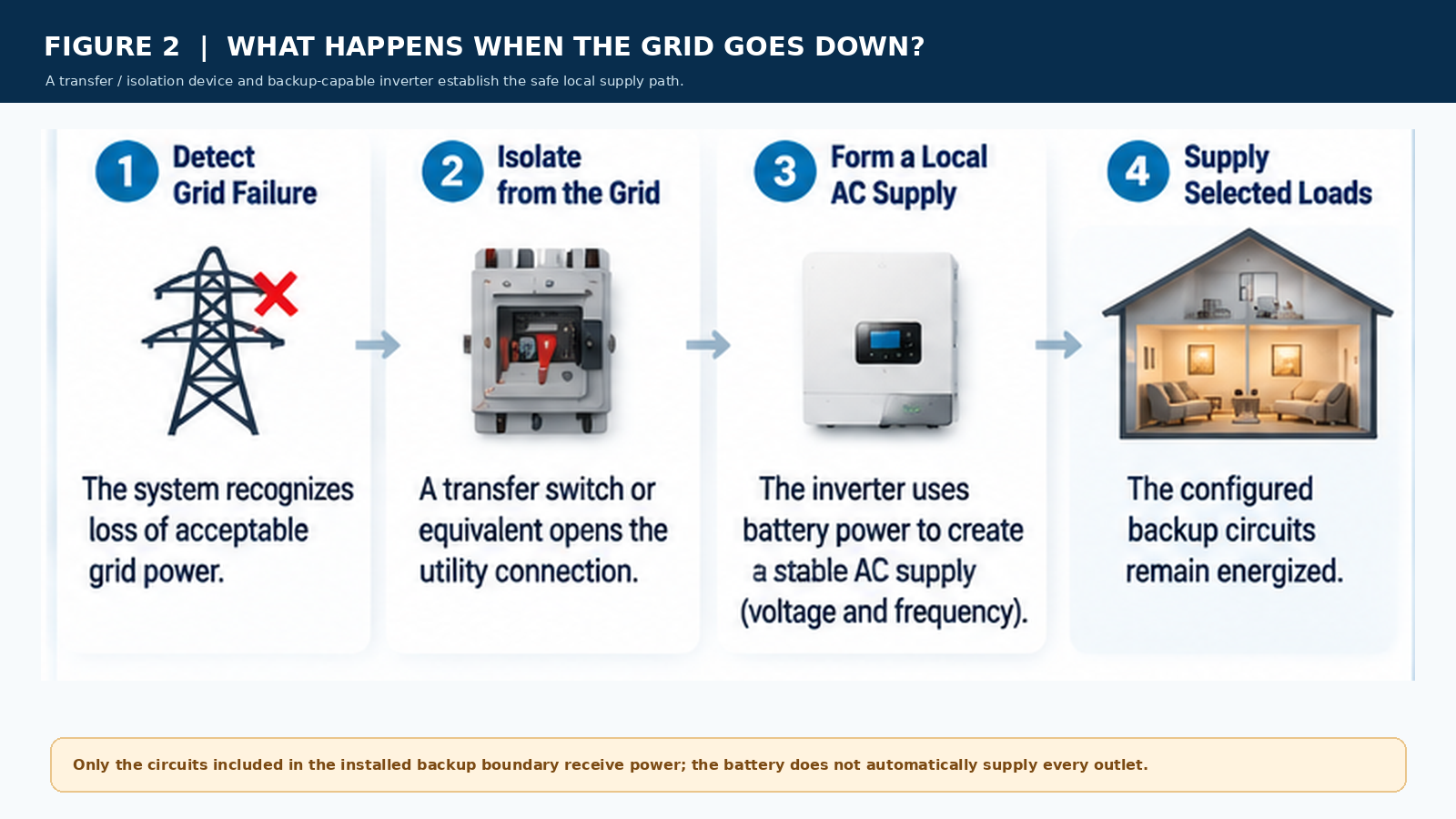
The backed-up part of a home may be a small set of selected circuits or a larger distribution section. The first arrangement can preserve lights, communication equipment and refrigeration while leaving high-demand equipment outside the backup boundary. A whole-home arrangement makes more loads eligible but increases the range of simultaneous power demand the system may face. This article does not choose the boundary for every home. It matters here because a grid-only battery cannot replenish itself during a long interruption, so including many discretionary loads can exhaust the available energy quickly. The circuit plan also determines whether a particular outlet or appliance actually receives power; a battery installed at the house does not automatically back up every outlet.
The transfer may cause a brief interruption. Whether a particular device rides through it depends on that device and the installed switching performance. Do not assume a fixed home battery behaves like a dedicated uninterruptible power supply for every sensitive appliance. If uninterrupted operation is essential, the proposal must state and test that requirement for the specific equipment. Likewise, do not interpret a marketing phrase such as “automatic backup” as proof that every load will continue to run or that a motor will restart successfully after the changeover.
Because the battery is drawing down a finite store and there is no local source refilling it while the utility remains unavailable. The stored energy at the start of the outage is reduced by the energy delivered to the loads, conversion losses and the system's own consumption. The available output may also be curtailed before the cells are literally empty, because the system protects the battery or enforces a minimum state of charge. If daily household demand stays high, the reserve can disappear rapidly; if occupants reduce demand, the same initial charge can last longer. NREL's resilience analysis identifies the energy stored at outage start, the critical load and available PV as distinct factors in backup duration; the no-PV case has no PV contribution.
A simple illustrative comparison shows the mechanism without pretending to size a real home. Suppose a battery has 10 kWh available at the relevant household delivery boundary when an outage begins. If supported loads average 0.5 kW, their energy use is about 0.5 kWh each hour, so the starting energy corresponds to roughly 20 hours before additional operating limits. If the same loads average 1 kW, they use about 1 kWh each hour and the rough interval halves to 10 hours. These are arithmetic examples, not guaranteed runtimes or recommendations for a particular battery. Actual output depends on changing loads, the defined usable-energy boundary, reserve, inverter losses, standby use, temperature and cutoff settings. A refrigerator, for instance, does not draw its rated running power continuously, while a heater may stay on for long periods. A full load schedule is needed for a purchasing calculation; the essential point here is that no-PV backup has no daily refill term to offset consumption.
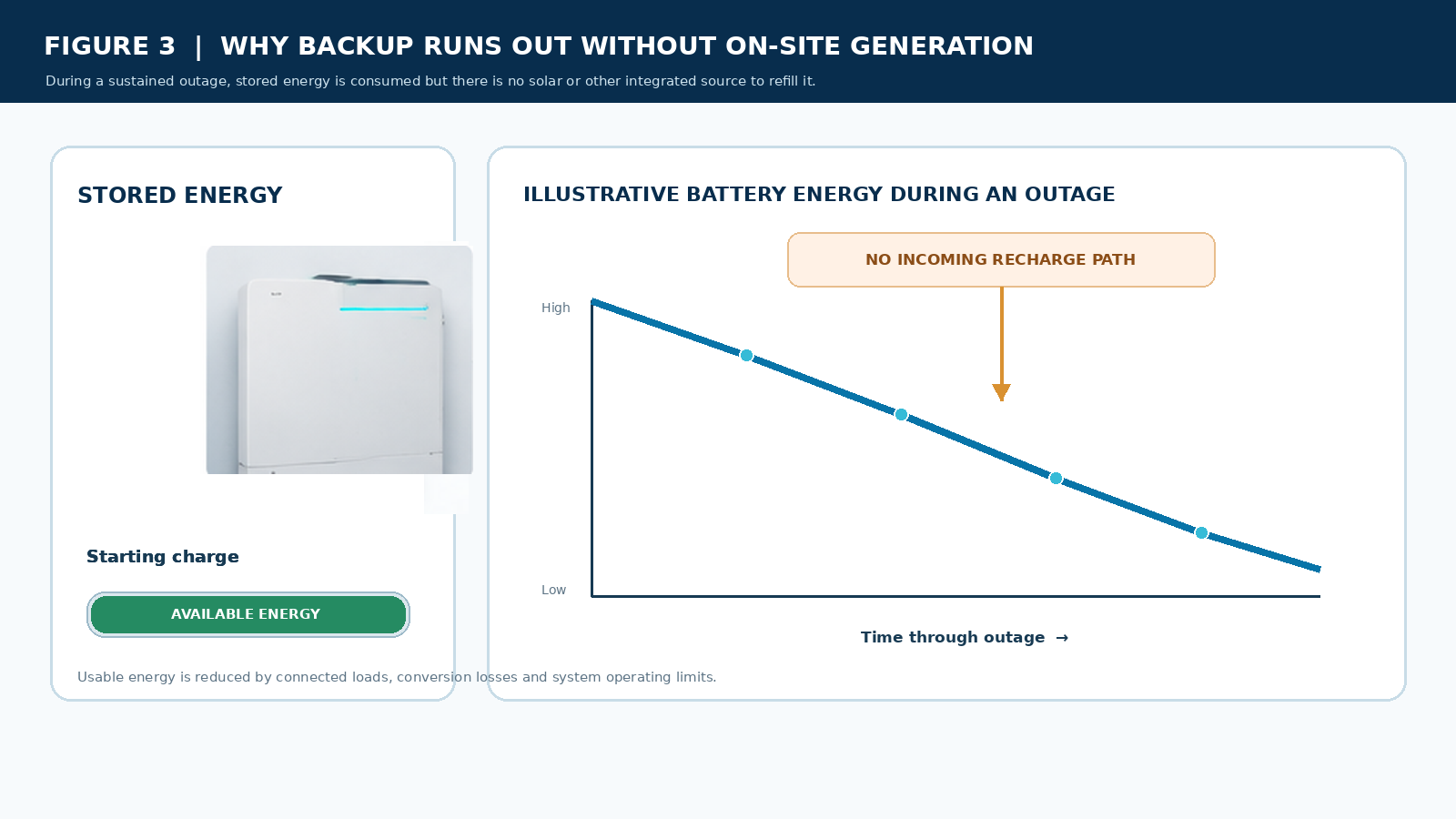
Power and energy create two different stopping conditions. The inverter may reject a simultaneous or startup demand even when the battery holds ample energy. Conversely, it may run the connected loads comfortably at first but shut down after the stored energy is exhausted. Adding battery energy alone does not prove that a high-power appliance can start, and a powerful inverter alone does not extend an empty battery's duration. If one load repeatedly trips the backup supply, the solution may involve the load, its starting behavior, circuit assignment or equipment rating. A claim that “the battery runs the whole house” must therefore be read with both the eligible circuit boundary and the power and duration limits in view.
The longer the outage, the more the initial state of charge matters. A forecast event may allow a supported system to charge ahead of time if grid power is still present and controls permit it. A sudden fault may arrive just after an ordinary discharge. An outage that extends overnight provides no automatic recharge at sunrise in a house without PV. Once the battery reaches its operating cutoff, supported circuits lose supply until the grid or another specifically integrated charging source becomes available. An unrelated portable generator or EV is not automatically a charging source for a fixed battery; compatibility and safe integration would need a separately designed arrangement.
The grid connection, battery state and backup switch jointly determine service. The table separates those changing conditions so a homeowner can identify which promise must be demonstrated. It assumes a generic grid-charged system designed for backup and makes no claim about a named model.
| Operating state | Available energy source | Battery and switching behavior | What the backed-up circuits can receive |
|---|---|---|---|
| Grid available, battery below reserve target | Utility grid | Compatible charger may replenish the battery; backup boundary remains connected according to normal design | Ordinary grid service; future backup readiness depends on time and charge rate |
| Grid fails with stored usable energy | Battery only | Backup equipment isolates the utility; inverter supplies the configured backup section | Electricity while output demand stays within limits and energy remains |
| Grid remains down as energy approaches cutoff | Diminishing battery store | Control may warn, shed loads or stop output under its own rules | Reduced or ending service; no-PV installation cannot replenish from sunlight |
| Grid returns and stabilizes | Utility grid | System reconnects through its approved sequence; charging may resume if enabled | Normal grid service; battery may still need significant recharge before the next outage |
The state changes explain why a commissioning demonstration matters. Seeing the battery discharge in an app while the grid is healthy proves that energy can be delivered under normal conditions; it does not demonstrate isolation, backup circuits or restoration behavior. A meaningful test for this H1 observes the system's approved simulated-grid-failure procedure, confirms which circuits remain energized, and checks that the system returns to normal and recharges afterward. The installer should conduct the electrical test under the applicable rules. The homeowner's role is to understand and witness the promised service, not to operate protective equipment or open panels.
It can be a good fit when the expected interruptions are short enough for the stored usable energy, the house can identify a limited set of important loads, and the grid usually stays up long enough between events to restore charge. It may also suit a homeowner who cannot or does not want to install PV but values quiet, stored-electricity backup. This is a conditional fit, not a claim that a fixed battery is always the cheapest or longest-lasting backup option. A single useful battery discharge can cover a frequent brief failure even if it cannot bridge a multi-day disaster.
The fit weakens when outages commonly outlast a single charge, a high proportion of household demand must continue unchanged, or a critical service cannot tolerate any transfer interruption. Several sequential outages may also defeat a design that assumes a fully charged battery at every start. A home that depends on an electrically powered medical device needs a device-specific continuity plan and appropriate professional advice; the generic duration examples here cannot establish that level of reliability. The same caution applies to electric heating, air conditioning, well pumps and other loads that can change demand sharply. The homeowner can decide what service matters, but an electrical designer must establish whether the actual installation can deliver it.
Cost claims require the same discipline. Grid charging at a lower retail price and discharging at a higher price may reduce a bill under some tariffs and control settings, but the relevant comparison includes round-trip losses, network charges, purchase and installation cost, and any restrictions on grid charging or export. Backup reserve may deliberately keep energy unused through many ordinary days. Those tradeoffs can be worthwhile for resilience, but they make a generic “pays for itself” statement unsound. A buyer should keep the backup requirement separate from a projected tariff benefit unless both are calculated from the same household data and permitted operating mode.
It should prove the requested service path, not merely list battery chemistry or a headline capacity. The proposal should identify the charging source and confirm that grid charging is enabled under the actual utility, ownership and equipment rules. It should show how the system detects loss of grid power, isolates the backed-up section and forms the local supply. It should name the circuits or loads included, the relevant continuous and short-duration output limits, and the usable energy at a stated measurement boundary. It should also describe how reserve settings, low-energy behavior and grid restoration work. These details answer whether the house will receive the service described in the H1. They do not require the homeowner to choose an inverter or draw protective wiring from scratch.
For comparison, separate three questions in each proposal. First, will it work at all during a grid failure? This requires the enabled backup architecture and an installed circuit boundary. Second, what can it supply at one moment? This requires the output rating and the likely simultaneous and starting demands of included loads. Third, how long might it supply them from one charge? This requires usable energy, the starting state of charge and an actual load pattern. A proposal that answers only the third question can still fail at the first two. A proposal that quotes only a model's nominal kWh cannot establish any of the three by itself.
Before accepting a quote, ask the provider to describe a normal-to-outage-to-grid-return sequence for the proposed equipment and to state which of your circuits stays live in the middle state. Ask how the charged battery is expected to behave after an ordinary evening of use and after one interrupted recharge period. This exposes assumptions about a full battery, transfer, reserve and recovery without turning the discussion into an unbounded data request. If the desired service is a long outage with no available recharge, the proposal must face that energy shortfall explicitly through a smaller supported load, a larger justified store, or a separately designed source. It cannot be solved by calling the existing grid-only battery “solar ready.”
Related News
Nov. 07, 2026
Can a Home Battery Start and Run High-Surge Household Loads?
Learn why battery kWh alone cannot prove motor-start backup. Compare inverter surge duration, running demand, simultaneous loads and a supervised backup test.
Nov. 07, 2026
How Much Home Battery Capacity Is Needed for Essential Loads?
Calculate home battery capacity from essential-load power, duty cycle and outage hours. See a transparent kWh example and avoid double-counting losses.
Nov. 07, 2026
How Should a Home Battery Specification Sheet Be Read for Backup and Daily Use?
Compare home battery capacity, usable energy, continuous and peak output, charging limits and rating conditions before judging daily use or backup claims.
Nov. 06, 2026
Whole-Home Battery Backup or Critical-Load Backup: Which Scope Fits the Home?
Compare whole-home and critical-load battery backup by protected circuits, peak power, outage duration and load control to choose a realistic home backup scope.
Nov. 06, 2026
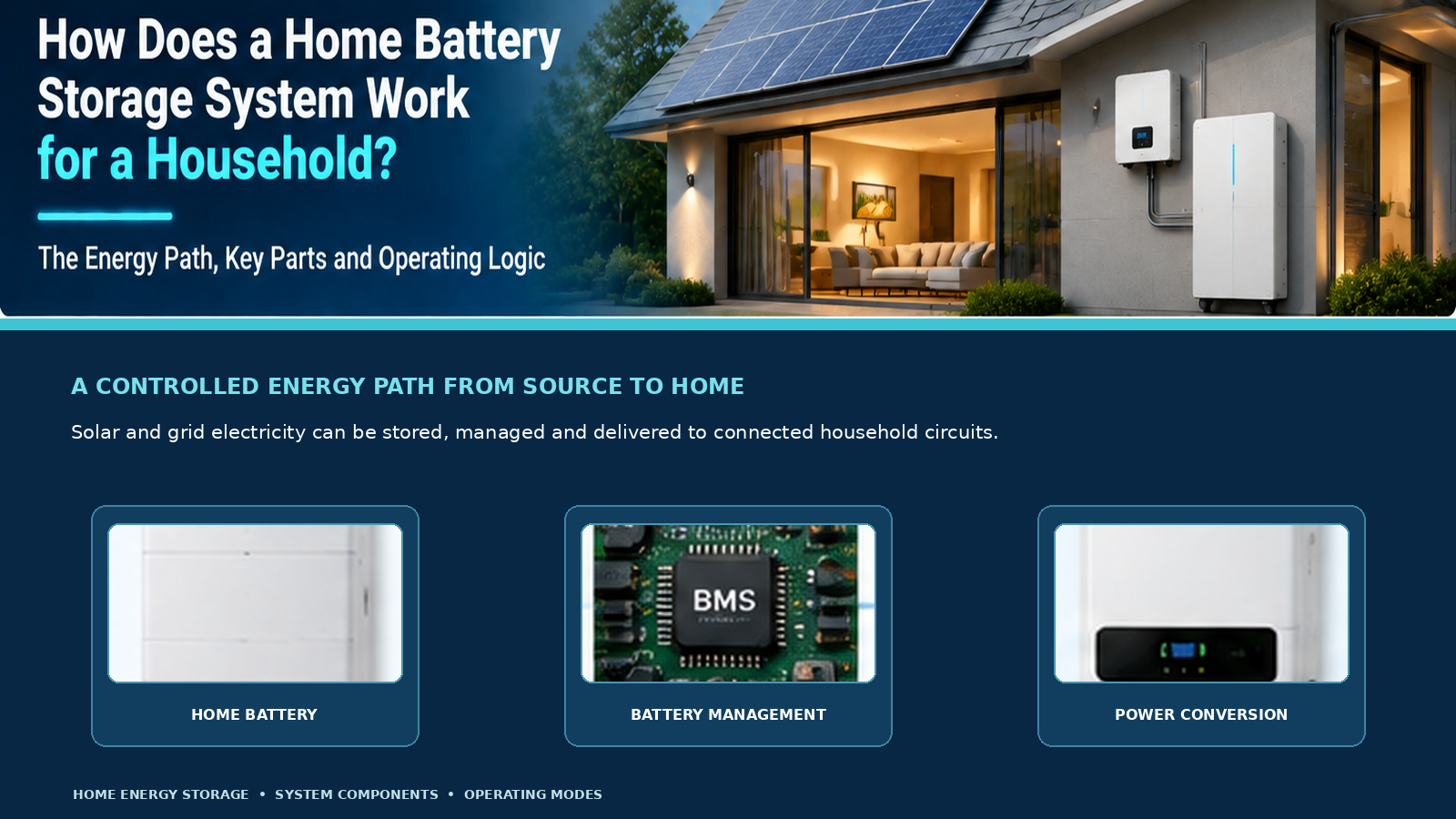
How Does a Home Battery Storage System Work for a Household?
Follow the energy path through a home battery, inverter and controls. Learn how charging, daily discharge and outage backup differ before comparing systems.
Nov. 06, 2026
How Can A Weak Battery Be Distinguished From A Weak Golf Cart Battery Bank?
Compare like-conditioned unit and bank readings to separate one weak battery from broad bank loss, charging shortfall or connection trouble.
Nov. 06, 2026
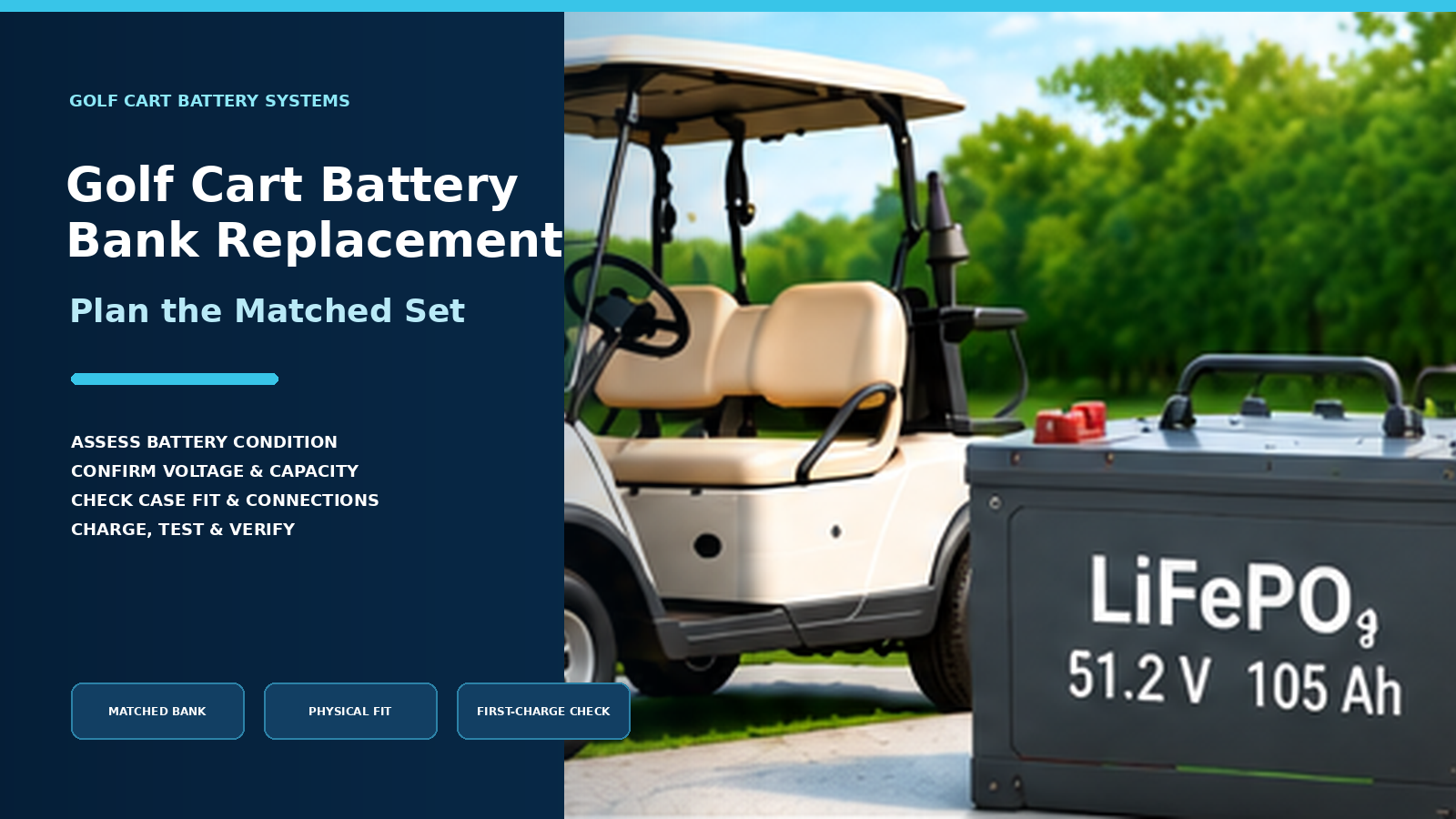
How Should A Replacement Golf Cart Battery Bank Be Planned?
Decide whether one unit or the bank needs replacement, then specify voltage, fit, connections and first-charge checks before ordering.
Nov. 06, 2026
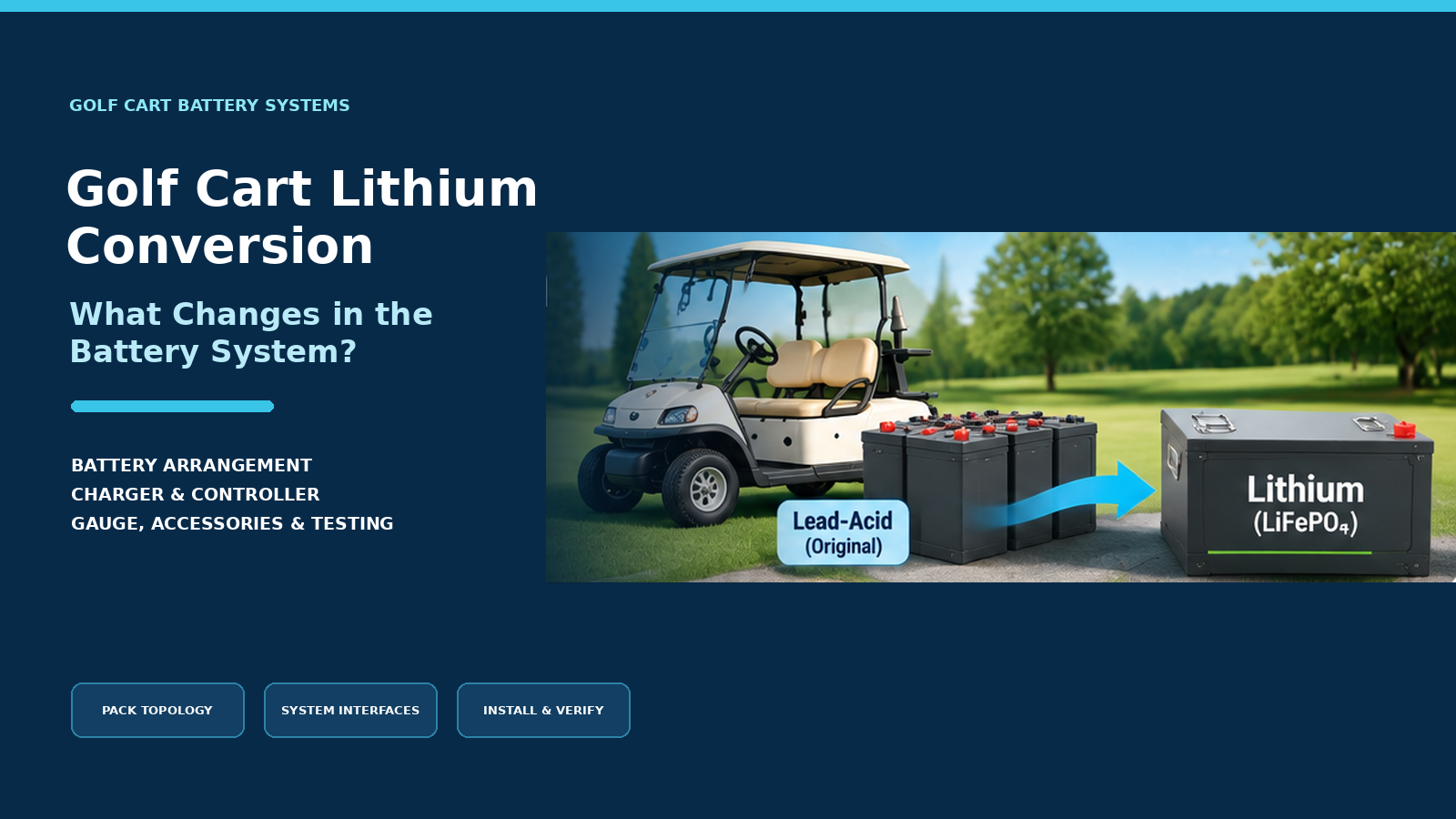
What Changes When A Golf Cart Battery Bank Is Converted To Lithium?
Map the battery bank, tray, charger, controller, gauge and accessory interfaces that change when converting a lead-acid golf cart to lithium.
Nov. 06, 2026
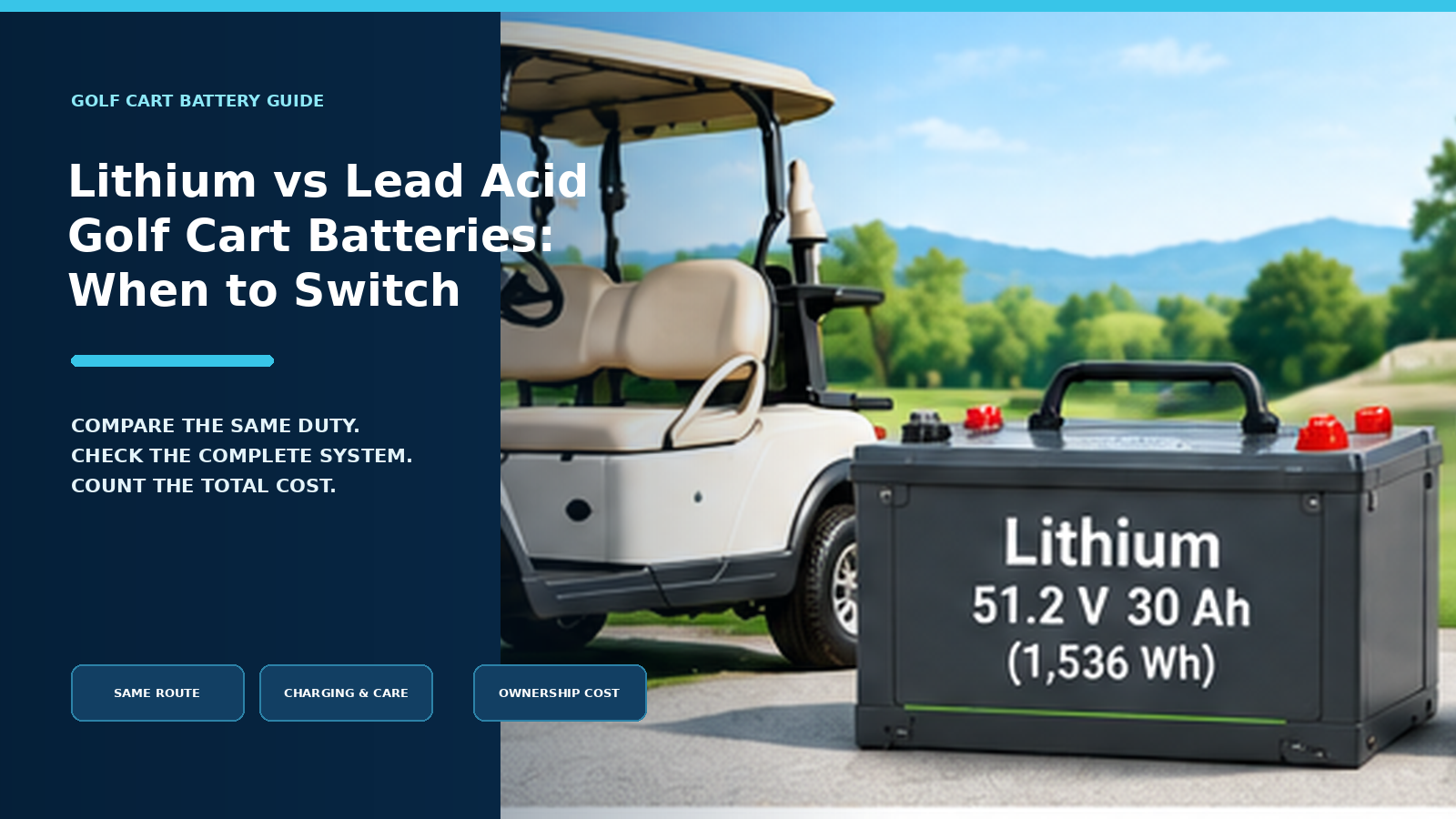
When Does Lithium Make Sense Instead Of Lead Acid For A Golf Cart?
Compare lithium and lead acid for the same golf-cart duty, charging routine, maintenance capacity and ownership horizon before deciding whether a switch is worthwhile.
Nov. 06, 2026
How Can Peak Current Demand Be Matched To A Golf Cart Battery?
Compare a golf cart’s acceleration and hill-load current by duration with battery continuous, pulse and protection ratings under matching conditions.
Nov. 06, 2026
How should a golf cart battery be sized for route energy and reserve?
Use measured route energy, usable battery capacity and a defined return reserve to plan golf cart battery size without treating Ah as guaranteed range.