For fleet buyers, 8 volt golf cart batteries are first a bank-management decision, not a search for a single drop-in pack. Confirm how many 8 V units form the existing series string, the tray and cable layout, charger profile, vehicle controller, route duty, and service strategy. If the project is considering lithium, treat that as a system migration: an 8 V lead-acid bank and a higher-voltage lithium pack are not automatically interchangeable.
This distinction matters because the same nominal cart voltage can be achieved with different battery architectures. A buyer who records only “48 V cart” may miss unit count, polarity layout, cable length, hold-down design, charger behavior, or the current demanded on hills. The defensible purchase is the one that preserves the vehicle’s electrical and mechanical interfaces while giving the fleet an auditable replacement and maintenance plan.
Start with the installed 8 V bank
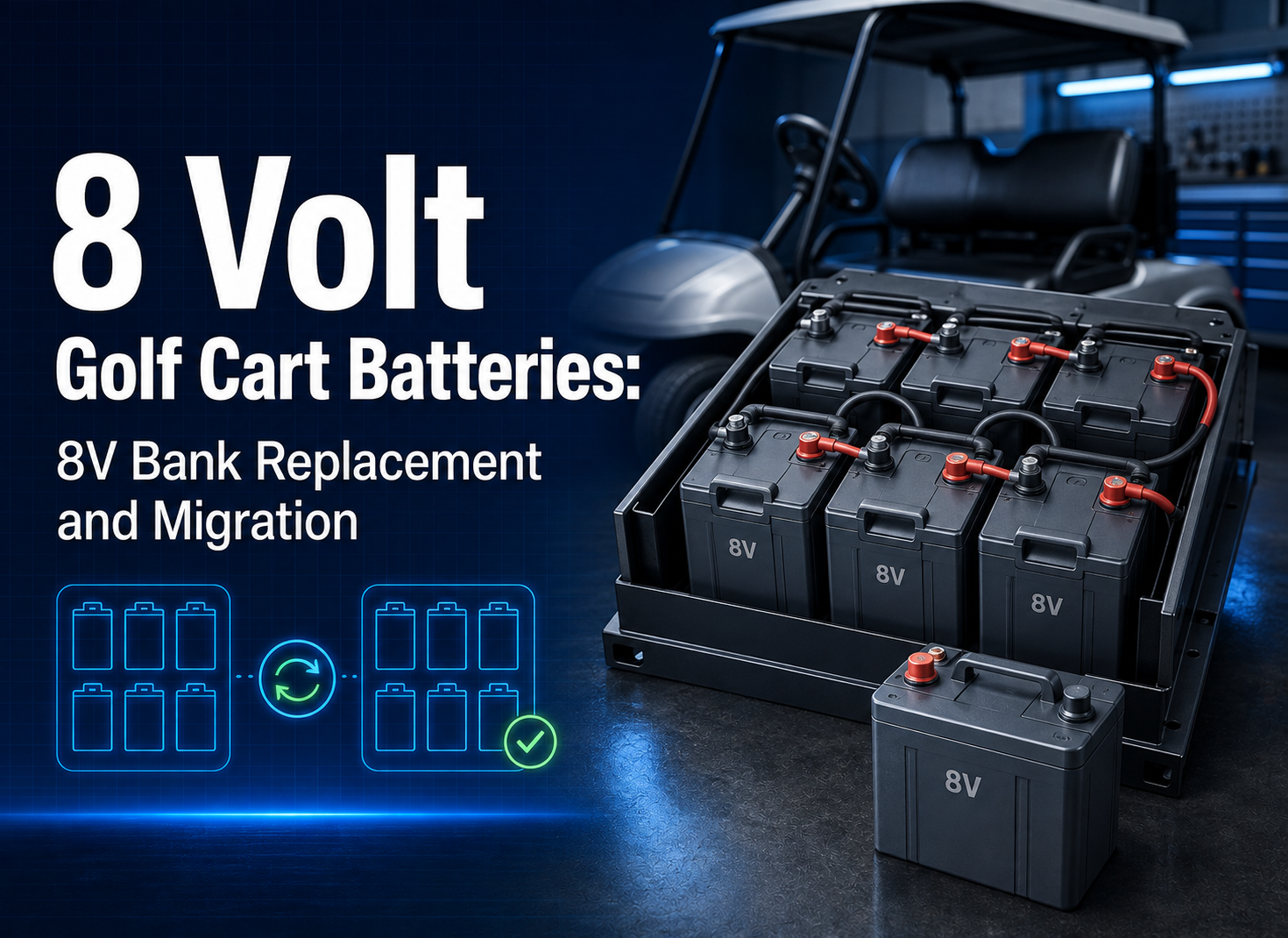
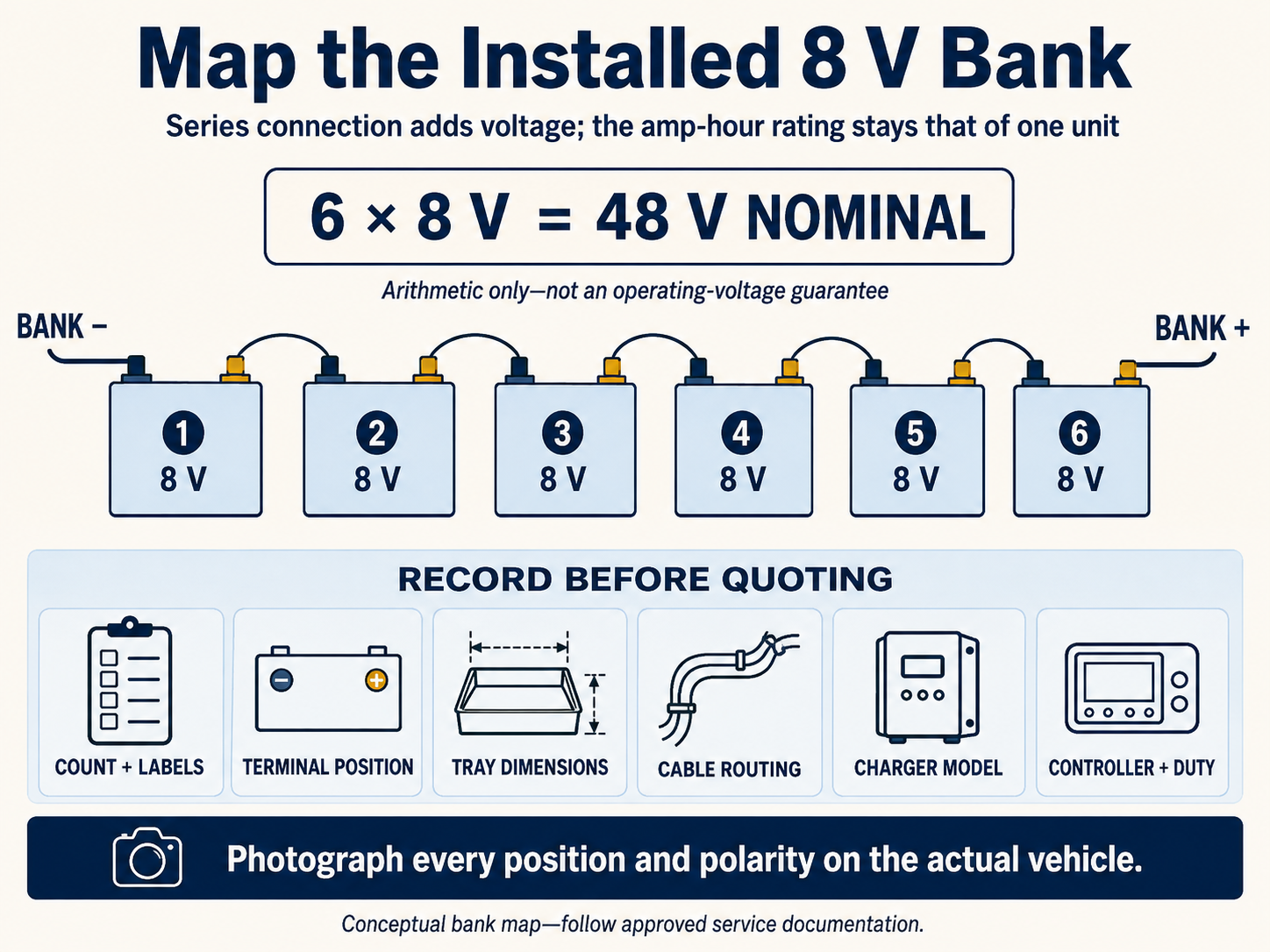
Many commercial carts use several 8 V batteries connected in series. Series connection adds voltage while the amp-hour rating of the string remains that of one unit. Six 8 V units, for example, create a nominal 48 V bank; that arithmetic does not establish the operating voltage window, usable energy, or charger setting.
Record the installed bank before requesting quotations. Photograph the tray, terminals, cable routing, restraint, charger connector, and labels. Capture each battery’s position and polarity so a replacement plan can be checked against the actual vehicle rather than a generic diagram.
|
Installed-bank record
|
Why it affects the decision
|
Evidence to keep
|
|
Battery count and nominal voltage
|
Defines the series architecture
|
Label photos and bank diagram
|
|
Case size and terminal position
|
Controls fit, cable reach, and restraint
|
Tray drawing and dimensions
|
|
Charger model and profile
|
Determines whether the existing charger can remain
|
Charger label and controlled manual
|
|
Controller and motor details
|
Frames continuous and transient demand
|
Vehicle documentation and duty log
|
|
Route and payload
|
Changes energy use and voltage sag
|
Representative operating record
|
Decide whether the project is replacement or migration
An 8 V replacement program retains the existing bank concept. The buyer compares like-for-like units, plans complete-bank replacement where required, and controls cable and connection quality. A migration program changes the architecture, often to a single higher-voltage lithium pack or another integrated arrangement. That change may affect the charger, state-of-charge indication, cabling, protection, mounting, BMS communication, and service procedure.
Do not mix these two sourcing questions in one quotation. Ask every supplier to identify which architecture is offered and to list all required changes. A low battery-only price is not comparable with a package that includes charger, mounting, wiring, display, commissioning, and documentation.
- Replacement path: prioritize dimensional fit, terminal layout, consistent bank age, cable condition, charger settings, and service stock.
- Migration path: require a vehicle-level interface review covering pack voltage window, current demand, charger, controller, connector, mechanical fit, protection, BMS behavior, and operator training.
- Uncertain path: run a vehicle audit before choosing chemistry or requesting a firm price.

Size from route energy and peak duty
Amp-hours alone do not describe fleet performance. Start with the route: distance per shift, elevation, payload, stops, surface, speed, accessory loads, ambient conditions, opportunity charging, and the reserve required when the cart returns late or is reassigned.
For an energy estimate, multiply voltage by amp-hours to obtain nominal watt-hours, then divide by 1,000 for nominal kilowatt-hours. This is a comparison input, not a promise of usable energy. Usable energy depends on the approved operating window, current, temperature, aging, control limits, and the complete bank or pack.
Peak duty deserves a separate check. Hill starts, acceleration, heavy payloads, or towing can demand far more current than steady travel. Ask for a current trace from a representative route or collect controller data where available. The battery, BMS, cables, terminals, contactors, and protection must all tolerate the same defined event. Do not accept a peak-current figure unless the supplier identifies the exact model, duration, temperature, state of charge, voltage limit, and test method.
Treat cart compatibility as a five-interface test
“Fits a golf cart” is not a useful acceptance criterion. Compatibility exists only when five interfaces close together.
- Electrical: nominal voltage, operating window, continuous demand, transient demand, polarity, cable size, connector, and protection.
- Mechanical: tray envelope, loaded mass, restraint, terminal clearance, service access, and cable bend radius.
- Charging: charger output range, charge stages, termination behavior, connector, and restart logic.
- Control: BMS protection behavior, state-of-charge display, communications if used, and response to low or high temperature.
- Operational: route, payload, reserve, charging window, driver behavior, and maintenance capability.
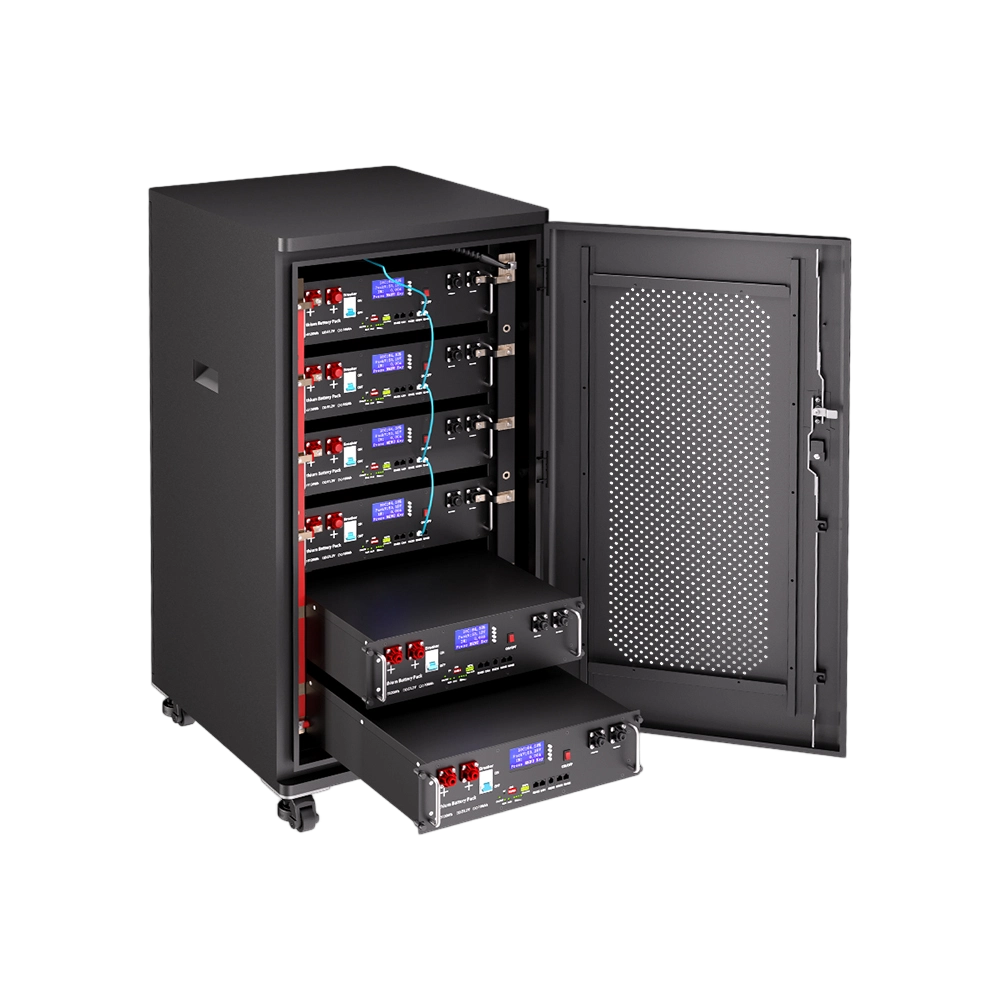
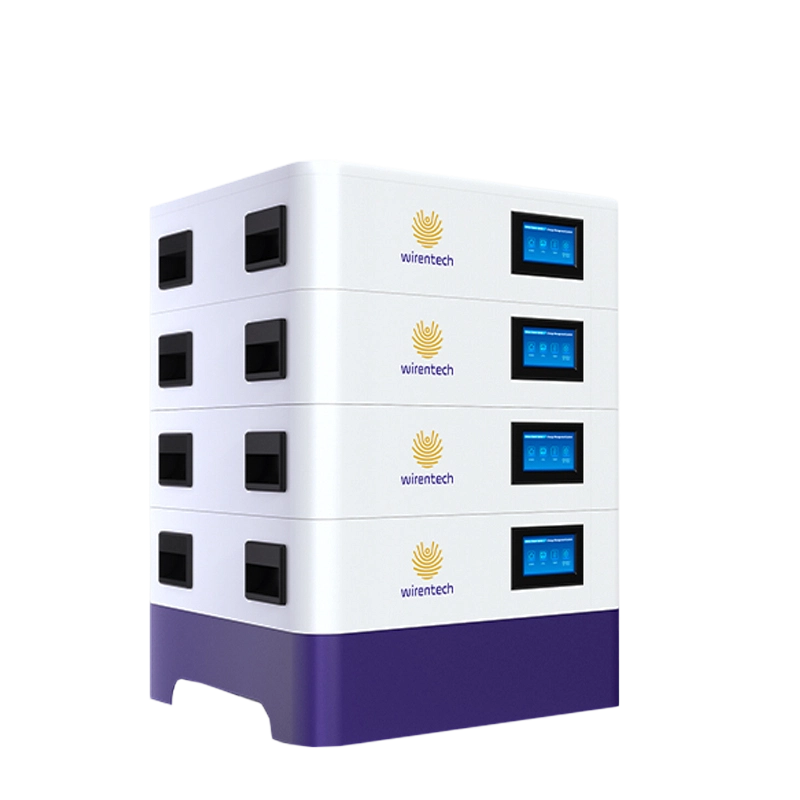
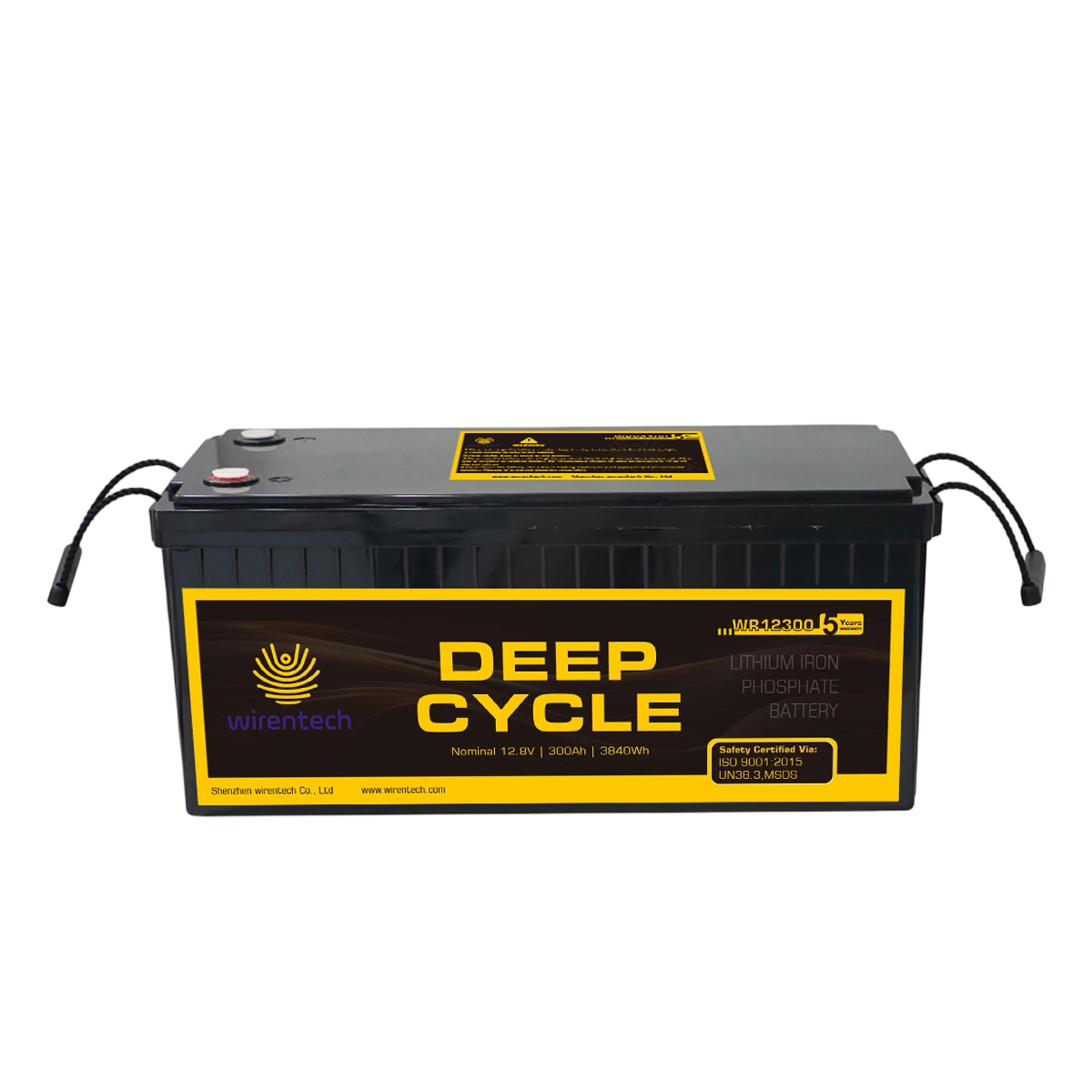
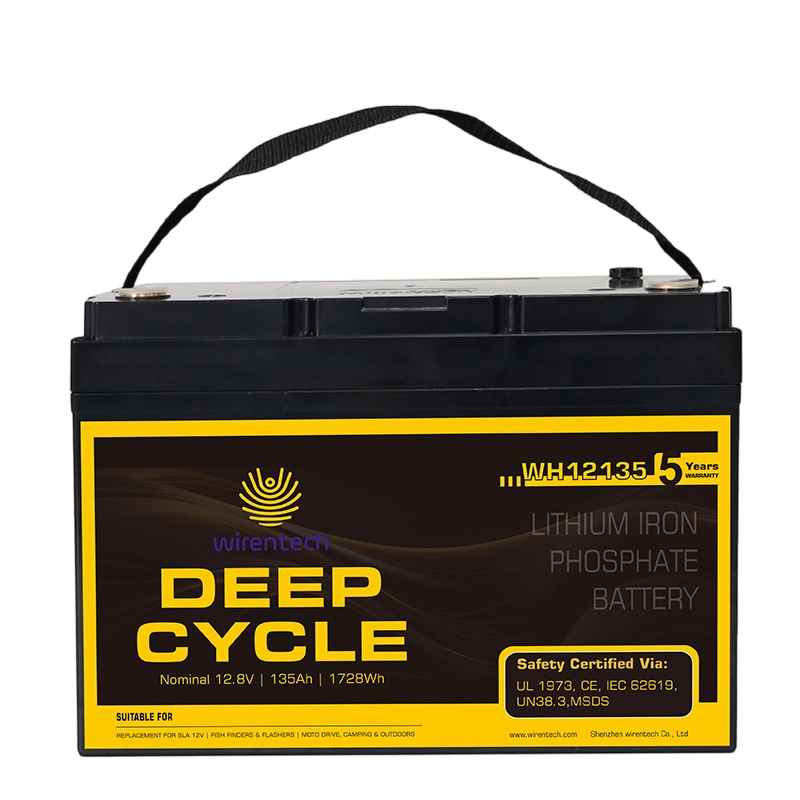
The product family can help a buyer review available form factors, but it does not prove fit for a specific cart. Wirentech’s Golf Cart Batteries category provides the relevant portfolio overview. Use it to shortlist configurations, then request model-specific drawings and interface records for the actual vehicle.
Build a fleet pilot that answers operational questions
A useful pilot is not a showroom demonstration. Select carts and routes that represent difficult duty, not only the lightest shift. Establish a baseline for the current bank, define pass criteria, and record exceptions.
|
Pilot question
|
Practical observation
|
Release decision
|
|
Can the cart complete the target route?
|
Distance, payload, stops, remaining reserve
|
Pass only against the agreed route profile
|
|
Does transient duty remain acceptable?
|
Start, hill, and acceleration behavior
|
Review current trace and protective events
|
|
Can charging fit the operating schedule?
|
Charge time and return-to-service window
|
Confirm against the actual charger/package
|
|
Is installation serviceable?
|
Restraint, cable access, isolation, removal
|
Approve repeatable work instruction
|
|
Can operators recognize faults?
|
Display, alarms, shutdown, recovery
|
Approve training and escalation path
|
Run the pilot long enough to expose route variation and charging behavior. Save configuration, serial number, charger, vehicle, date, ambient condition, and logs. If a change is made during the pilot, record it and repeat the affected test rather than combining unlike results.
Compare wholesale offers by delivered scope
For a fleet order, compare total delivered scope instead of unit price alone. Normalize the battery architecture, quantity, charger inclusion, cables, trays or brackets, displays, protection, freight basis, packaging, documents, commissioning, spare policy, warranty terms, and quotation validity.
Ask the supplier to mark each requirement as compliant, conditional, excluded, or requiring engineering confirmation. A blank cell is not acceptance. Where the project uses an 8 V bank, require the offer to state whether units should be replaced as a complete matched set and how incoming, installation, and return processes are controlled.
Do not publish or rely on a universal MOQ, lead time, cycle life, warranty, or price. Those values must come from a current quotation or approved model-specific document for the destination market and order scope.
Control installation quality across the whole bank
Bank reliability depends on connections as much as batteries. Inspect cable condition, lug fit, polarity, routing, restraint, cleanliness, corrosion, and protective covers. Use the approved torque method and record the result; an unspecified “tight” connection is not auditable.
Do not combine old and new units unless the applicable manufacturer procedure permits it. Differences in age, state of charge, internal condition, or capacity can cause imbalance and uneven loading. Before commissioning, align the bank or pack according to the approved procedure, verify charger settings, and confirm that all covers and restraints are installed.
After installation, perform a controlled functional check with representative acceleration, braking behavior if relevant to the system, hill duty, charging, display indication, and shutdown/restart. The release record should identify the vehicle, installed battery serials, technician, date, and any deviation.

Use evidence that matches the exact product
Certification and transport files must identify the relevant model and scope. UN 38.3 is a transport-test requirement; it is not evidence that a battery fits a cart. An interface name such as CAN or RS485 does not prove compatibility with a vehicle controller. A cycle-life number without test conditions cannot be converted into fleet years.
For any shortlisted model, request:
- current datasheet and dimensional drawing;
- charger specification and approved charge profile;
- continuous and transient current definitions with conditions;
- vehicle or controller compatibility record, if claimed;
- transport documents required for the route and market;
- applicable certification files with exact model scope;
- installation, commissioning, service, and warranty documents.

Frequently asked questions about 8 V fleet batteries
Should a fleet replace one failed 8 V battery or the whole bank?
Follow the battery and vehicle manufacturer’s controlled procedure. In a series bank, age and condition differences can affect balance and performance, so a single-unit replacement should not be assumed acceptable without approval.
Can a 48 V lithium pack directly replace six 8 V batteries?
Not by voltage label alone. Confirm the full operating window, charger, controller demand, cables, protection, mechanical fit, BMS behavior, display, and installation procedure.
How should range be estimated before a pilot?
Use route energy, payload, elevation, accessories, ambient conditions, reserve, and charging opportunities. Treat the calculation as a planning estimate and validate it on representative vehicles and routes.
Does CAN or RS485 guarantee vehicle compatibility?
No. An interface only identifies a communication medium. Compatibility requires the correct protocol, messages, pinout, wiring, configuration, and validated behavior for the exact equipment.
Which certification documents should a distributor request?
Request the files required for the destination and application, then confirm that the exact model is within scope. Keep transport evidence separate from product or installed-system compliance.
What makes a wholesale quotation comparable?
Use one requirement sheet for architecture, quantity, accessories, charger, documents, freight, commissioning, spare policy, warranty terms, exclusions, currency, and validity. Compare only responses to the same scope.
What data should be sent for a fleet quotation?
Send cart brand and model, battery count and labels, tray dimensions, controller and charger details, route and payload, target reserve, environment, quantity, destination, required documents, and pilot acceptance criteria.
Make the bank architecture explicit before buying
The strongest 8 V battery program begins with a verified bank diagram and ends with repeatable fleet service. Retain the 8 V architecture only when replacement fit, charging, route duty, and bank maintenance are controlled. Choose a migration only when every vehicle-level interface and the delivered package are defined.
For an actionable quotation, provide Wirentech with one representative cart record: photos and dimensions of the installed bank, charger and controller identifiers, route current or duty data, fleet quantity, destination market, and the acceptance tests the pilot must pass.